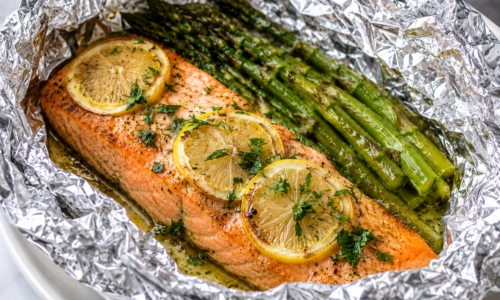
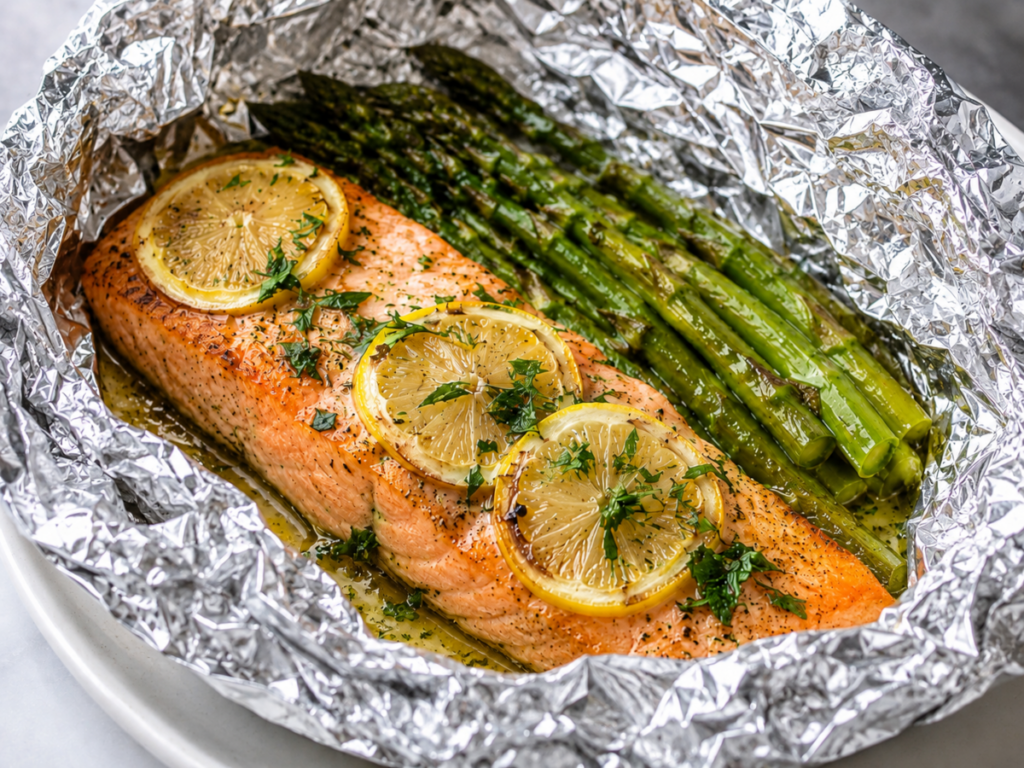
Some meals earn a place in regular rotation because they are impressive. Others stay because they make ordinary evenings easier. Wild salmon and asparagus cooked together in a sealed packet belongs firmly in the second group, although the finished dish still looks and tastes like something that took more effort than it did.
The method is simple: place a salmon fillet over a bed of asparagus, add lemon and ghee, seal everything in parchment or foil, then bake or grill until the fish is cooked through and the vegetables are tender. The packet traps steam and aromatic moisture around the food, so the salmon stays moist while the asparagus cooks in the same enclosed space. There is almost no cleanup, very little active cooking time, and no need to build the meal around grains, bread, beans, or a complicated sauce.
For someone following a low-lectin eating pattern, that simplicity has another advantage. Salmon is an animal food rather than a source of plant lectins, while asparagus is commonly included in low-lectin meal plans. More broadly, research on dietary lectins does not support treating every lectin-containing food as equally problematic, and the biological effects of lectins vary widely by source, dose, preparation, and individual context. Reviews of the subject also point out that food processing and heat can alter many antinutritional compounds, especially the better-known lectins found in certain legumes.
Why Salmon and Asparagus Work So Well Together
Salmon and asparagus cook at compatible speeds, which is one reason the packet method works so reliably. A moderately thick salmon fillet usually needs only a short period of cooking, and asparagus becomes tender in roughly the same window when it is enclosed with moisture. Instead of preparing a protein in one pan and a vegetable in another, the two ingredients share the same cooking environment.
The flavors also support each other without requiring much seasoning. Salmon has enough natural richness to carry lemon and herbs, while asparagus brings a mild grassy flavor and a firmer texture. Ghee melts through both ingredients and helps distribute the lemon and seasonings across the packet rather than leaving them concentrated in one spot.
From a nutrition standpoint, salmon is one of the fatty fish that supplies the long-chain omega-3 fatty acids EPA and DHA. The National Institutes of Health notes that cold-water fatty fish, including salmon, contain relatively high amounts of these omega-3s, although the exact amount varies with species and diet. Asparagus contributes fiber and is also a source of several vitamins and minerals, including folate.
None of that means this particular dinner has special therapeutic powers. It means the ingredients fit comfortably into a nutrient-dense meal pattern while also being easy to prepare. That distinction matters because a sustainable way of eating is built more often on repeatable meals than on foods carrying oversized health claims.
The Packet Method Does More Than Reduce Cleanup
Sealing food in a packet creates a small moist cooking chamber. Water naturally released from the asparagus, moisture from the lemon, melted ghee, and steam from the fish stay close to the ingredients instead of rapidly escaping into the oven or grill. The result is a gentle style of cooking that is especially useful for salmon, which can become dry when exposed to high heat for too long.
Parchment works well in the oven because it keeps the food enclosed without placing it directly against metal. Foil is more practical on a grill because it is stronger and better suited to the hotter, less predictable environment around grill grates. If you prefer to keep the food off the foil, place a sheet of parchment around the food first and wrap the outside with heavy-duty foil before grilling.
The packet should be sealed well but not crushed tightly against the fish. Leaving a small amount of space inside gives steam somewhere to circulate. That trapped steam helps the asparagus soften and lets the lemon and ghee season the salmon from several directions rather than only from the top.
Wild Salmon & Asparagus Foil Packets Recipe
This recipe makes a complete protein-and-vegetable meal on its own, but it also leaves room for an additional side if you need more food. Cauliflower mash, roasted cauliflower, sautéed greens, or a simple avocado salad can increase the volume of the meal without changing its basic low-lectin structure.
Servings: 4
Prep time: 10 minutes
Cook time: 12 to 18 minutes
Total time: About 25 minutes
Ingredients
- 4 wild salmon fillets, about 5 to 6 ounces each
- 1 pound asparagus, woody ends trimmed
- 2 tablespoons ghee, softened or melted
- 1 lemon, thinly sliced
- 2 tablespoons fresh chopped parsley, dill, or a mixture
- 1 small garlic clove, finely minced, optional
- 1/2 teaspoon fine sea salt, plus more to taste
- 1/4 teaspoon freshly ground black pepper, optional according to your dietary preferences
- Additional lemon wedges for serving, optional
- 4 large sheets parchment paper for baking, or heavy-duty foil for grilling
Directions
Oven Method
- Heat the oven to 400°F. Place four large sheets of parchment or foil on the counter and divide the asparagus among them, arranging the spears in compact beds that will fit beneath the salmon.
- Place one salmon fillet on each portion of asparagus. Brush or spoon the ghee over the salmon and vegetables, then season with salt, optional black pepper, herbs, and garlic if using.
- Lay two or three thin lemon slices over each salmon fillet. Fold the packet over the food and crimp or roll the edges securely, leaving a little open space inside for steam.
- Arrange the packets on a rimmed baking sheet and bake for about 12 to 18 minutes. Cooking time will depend on the thickness of the salmon, the starting temperature of the fish, and how tightly the packet is sealed.
- Open one packet carefully, keeping your hands and face away from the escaping steam. The FDA recommends cooking finfish to an internal temperature of 145°F, or until the flesh is opaque and separates easily with a fork.
Grill Method
- Preheat a grill to medium heat and use heavy-duty foil packets rather than parchment alone.
- Place the sealed packets on the grates, close the lid, and cook for roughly 10 to 15 minutes, checking a packet near the end of the cooking window. Thickness matters more than the clock, so use the same 145°F food-safety target for the salmon rather than assuming every fillet will finish at the same moment.
Grilling adds a slightly deeper aroma around the edges of the vegetables, even though the food remains protected inside the packet. If you want more browning on the asparagus, open the foil during the last few minutes and place the asparagus directly on the grates after the salmon is done, but that extra step is optional.
Choosing Salmon Without Making Dinner Complicated
Wild salmon fillets can vary quite a bit in thickness, fat content, color, and flavor. For this particular recipe, the most useful thing to pay attention to is thickness because it has a direct effect on how quickly the fish cooks. A thin tail portion may finish several minutes before a thick center-cut piece.
If the fillets you purchase are dramatically different in size, make separate packets and begin checking the smaller pieces first. That small adjustment is more reliable than extending the cooking time for the entire batch and risking dry salmon simply because one thicker fillet needed a few extra minutes.
Frozen wild salmon is also perfectly practical. The FDA recommends thawing frozen seafood gradually in the refrigerator overnight, although sealed seafood can also be thawed more quickly in cold water when necessary. Pat the fish dry before assembling the packets so excess surface moisture does not unnecessarily dilute the ghee, lemon, and seasoning.
There is no reason to treat frozen fish as a second-rate ingredient simply because it came from the freezer. A meal plan that works on busy weekdays is more useful than one that depends on finding fresh fish at exactly the right moment, and keeping individually frozen portions available can make this recipe one of the easier dinners to assemble with little advance planning.
Where This Fits in a Low-Lectin Approach
A low-lectin pattern can become unnecessarily complicated if every meal turns into a search for absolute certainty about microscopic amounts of individual compounds. Lectins are a broad group of carbohydrate-binding proteins rather than one single substance, and researchers continue to study their differing biological effects. Reviews of antinutritional factors emphasize that their impact depends on the food, processing method, amount consumed, and the broader diet, which is one reason sweeping statements about all lectins are difficult to defend scientifically.
This recipe takes a more practical route. It avoids several foods that many low-lectin eaters choose to limit while using a straightforward protein, a non-starchy vegetable, fat, citrus, and herbs. It does not require specialty flour, packaged substitutes, or a long list of ingredients that will sit unused in the pantry.
That simplicity also makes the meal useful for tracking personal tolerance. If you are keeping notes on digestion, energy, fullness, or other reactions, meals with fewer ingredients can make patterns easier to interpret than meals containing several sauces, processed foods, and mixed ingredients. Tracking still cannot prove that one ingredient caused a particular symptom, but it can help reveal repeated associations that may be worth paying attention to or discussing with a qualified health professional.
Individual tolerance also deserves room in the recipe. Someone who feels good eating asparagus has little practical reason to remove it solely because it is a plant food, while a person who repeatedly notices digestive discomfort after eating it may choose another vegetable. The purpose of a personalized eating pattern is not to collect the longest possible list of forbidden foods, but to build meals from ingredients that work well for the individual.
Small Adjustments That Keep the Recipe Flexible
The basic packet is forgiving enough to change without losing the method. Dill gives the salmon a classic fresh flavor, parsley is milder, and rosemary works well in small amounts if you prefer something more aromatic. Garlic can be included or left out depending on digestive tolerance, and the same is true of black pepper.
Ghee works especially well because it melts into the packet and coats the fish and vegetables evenly. Olive oil can replace it if that better fits your preferences or if you are avoiding dairy ingredients. The flavor will be slightly different, but the cooking method remains essentially the same.
The asparagus can also be swapped for another vegetable that cooks quickly. Thin zucchini strips, baby bok choy, sliced fennel, or tender greens can work, but each changes the amount of moisture inside the packet and may require a slightly different cooking time. Dense vegetables such as cauliflower or winter squash should be partially cooked first or cut very small so the salmon does not overcook while waiting for the vegetables to soften.
Lemon can be adjusted just as easily. Thin slices provide aroma and moisture without making the salmon sharply acidic, while a squeeze of fresh lemon after cooking produces a brighter flavor. If citrus bothers your digestion, omit it and rely on herbs, ghee, and a little salt instead.
A Meal Worth Repeating
The strongest argument for this dish is not that it follows a dietary label perfectly. It is that four basic ingredients can become a full dinner with very little friction, and the same method can be repeated with different herbs, vegetables, and fish depending on what is available.
That matters on the nights when eating according to your preferences has to compete with work, errands, fatigue, and the temptation to order something easier. A salmon packet requires only a few minutes of assembly, cooks without constant attention, and leaves behind almost no mess. For a low-lectin routine to remain workable over time, meals like this often have more practical value than elaborate recipes reserved for the days when everything goes according to plan.