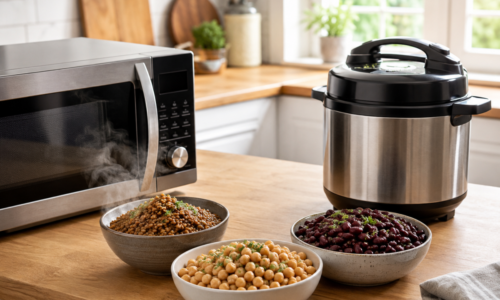
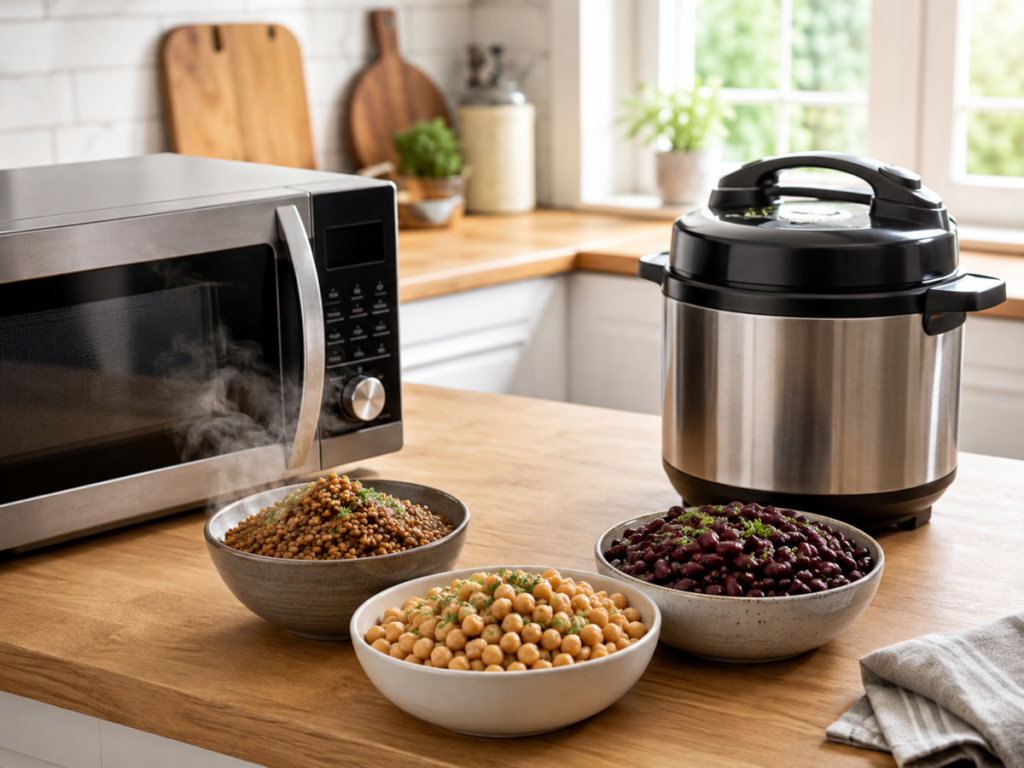
Microwave cooking sits in an awkward place in discussions about lectins. It is fast, convenient, and capable of heating food to temperatures that alter proteins, yet it does not always produce the same result as boiling or pressure cooking. For someone trying to reduce active dietary lectins, that distinction matters most with dried legumes, especially kidney beans.
The research does not support a simple rule that microwaving either “destroys lectins” or “does nothing to lectins.” Results vary with the food, the specific lectin, how much water is present, whether the food was soaked first, the microwave power, the heating time, and how evenly the food reaches a high enough temperature. A 2026 European Food Safety Authority review found that microwave treatment can reduce lectin activity substantially in some seeds, while certain kidney bean varieties can retain meaningful phytohaemagglutinin activity after microwaving.
That makes the microwave useful in a low-lectin kitchen, but it should be used for the jobs it performs well. Reheating foods that were already properly cooked is very different from relying on a microwave to make raw dried beans safe.
Microwaves Heat Food, Not Lectins Directly
A microwave oven does not have a special lectin-destroying effect. Microwave energy is absorbed by components in food, especially water, and that energy becomes heat. The FDA explains that microwave energy causes water molecules in food to move rapidly, producing the heat that cooks the food.
Lectins are proteins, and heat can change their three-dimensional structure. When enough heat is applied for enough time, a lectin may lose the shape needed to bind carbohydrates and produce its biological activity. In bean research, this loss of activity is commonly measured with haemagglutination tests, which examine whether the lectin can still cause red blood cells to clump.
The appliance is therefore only part of the equation. A microwave can generate temperatures capable of denaturing proteins, but the food still has to reach those temperatures throughout the portion and stay hot long enough. USDA guidance notes that microwave ovens can heat unevenly and leave cooler areas inside food, which is one reason stirring, rotating, adding moisture, and allowing standing time can improve heat distribution.
The Legume Studies Show Strong Effects, With Some Big Exceptions
One of the most frequently cited experiments on this subject compared microwave heating with conventional cooking in several legumes. Researchers tested faba beans, peas, chickpeas, soybeans, lentils, and common beans under different moisture conditions. Microwave treatment reduced or eliminated haemagglutinin activity in several of the legumes, but common beans were an exception and retained antinutritional activity after the microwave treatment used in the study.
Other studies have produced encouraging results when legumes were soaked and then microwaved in water. In the evidence reviewed by EFSA, soaked chickpeas and mung beans reached no detectable haemagglutinating activity after microwave cooking under the tested conditions. Soaked and microwaved velvet beans also showed a very large reduction.
Faba beans illustrate why broad statements are risky. In one study summarized by EFSA, six minutes of microwaving reduced lectin activity by 75 percent in green faba beans and 87.5 percent in white faba beans. Cooking at 100°C for 30 minutes reduced activity further, while autoclaving at 121°C for 20 minutes reduced the measured activity to zero in both samples.
Those numbers are useful, but they should not be read as universal cooking instructions. Different studies use different bean varieties, microwave powers, moisture levels, sample sizes, and laboratory methods. EFSA specifically noted that results from different methods of measuring lectin concentration or activity can be difficult to compare directly.
Kidney Beans Deserve More Caution
Red kidney beans contain phytohaemagglutinin, usually shortened to PHA, a lectin with a well-documented history of causing acute gastrointestinal illness when beans are eaten raw or insufficiently cooked. The FDA lists nausea, severe vomiting, and diarrhea among the symptoms associated with high exposure from raw or undercooked beans, while properly cooked and canned kidney beans contain much lower active PHA levels.
This is where microwave cooking becomes a poor place to experiment. EFSA’s 2026 assessment found that properly processed beans do not present a lectin-related health concern, but it also concluded that insufficient cooking that leaves a large share of active PHA can create a health concern. The same review noted public-health guidance recommending soaking dried beans and boiling them thoroughly, and it cited guidance that microwave heat treatment should not be treated as sufficient on its own for destroying lectins in dried beans.
Older controlled heating work supports the value of sustained wet heat. Presoaked red kidney beans heated at 100°C for 15 minutes had haemagglutinin activity reduced below detectable levels in one study, while much lower temperatures were far less effective even when maintained for a long time.
For a low-lectin approach, the practical choice is simple. Raw dried kidney beans are better handled with a proven soaking and thorough boiling method, or with an appropriate pressure-cooking method, rather than trying to determine whether a particular microwave cycle was enough.
Moisture Changes What the Microwave Can Accomplish
Water has two roles in the story. It helps the microwave heat the food efficiently, and it helps create the moist cooking environment in which many legume lectins lose activity more reliably. Dry seeds and hydrated seeds can respond very differently to the same appliance.
The 1998 legume study found that soaked soybeans responded better to microwave treatment than dry soybeans. A later review of microwave processing likewise described soaking as a useful pretreatment because it increases hydration and may also allow some compounds to leach into the soaking water before heat is applied.
This helps explain why “microwave for six minutes” is not a meaningful universal instruction. Six minutes applied to a shallow dish of soaked beans in plenty of water is not the same thermal process as six minutes applied to a dense bowl of partially hydrated beans. Microwave wattage, batch size, container shape, starting temperature, and stirring can all change the temperature history of the food.
Pressure Cooking and Boiling Give More Predictable Control
Boiling has a practical advantage because a pot of water provides a relatively uniform high-temperature environment around the food. Pressure cooking can raise the cooking temperature above the normal boiling point of water, which is one reason it is often used for foods where stronger heat treatment is desired.
Laboratory autoclaving is not identical to a home pressure cooker, so research using an autoclave should not be translated directly into home timing. Still, studies comparing microwave heating, boiling, and autoclaving repeatedly show that higher-temperature moist heat can reduce lectin activity very effectively when the food is held under the needed conditions.
For someone who already pressure cooks legumes as part of a low-lectin routine, the microwave is better viewed as a secondary appliance. Pressure cook or otherwise fully cook the food first, cool and store it safely, then use the microwave later for reheating. There is no evidence that ordinary microwave reheating somehow restores PHA that was already permanently denatured by adequate heat treatment. Laboratory work on *Phaseolus vulgaris* lectins has found thermal denaturation to be irreversible under the tested conditions.
Wheat and Other Lectins Need a Separate Conversation
Beans dominate the food-safety discussion because PHA has the clearest human evidence, but low-lectin eating often includes concern about lectins from grains and other plant foods as well. Those compounds should not automatically be treated as if they behave like kidney bean PHA.
Wheat germ agglutinin, or WGA, is a good example. Research shows that its biological activity falls as heating temperature and exposure time rise, and cooking whole-grain pasta can substantially reduce active WGA. A recent review also notes that the effect of food processing varies by method and conditions.
Direct evidence on ordinary household microwave cooking and WGA is much thinner than the evidence for legumes. EFSA’s 2026 assessment could perform a formal risk characterization only for PHA because data for other lectins were not sufficient. That does not mean every other lectin is harmless or harmful. It means the current evidence does not support treating a microwave timing rule for beans as a scientifically proven rule for wheat, peanuts, tomatoes, or every other lectin-containing food.
A Practical Place for the Microwave in Low-Lectin Cooking
The microwave works very well for reheating foods that have already gone through the preparation method chosen for lectin reduction. Pressure-cooked beans, thoroughly cooked lentils, roasted vegetables, cooked greens, soups, stews, and leftovers can all be reheated without turning the microwave into the primary lectin-control step.
It can also be useful for cooking lower-risk foods where lectin inactivation is not the main food-safety issue. In those cases, covering the food, adding a little liquid when appropriate, stirring midway through cooking, and allowing a short standing period can make heating more even. USDA microwave guidance recommends these practices because microwave ovens can create hot and cold regions within the same dish.
For dried kidney beans and similar high-PHA beans, convenience is better found elsewhere. Batch cooking a larger amount with a well-established wet-heat method, portioning it, freezing or refrigerating it safely, and using the microwave only when the meal is ready to eat gives you the speed of microwave cooking without asking it to perform the least predictable part of the process.
That division of labor also makes a low-lectin routine easier to sustain. The cooking method that does the heavy work can happen once, while the microwave handles the fast weekday meal that comes later.