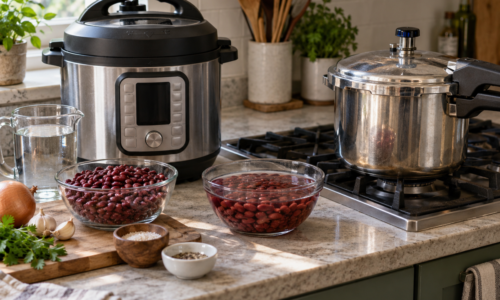
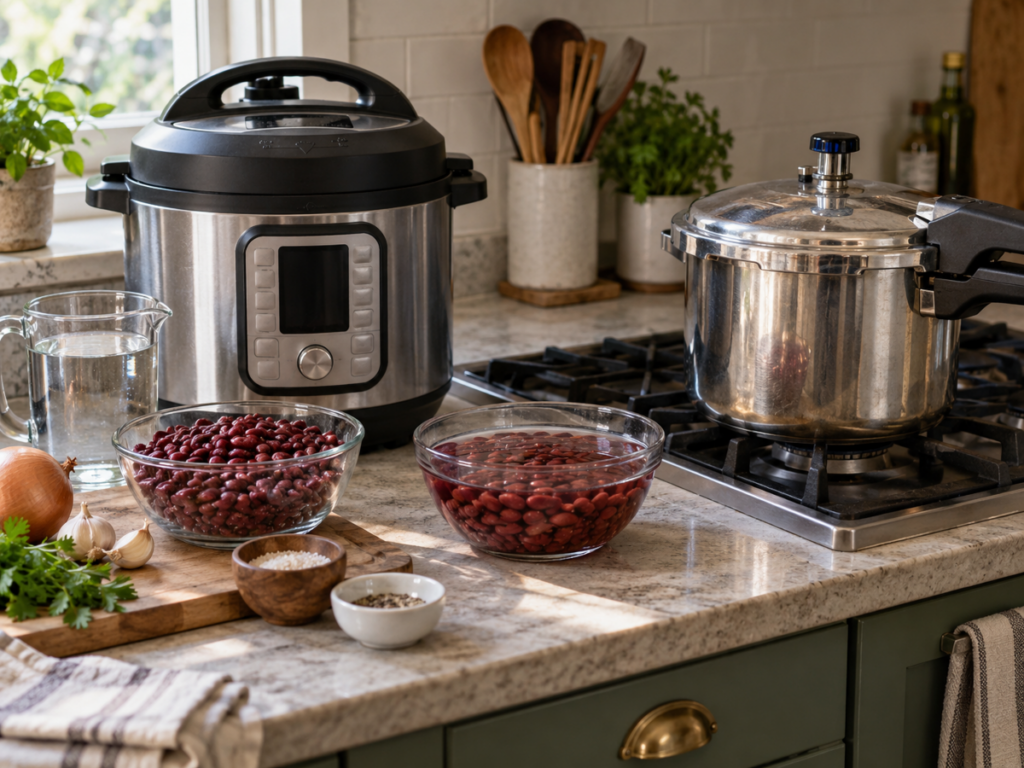
Pressure cooking has earned a special place in low-lectin kitchens because it combines moisture, heat, and pressure in a way that can sharply reduce the activity of heat-sensitive lectins in foods such as beans. The confusing part is that an Instant Pot and a traditional stovetop pressure cooker do not always operate at the same pressure. That difference affects cooking temperature and speed, but it does not automatically mean that one appliance makes food “safe” while the other does not.
The useful comparison is not simply electric versus stovetop. It is pressure, temperature, time, hydration, and the particular food being cooked. Once those pieces are separated, the PSI numbers make much more sense.
What the PSI Numbers Actually Mean
Instant Pot currently lists its standard High Pressure setting at about 10.2 to 11.6 pounds per square inch, or psi, above atmospheric pressure. On select models, a Max Pressure setting can reach 15 psi. Instant Pot also lists a working temperature of roughly 239°F to 244°F for the 10.2 to 11.6 psi range.
A conventional stovetop pressure cooker commonly operates around 15 psi. Presto, for example, states that its weighted pressure cookers reach and maintain 15 pounds of pressure during normal pressure cooking. That higher pressure raises the boiling point of water further, so the cooking environment is closer to about 250°F, or 121°C, near sea level.
That means a typical Instant Pot on High is operating several psi below a traditional 15 psi stovetop cooker. The difference is real, and it helps explain why stovetop pressure-cooker recipes often use somewhat shorter cooking times. The stovetop cooker is generally exposing the food to a higher temperature once full pressure is reached.
Pressure numbers can also be misunderstood because kitchen appliances usually report gauge pressure rather than absolute pressure. A reading of 15 psi in a pressure cooker means roughly 15 psi above the surrounding atmospheric pressure, not a total internal pressure of only 15 psi. For practical cooking, the more useful point is that increasing pressure raises the temperature at which water boils, allowing moist heat to work at temperatures well above the normal 212°F, or 100°C, boiling point.
Lectin Inactivation Is Mainly a Heat Process
Lectins are proteins, and many food lectins lose biological activity when their three-dimensional structure is disrupted by sufficient heat. In cooking research, this is often measured by a reduction in hemagglutinating activity, which reflects a lectin’s ability to bind and agglutinate red blood cells under laboratory conditions. Saying that cooking “destroys” lectins is convenient shorthand, but “inactivates” or “denatures” them is often more precise.
Red kidney bean phytohaemagglutinin, commonly abbreviated PHA, is the best-known food-safety example. The FDA notes that raw kidney beans can contain very high PHA activity and that adequate moist cooking greatly reduces it. The agency also warns that low-temperature cooking can be inadequate, which is why slow cookers are a poor choice for preparing dry kidney beans from raw.
A 2026 assessment from the European Food Safety Authority reached a similar practical point. EFSA found that undercooked beans can pose a health concern, while properly prepared pulses do not present a lectin-related risk. Its consumer guidance emphasizes soaking dry beans, changing the water, and then boiling them thoroughly until soft.
Pressure itself is not the main reason lectins become inactive. The pressure allows water and steam to reach a higher temperature, and that elevated moist heat speeds protein denaturation and softens the food more quickly. This distinction matters because very high hydrostatic pressure used in industrial food processing is a different technology from ordinary kitchen pressure cooking. Research on hydrostatic pressures measured in hundreds of megapascals should not be treated as evidence about a 10 to 15 psi kitchen cooker.
Does 15 PSI Destroy More Lectin Than 11 PSI?
At the same cooking time, a 15 psi stovetop cooker has a temperature advantage over an Instant Pot running around 10.2 to 11.6 psi. Higher temperature generally accelerates heat-driven protein denaturation, so a stovetop cooker can reach a similar cooking endpoint faster. That is a reasonable food-science expectation, but it should not be turned into the claim that 15 psi is required for lectin reduction.
Research on red kidney beans shows that lectin activity can be reduced to very low or undetectable levels under several combinations of time and temperature. A classic Journal of Food Science study reported that pressure cooking at 15 psi for 45 minutes without presoaking reduced hemagglutinin activity below detectable levels. The same study found that presoaked beans heated at 100°C for 15 minutes also reached that endpoint, while much lower temperatures were far less effective.
More recent reviews reinforce the idea that the outcome depends on the whole treatment rather than one magic pressure number. EFSA’s 2026 review found that soaking combined with heat treatment at or above 100°C for sufficient time can reduce lectin activity in beans by roughly 90 to 100 percent, depending on the bean and processing conditions. It also reported complete loss of measurable hemagglutinating activity in some legumes after autoclaving around 121°C, but responses differ across species and lectin types.
For a low-lectin cook, the practical reading is straightforward. A stovetop cooker at 15 psi gives you more thermal intensity per minute, while an electric cooker operating at lower pressure can compensate with time. The higher PSI setting may be faster, but PSI alone does not tell you how much active lectin remains in the finished food.
Why Instant Pot Timing Often Runs Longer
Electric pressure cookers regulate heat automatically. They cycle power to maintain a programmed pressure range, and the cooking countdown begins only after the unit has reached pressure. Instant Pot notes that the preheating and pressurization stage can take 10 to 40 minutes or longer depending on the amount and starting temperature of the food.
A stovetop cooker behaves differently. The burner supplies more direct heat, and the cook adjusts the burner once the regulator indicates that full pressure has been reached. A well-managed 15 psi stovetop cooker can therefore maintain a hotter cooking environment than a standard Instant Pot High setting.
This does not mean the electric cooker is weak. A working temperature around 239°F to 244°F is already well above normal boiling temperature, and moist heat in that range can be very effective at softening beans and reducing heat-sensitive antinutritional factors. The difference is more about cooking rate than a simple pass-or-fail threshold.
The distinction becomes especially useful when adapting recipes. A bean recipe developed for a 15 psi stovetop cooker should not automatically be copied minute-for-minute into an electric pressure cooker that operates closer to 10 or 11 psi. Texture, hydration, bean age, batch size, soaking, and natural-release time all change the final result.
Kidney Beans Deserve Their Own Safety Rule
Low-lectin cooking and food safety overlap most clearly with dry red kidney beans. Raw or insufficiently cooked kidney beans can cause rapid gastrointestinal illness because of PHA, so this is one place where personal tolerance should not replace established preparation guidance. Individual dietary experimentation makes sense for many low-lectin choices, but undercooked kidney beans are a recognized food-safety issue.
Current EFSA guidance advises soaking beans for 6 to 12 hours until softened, discarding the soak water, then boiling in fresh water for at least 30 minutes at 100°C and cooking until soft. FDA guidance has also emphasized soaking and vigorous boiling, and Health Canada advises soaking dry red kidney beans for at least five hours, discarding the water, and boiling them vigorously for at least ten minutes. The exact consumer instructions differ somewhat among authorities, so using the more conservative soaking and thorough-cooking approach is sensible when kidney beans are involved.
There is no equally well-established government rule stating that a particular Instant Pot program for a particular number of minutes guarantees a specific residual PHA level in every batch of dry kidney beans. Bean variety, storage age, hydration, starting temperature, quantity, appliance model, altitude, and whether the beans actually softened can all affect the process. For food-safety decisions, a tested recipe from the appliance manufacturer or another reliable source is preferable to assuming that pressure alone has done the job.
Canned beans are different because they have already received commercial heat processing. Health Canada specifically states that canned red kidney beans do not require additional cooking to destroy lectins. For someone following a low-lectin lifestyle, pressure cooking canned beans again may fit a personal preference, but it is not required for the basic PHA food-safety concern.
The Best Choice for a Low-Lectin Kitchen Depends on How You Cook
A stovetop pressure cooker makes sense for someone who wants the highest common household pressure, faster cooking, and direct control over heat. At 15 psi, it reaches a higher cooking temperature than most Instant Pot models on their standard High setting. It can be especially appealing for cooks who regularly prepare large batches of beans, tougher cuts of meat, or ingredients where shaving time from repeated batches matters.
An Instant Pot offers a different kind of convenience. The pressure is automatically regulated, the unit does not require the same burner management, and natural release can happen without much attention. For regular meal preparation, those features can make pressure cooking easier to use consistently, and consistency often matters more than owning the appliance with the highest possible PSI.
Select Instant Pot models with a Max setting can reach 15 psi, which narrows the technical difference considerably. Even then, recipe timing should follow the specific model rather than the brand name alone, because pressure programs and operating temperatures vary.
For low-lectin meal planning, both styles can be useful tools. The stovetop model offers more temperature at full pressure, while the electric model trades some of that intensity for automation. Neither appliance can turn every food into a universally “lectin-free” food, and the scientific literature does not support treating every plant lectin as equally heat-sensitive or equally relevant to human health.
Pressure, Time, and Preparation Work Together
The most reliable way to think about lectin reduction is as a process rather than a PSI contest. Soaking can hydrate dry beans and shorten the path to thorough cooking, moist heat denatures many lectins, higher pressure raises cooking temperature, and sufficient time allows heat to reach the center of the food. A higher-pressure stovetop cooker can move through that process faster, while a lower-pressure electric cooker can often reach a similar culinary endpoint with more time.
For people who use a low-lectin approach because they are tracking individual food tolerance, the finished texture is also useful practical information. Beans that remain hard or chalky in the center have not received the same degree of hydration and heat as fully softened beans. That does not provide a laboratory measurement of lectin activity, but it is a good reason to keep cooking rather than treating the timer as the only sign that the batch is finished.
Pressure cooking is strongest when it is treated as one preparation method among several, not as a guarantee attached to a particular appliance. A 15 psi stovetop cooker gives more heat per minute, an Instant Pot on High generally uses lower pressure and temperature, and both can be effective when the food, preparation method, and cooking time are matched appropriately. For kidney beans, the safest approach remains thorough soaking and cooking based on established food-safety guidance, with pressure cooking serving as a useful way to deliver that heat efficiently.