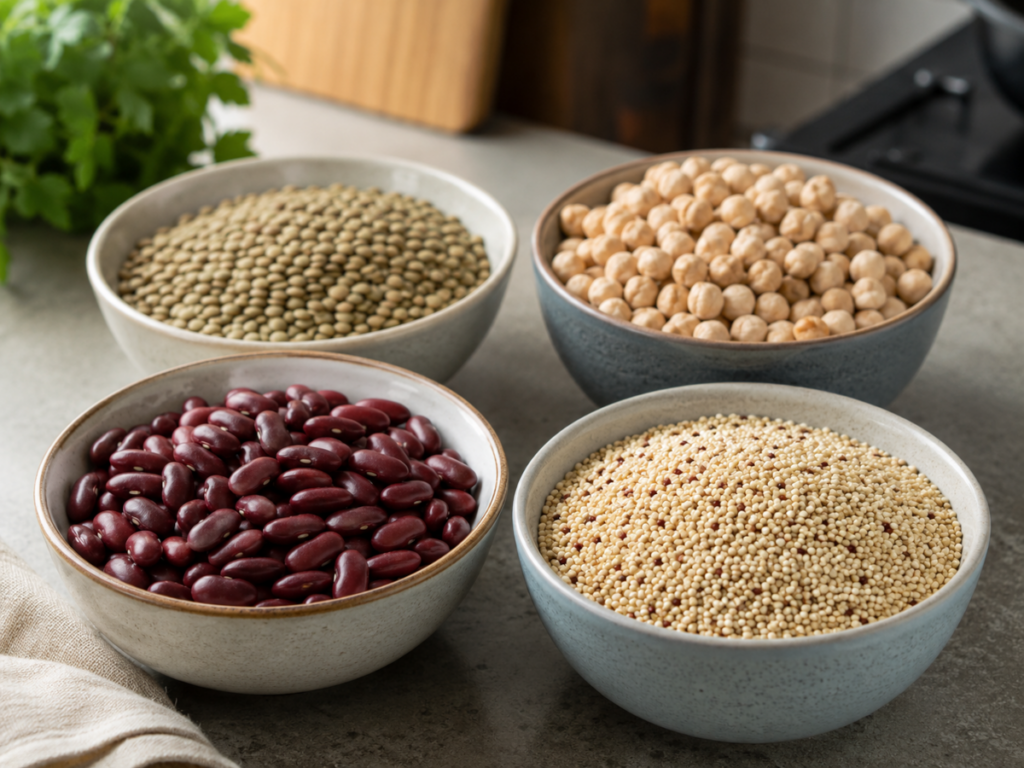
Plant foods rarely contain only one compound that matters to digestion. A bowl of beans, lentils, or quinoa brings protein, starch, fiber, minerals, polyphenols, and a collection of plant defense compounds that evolved to protect the seed. Two of the compounds that often come up in low-lectin discussions are lectins and saponins, yet they behave very differently once food is eaten.
That distinction matters because the digestive effects of a food cannot be predicted by adding up a list of “antinutrients.” Lectins are carbohydrate-binding proteins, while saponins are glycosides with both water-friendly and fat-friendly portions. They can occur in the same foods, especially legumes, but they are changed by cooking in different ways and interact with the digestive tract through different mechanisms. Research also does not support treating every lectin or every saponin as if it has the same biological effect.
Lectins Bind to Carbohydrates on Cell Surfaces
Lectins are proteins that recognize and bind to particular carbohydrate structures. Plants use them for several biological purposes, including defense, seed biology, and interactions with microbes. In food discussions, the best-known example is phytohaemagglutinin, or PHA, a lectin found at especially high levels in raw red kidney beans.
The acute risk from poorly cooked kidney beans is well established. The U.S. Food and Drug Administration warns that raw or undercooked beans containing high levels of PHA can cause nausea, severe vomiting, and diarrhea, and advises soaking kidney beans for at least five hours, discarding that water, and boiling them in fresh water for at least 30 minutes. Properly cooked and canned kidney beans contain far less active PHA.
That food-safety example is sometimes stretched into a broader claim that all dietary lectins damage the human gut. The evidence is much less clear once we move beyond raw or improperly cooked high-lectin beans. Laboratory and animal work shows that certain lectins can bind to intestinal cells and, at sufficiently high exposures, interfere with nutrient absorption or alter intestinal function. Human research on ordinary amounts of properly prepared lectin-containing foods is far more limited, and a 2024 systematic review of diet and intestinal permeability in healthy people found no strong evidence that diets in general consistently increase or decrease intestinal barrier permeability.
Saponins Behave More Like Surface-Active Compounds
Saponins belong to a different chemical family. They consist of a sugar portion attached to a steroid-like or triterpenoid portion, giving them an amphiphilic structure, meaning part of the molecule interacts readily with water while another part interacts more readily with fats. Their name comes from the soap-like foam that many saponin-rich plant extracts can form in water.
This structure helps explain why researchers study saponins for their interactions with cell membranes, cholesterol, digestive compounds, and gut microbes. Their large and chemically varied structures also mean that many saponins are poorly absorbed intact, leaving much of their activity concentrated inside the digestive tract before gut microbes transform them into smaller metabolites. Reviews of saponin metabolism describe this microbiome interaction as an active area of research rather than a settled map of what every dietary saponin does in humans.
Saponins can produce both undesirable and potentially useful effects depending on the specific compound, concentration, food, and person. Some experimental work has raised concerns about membrane irritation or changes in permeability at higher concentrations, while other research has explored possible effects on cholesterol metabolism, inflammation, and the gut microbiota. Many of those proposed benefits come from laboratory, animal, or concentrated-extract studies, so they should not be treated as proof that eating more saponin-rich food will produce the same result.
The Gut Does Not Experience These Compounds in Isolation
A bean does not deliver purified lectin through one tube and purified saponin through another. Both arrive inside a cooked food matrix containing fiber, starch, proteins, minerals, and many other compounds, and digestion changes that matrix every step of the way. The concentration that reaches intestinal tissue may be quite different from the amount measured in the raw ingredient.
This is where discussions of “interaction” need care. It is biologically plausible that lectins and saponins could influence the same general environment, including epithelial surfaces, digestive processes, and gut microbes, while doing so through different molecular routes. What is missing is strong human evidence showing that ordinary dietary lectins and saponins consistently act together in an additive or synergistic way to impair the gut.
That gap matters. A laboratory study using isolated compounds at controlled concentrations can reveal a possible mechanism, but it does not automatically predict what happens after a person eats a cooked serving of beans. Food preparation, serving size, digestive conditions, microbial metabolism, and individual tolerance all change the exposure.
Cooking Changes Lectins and Saponins Differently
Lectins are proteins, so sufficiently intense moist heat can denature many food lectins and reduce their biological activity. This is why boiling is so effective for kidney beans and why low-temperature slow cooking is a poor choice for starting with raw kidney beans. The FDA specifically warns that slow cookers may not reach temperatures high enough to reliably destroy PHA.
For someone following a low-lectin approach, this makes cooking method more useful than simply labeling an ingredient as allowed or forbidden. Soaking beans, discarding the soaking water, and then using thorough moist heat can substantially reduce several heat-sensitive or water-soluble compounds. Pressure cooking is also a practical household method because it combines moisture with temperatures above the normal boiling point, although the exact reduction depends on the food, pressure, time, and preparation used. Reviews of legume processing consistently find that soaking, boiling, fermentation, germination, and pressure-based heat treatments can reduce various antinutritional factors, but no single method affects every compound equally.
Saponins respond differently because they are not proteins. Some are water soluble enough to leach into soaking, rinsing, blanching, or cooking water, while heat stability varies by saponin structure and food. Studies of legumes and quinoa show that washing, soaking, polishing, boiling, and other processing methods can lower saponin levels, sometimes largely through physical removal or leaching rather than simple heat denaturation.
Quinoa offers a familiar kitchen example. Its outer layers can contain bitter saponins, which is why commercial quinoa is often prewashed or polished and why rinsing before cooking remains common advice. Research on quinoa processing confirms that polishing and wet processing can lower saponin content, although the degree of reduction varies with the variety and method.
Why One Person May Tolerate a Food Better Than Another
Digestive response is shaped by more than the concentration of one plant compound. Portion size, total fiber, resistant starch, fermentable carbohydrates, fat content, meal composition, gut microbial activity, and existing digestive sensitivity can all influence how a meal feels afterward. A person who experiences bloating after beans, for example, cannot assume that lectins or saponins alone caused it because fermentable oligosaccharides and fiber can also produce gas and discomfort.
The same caution applies in the other direction. Feeling fine after a food does not prove that every plant defense compound in it has been removed. Tolerance is a practical observation, while chemical analysis is a different kind of measurement. For everyday eating, both ideas can coexist: food preparation can reduce selected compounds, and personal response can help determine whether the finished food deserves a place in someone’s routine.
Tracking can be especially useful when several variables are changing at once. Instead of recording only “beans caused symptoms,” note the bean type, whether it was canned or dried, how long it was soaked, the cooking method, portion size, other foods eaten with it, and the timing of any digestive reaction. A repeated pattern across several meals is more informative than a single uncomfortable evening.
A Low-Lectin Strategy Can Focus on Exposure Rather Than Perfection
The most practical way to think about lectins and saponins is as separate compounds that sometimes share the same food. Their presence does not mean the food behaves the same way raw, soaked, boiled, pressure cooked, fermented, canned, or commercially processed. Preparation changes exposure, and the changes are compound-specific.
For higher-lectin legumes, thorough moist cooking deserves priority because active lectins in improperly prepared beans are a documented food-safety concern. For saponin-rich foods, rinsing, soaking, removing outer seed layers where appropriate, and cooking in water may lower exposure, although the effect varies considerably by food and method. Combining preparation steps can be useful for someone who wants a more conservative approach without assuming that every trace of a plant defense compound must be eliminated.
This also leaves room for dietary quality. Legumes and other plant foods provide protein, fiber, minerals, and other components that can be nutritionally useful, so removing an entire food category solely because it contains a named defense compound may create tradeoffs. A low-lectin pattern can instead emphasize foods that are naturally lower in problematic lectins, use preparation methods that reduce exposure where appropriate, and reserve more carefully prepared foods for people who tolerate them.
Research on saponins adds another reason to avoid simple good-versus-bad labels. Their effects appear to depend heavily on structure, dose, metabolism, and the gut microbiota, and human evidence is still developing. Lectins are equally diverse, although raw kidney bean PHA stands apart because its acute toxicity is clearly documented. Treating these two compound families as interchangeable misses the chemistry that determines how food preparation and digestion change them.
For a person trying to build a sustainable low-lectin routine, the useful experiment happens in the kitchen before it happens on a restriction list. Rinsing, soaking, discarding soaking water, choosing canned or thoroughly cooked legumes when appropriate, using moist heat, and keeping portions reasonable can change the exposure substantially. Then personal tolerance, recorded over time rather than judged from one meal, can help decide whether a particular food and preparation method belongs on the table.