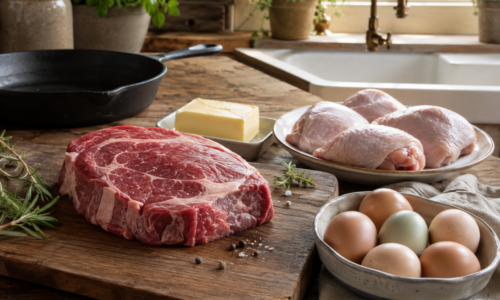
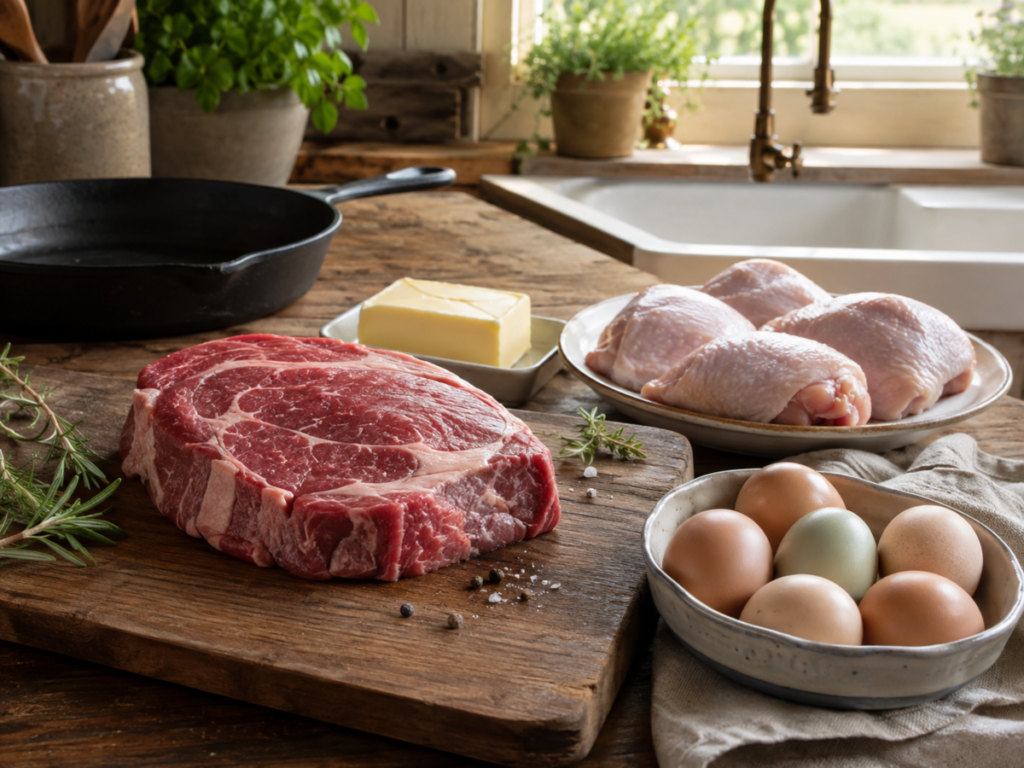
A low-lectin grocery list often begins with plants, because lectins are proteins found widely in plant foods and are especially concentrated in certain raw or improperly prepared legumes and grains. Once the conversation moves to meat, eggs, and dairy, the reasoning becomes less obvious. People following a low-lectin lifestyle are often told to choose grass-fed beef, grass-fed dairy, pasture-raised poultry, and carefully sourced pork, yet those recommendations are frequently repeated without explaining what the animal’s diet actually changes.
The strongest scientific case is not that a cow, pig, or chicken simply stores the lectins from its feed and passes them directly to the person eating it. There is not good human evidence showing that conventional meat exposes people to intact feed lectins in the same way that eating inadequately cooked high-lectin plant foods can. Feed does matter, however, because it can influence the animal’s digestion, fat metabolism, fatty-acid profile, and the composition of the food produced. For someone building a low-lectin eating pattern, that makes animal feeding practices relevant, but for reasons that deserve more precision than the familiar phrase “you are what you eat.”
Ruminants Process Food Differently
Cattle, sheep, goats, and other ruminants have a digestive system built around microbial fermentation before food reaches the true stomach. The rumen contains a large microbial community that breaks down fibrous plant material and changes many dietary compounds before they are absorbed by the animal. This is one reason cattle can obtain substantial nutrition from grasses and other forage that humans cannot digest efficiently.
That microbial processing also changes dietary fats. Rumen microorganisms convert many unsaturated fatty acids into more saturated forms through a process called biohydrogenation, and the resulting intermediates can affect the fatty-acid profile of beef and dairy products. Modern dairy research continues to show that feed composition, fat source, and rumen microbial activity can alter the fats that eventually appear in milk.
Lectins are more complicated. Older experimental work found that some plant lectins can bind to rumen material or resist complete breakdown under laboratory conditions, so it would be inaccurate to claim that the rumen automatically destroys every lectin. More recent animal-nutrition reviews likewise describe the rumen as having a partial, rather than absolute, ability to deal with plant antinutritional compounds. What matters for the person eating beef or drinking milk is that evidence of lectins affecting livestock digestion is not the same as evidence that biologically active feed lectins accumulate in animal foods at meaningful levels for humans.
Why Grass-Fed Beef Gets So Much Attention
Grass-fed beef has a legitimate nutritional distinction from grain-finished beef, although the size of the difference varies. Research generally finds that grass-finished beef contains more omega-3 fatty acids and conjugated linoleic acid, often called CLA, while grain-finished beef tends to contain more total monounsaturated fat and may contain more total fat depending on the cut and production system. A 2025 analysis of more than 300 North American beef samples found higher omega-3 concentrations and a lower omega-6-to-omega-3 ratio on average in grass-fed beef, but it also found substantial variation within both grass-fed and grain-fed products.
That variability matters at the grocery store. “Grass-fed” can tell you something about production, but it cannot tell you the exact fatty-acid content of a particular steak. Breed, forage quality, finishing practices, season, age, total fat content, and the specific cut all affect the finished food.
For a low-lectin lifestyle, grass-fed beef therefore makes sense as a sourcing preference rather than a requirement that must be met at every meal. It fits well with a dietary pattern that emphasizes ruminants raised primarily on forage, and it may offer a somewhat different fat profile. If grass-fed beef is unavailable or too expensive, choosing an unbreaded, minimally processed cut of conventional beef does not suddenly turn the meal into a high-lectin food.
Grass-Fed Dairy Changes the Fat Profile, Not the Basic Identity of Milk
Milk from cows eating more fresh pasture tends to contain more omega-3 fatty acids, vaccenic acid, and CLA, along with lower proportions of some omega-6 fatty acids than milk from cows fed more conventional total mixed rations. The exact composition shifts with season, pasture availability, breed, supplemental feed, and farm management, so “grass-fed dairy” is still a broad category rather than a single nutritional formula. Reviews of pasture-based dairy consistently find these compositional changes, while also making clear that feeding system is only one of several factors shaping milk.
Those differences should not be stretched into claims that grass-fed milk is proven to produce superior health outcomes. A change in fatty-acid composition is measurable, but long-term human trials comparing grass-fed and conventional dairy are limited. Grass-fed milk can be a reasonable choice for someone who values the feeding system or prefers its fat profile, yet seafood, for example, remains a far more concentrated source of the long-chain omega-3 fats EPA and DHA.
Grass-fed also does not mean A2, lactose-free, raw, organic, or free of milk proteins. A2 refers to a form of beta-casein determined mainly by the cow’s genetics, not whether the cow ate grass. Recent crossover trials suggest A2-only milk may reduce some digestive symptoms for some people compared with milk containing both A1 and A2 beta-casein, although symptom patterns are not uniform and broader health claims remain unproven. Someone who tolerates butter or ghee better than fluid milk may also be responding to differences in lactose, milk-protein content, portion size, or digestion rather than the cow’s feed alone.
Pork Works Differently Because Pigs Are Not Ruminants
Pigs are single-stomach animals, much closer to humans than cattle in the basic organization of digestion. They do not have a rumen performing extensive microbial fermentation before the stomach and small intestine, so dietary fat can influence pork fat more directly. Feeding studies have repeatedly shown that changing the fats in a pig’s diet can change the fatty acids deposited in its tissues.
This is one reason pork deserves its own category instead of being folded into a general “grass-fed meat” rule. Pigs are omnivores and do not thrive on grass alone, so a “grass-fed pork” expectation is biologically misplaced. Pasture-raised pigs can forage on grasses, roots, plants, insects, nuts, and other foods, but they typically still receive formulated supplemental feed.
For a strict low-lectin eater who wants to reduce reliance on animals raised on grain- and soy-heavy rations, pork sourcing may require more investigation than beef sourcing. A farm that discloses its feed practices can give more useful information than a vague front-label claim. Still, there is no solid basis for treating conventionally raised pork as though soybean or corn lectins are simply deposited intact into a pork chop and then delivered to the diner.
Poultry and Eggs Reflect Feed in Their Fats
Chickens are also single-stomach animals, and their dietary fats can show up relatively directly in meat and egg lipids. Poultry nutrition research has long demonstrated that increasing specific omega-3 fats in chicken feed can raise omega-3 concentrations in the edible tissues or egg yolks. The response depends on the fatty acid being fed, the amount, and the part of the bird being measured.
That fact helps explain why eggs can be sold as omega-3 enriched. The hen’s feed has been deliberately formulated to change the nutrient profile of the egg. It also explains why feed quality may be of interest to people who choose poultry and eggs frequently, even though that concern should not be confused with direct evidence of lectin transfer.
Pasture-raised chickens are still commonly given supplemental feed because pasture alone does not reliably meet their nutritional needs. Access to forage can change what the birds eat, but the words “pasture-raised” do not guarantee that the ration contains no corn, soy, or other plant ingredients. If feed composition is a personal priority, farm-level information or a meaningful third-party standard is more informative than assuming pasture access answers every question.
Feed Quality Matters More for Fat Composition Than for Lectin Exposure
The difference between fatty acids and lectins helps clear up a lot of confusion. Fatty acids are components of dietary fat that animals can absorb, modify, synthesize, and deposit in tissues, milk, or eggs. That pathway is well documented, especially in pigs and poultry, where changing dietary fats can noticeably change the final product.
Lectins are proteins. They can interact with an animal’s digestive tract, and some are more resistant to digestion than ordinary food proteins, but they are still handled through biological processes very different from the deposition of dietary fats. The current evidence does not support treating a chicken breast, pork chop, steak, or glass of milk as if it contains the same lectin exposure as the animal’s feed.
This does not make feed irrelevant. Feed composition can affect animal growth, gut health, product quality, fatty-acid content, and sometimes flavor. It simply means that someone following a low-lectin lifestyle can separate a direct lectin question from a broader food-quality question instead of blending the two together.
Labels Help, but They Need Context
Animal-raising claims such as “grass-fed,” “free-range,” and “pasture-raised” are voluntary labeling claims in the United States. USDA’s Food Safety and Inspection Service updated its guidance in 2024 to strengthen how producers substantiate these claims and strongly encourages third-party certification for animal-raising claims. That makes certification and producer transparency useful shopping tools, especially when the exact feeding practice matters to the buyer.
The words still need to be read carefully. Grass-fed beef does not automatically mean organic, and organic beef does not automatically mean grass-finished. Pasture-raised chicken does not automatically mean soy-free, while omega-3 eggs may come from hens receiving a specifically enriched feed whether or not they spend time outdoors.
A practical hierarchy can keep shopping from becoming exhausting. Start with a minimally processed animal food you tolerate well, then consider feeding system, farm practices, certification, and budget. A grass-fed ribeye that strains the grocery budget is not automatically a better long-term choice than an affordable conventional cut paired with vegetables and preparation methods that already fit your low-lectin routine.
Individual Tolerance Still Has the Last Word
Dairy is the clearest example of why sourcing cannot replace personal observation. Someone can react poorly to beautifully sourced grass-fed milk because lactose, casein, portion size, or another feature of dairy does not agree with them. Another person may tolerate conventional yogurt or aged cheese without difficulty because fermentation, serving size, and individual digestion matter more for them than the cow’s feeding system.
The same practical thinking applies to meat and eggs. A person may prefer grass-fed beef, pastured pork, and pasture-raised eggs because those foods match their goals, taste preferences, or sourcing values, while still recognizing that the evidence does not require perfection. Tracking meals, preparation methods, serving sizes, and symptoms can reveal much more about personal tolerance than trying to infer a reaction from a single label on the package.
If feed sourcing is something you want to test for yourself, keep the comparison simple. Try similar cuts or products in similar portions on different days rather than changing the meat, cooking fat, vegetables, and serving size all at once. Record the source, preparation method, portion, and how you felt afterward. That kind of tracking cannot prove a biochemical mechanism, but it can show whether paying more for a particular feeding or raising standard produces a consistent, practical difference in your own meals.