

Air fryers have earned a permanent place in many kitchens because they can brown vegetables, crisp proteins, and reheat leftovers with very little added oil. For someone following a low-lectin approach, though, the more useful question is not whether an air fryer gets hot. The real issue is whether that type of heat reliably reduces lectin activity in foods that contain meaningful amounts of lectins, and how it compares with boiling, steaming, and pressure cooking.
The short answer is that air frying can damage or deactivate some heat-sensitive lectins, but it should not be treated as a dependable primary method for making raw high-lectin foods safe. Dry heat and moist heat do not behave the same way, and surface temperature alone does not tell us what is happening throughout the food. That distinction matters most with foods such as raw kidney beans, where improper cooking is a genuine food-safety problem rather than simply a matter of personal dietary preference.
Lectins Respond to Heat, but They Do Not All Respond the Same Way
Lectins are carbohydrate-binding proteins found throughout nature, including many plant foods. Some are readily altered by cooking, while others tolerate heat better. Their behavior depends on the specific lectin, the food matrix around it, the amount of moisture present, the temperature reached, and how long that temperature is maintained.
This is one reason broad statements such as “heat destroys lectins” are too simple. Research on beans has repeatedly shown that sufficient cooking can greatly reduce or eliminate hemagglutinating activity, but lower-temperature heating may leave substantial activity behind. The FDA specifically warns that raw or undercooked kidney beans can cause acute gastrointestinal illness because of phytohaemagglutinin, and it recommends proper boiling rather than low-temperature slow cooking.
The chemistry also helps explain why cooking method matters. Heating can unfold proteins and change the shape that allows a lectin to bind to carbohydrates, but some lectins are more heat-stable than others. Experimental work and later reviews both show that temperature, moisture, and food type strongly affect how much activity remains after processing.
What an Air Fryer Is Actually Doing to Food
An air fryer is essentially a compact, high-speed convection oven. It circulates very hot air around the food, driving moisture from the surface and promoting browning. Modern reviews of hot-air frying describe moisture loss as one of the defining changes during cooking, which is why the method produces crisp edges so effectively.
That dry environment is useful for texture, but it is not the same environment created by simmering food in water or cooking it under steam pressure. A food may be exposed to air at 375 or 400 degrees Fahrenheit while its interior remains much cooler for part of the cooking period. Small pieces heat faster than large dense pieces, and a browned exterior does not guarantee that every part of the food experienced the same thermal treatment.
There is also no established mechanism by which air frying “locks lectins in” as if heat seals them inside a food. A better way to describe the limitation is that air frying removes one pathway that wet cooking provides. Because there is no pot of cooking water to discard, water-soluble compounds that might migrate out of the food during boiling are not removed in the same way. The lectins that remain must be reduced mainly through heat-induced structural change rather than through a combination of heat and leaching.
Why Moist Heat Has an Advantage for High-Lectin Foods
For foods with substantial lectin activity, moist heat has the best practical track record. Boiling surrounds the food with water held near 212 degrees Fahrenheit at sea level, allowing heat to penetrate while also creating an opportunity for some soluble compounds to move into the cooking liquid. Research reviews consistently report major reductions in lectin activity after adequate soaking and boiling of legumes.
Kidney beans deserve special treatment because their lectin content can be high enough to cause food poisoning when they are raw or inadequately cooked. The FDA cites evidence that boiling can destroy the toxin and advises consumers to boil beans long enough to ensure adequate heating throughout. Slow cookers are specifically discouraged for raw kidney beans because some operate at temperatures that are too low to reliably destroy phytohaemagglutinin.
For a low-lectin kitchen, this means an air fryer should not replace the established wet-cooking step for raw dried kidney beans. Soaking beans and then trying to make them edible by air frying would introduce too much uncertainty about internal temperature, moisture, and remaining lectin activity. Air frying becomes much more reasonable after the beans have already been thoroughly cooked by a method known to reduce lectins.
Pressure Cooking Remains a Strong Fit for Many Legumes
Pressure cooking combines water, high temperature, and pressure, allowing the cooking environment to rise above the normal boiling point of water. That combination makes it especially effective for dense foods such as legumes because heat penetrates rapidly while the food remains surrounded by moisture. Studies of legumes and other lectin-containing seeds have found strong reductions in antinutritional activity with pressurized moist heat, and reviews continue to identify autoclaving or pressure-based processing as an effective method for lectin reduction.
This does not mean every bean needs to be eaten by someone following a low-lectin approach. Ingredient choice still comes first, and personal tolerance matters. But for readers who choose to include certain legumes, pressure cooking provides a more predictable starting point than roasting or air frying raw seeds.
A practical sequence is simple: soak when appropriate, discard the soaking water, pressure-cook in fresh water, and then use the air fryer only if a crisp texture is desired afterward. That gives the air fryer a job it performs very well without asking it to perform the more uncertain job of lectin reduction from the raw state.
Boiling, Steaming, Roasting, and Air Frying Are Not Interchangeable
Boiling is the most straightforward comparison because the food is fully surrounded by hot water. For high-lectin legumes, it has direct evidence behind it, especially when the food is cooked thoroughly rather than merely warmed. It also allows part of the water-soluble material to leave the food and remain in the cooking liquid.
Steaming also provides moist heat, but the food is not immersed in water. That makes it useful for many vegetables because it can soften them without washing as many water-soluble nutrients into a pot of cooking liquid. For raw kidney beans or other foods where lectin inactivation is a safety concern, however, steaming should not be assumed to be equivalent to a validated boiling or pressure-cooking process unless the food has been cooked thoroughly under conditions known to be adequate.
Roasting and baking are closer relatives of air frying. They use dry heat, can reach high temperatures, and can reduce some heat-sensitive antinutritional factors, but their effectiveness varies with the food, temperature, moisture level, and exposure time. Research on roasted seeds shows that dry heat can sharply lower lectin activity under some conditions, yet moist heat has often performed more reliably in foods where lectin reduction is the main goal.
Air frying belongs in that same dry-heat family. It is faster and more aggressive at the surface than many conventional ovens because of the rapid air movement, but the basic limitation remains. A high appliance setting is not a substitute for knowing what temperature the interior of the food reached and whether that treatment has been shown to reduce the specific lectin involved.
The Best Use of an Air Fryer in a Low-Lectin Kitchen
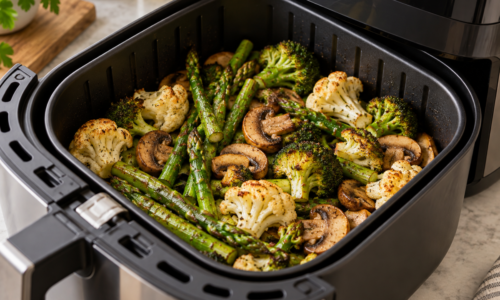
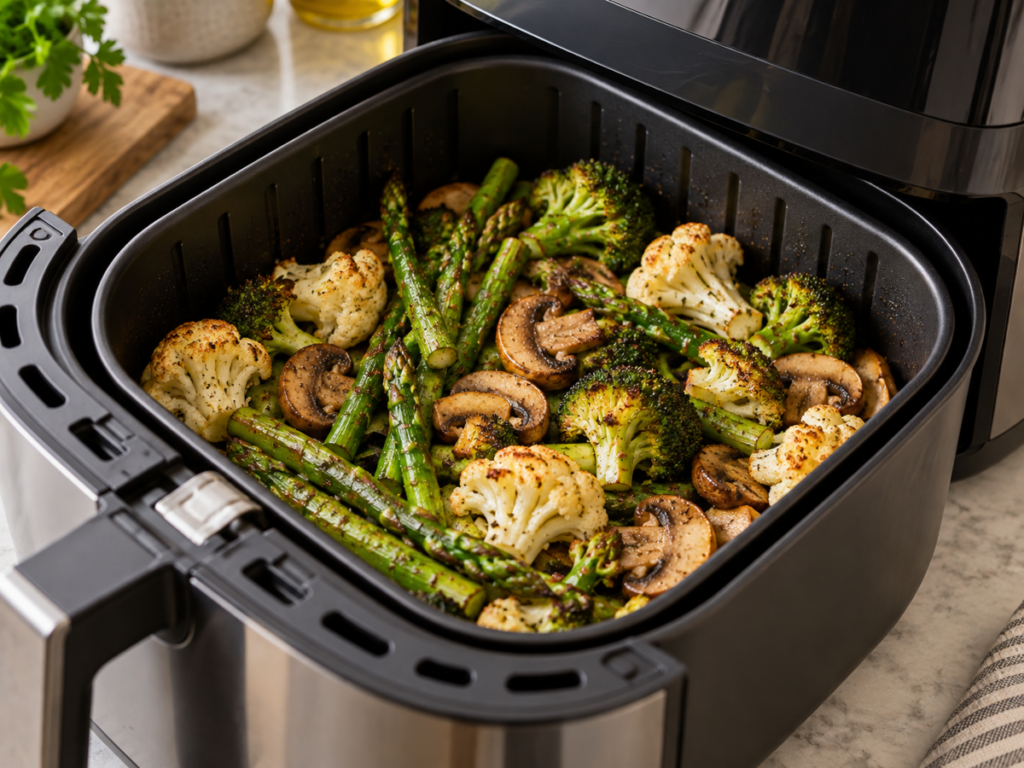
Air frying works especially well with foods that are already low in lectins or that have already received the preparation step needed to reduce them. Fish, poultry, meat, peeled root vegetables that fit a person’s plan, cruciferous vegetables, asparagus, mushrooms, and many other commonly used low-lectin ingredients can benefit from the air fryer’s speed and browning ability. In those cases, lectin reduction does not need to be the appliance’s main job.
The same principle can be applied to foods that need more preparation. A batch of properly pressure-cooked beans, if included in someone’s diet, can be chilled and later crisped in the air fryer. Vegetables that a person prefers to peel, deseed, blanch, or otherwise prepare first can be finished with dry heat for flavor and texture. This separation of tasks is often more dependable than expecting one appliance to handle every part of food preparation.
Air frying can also be useful for reheating previously cooked foods because it restores crispness without requiring much oil. For meal planning, that makes it easier to cook larger batches by a method chosen for lectin reduction and then use the air fryer later for convenience. The result is a kitchen routine built around preparation sequence rather than around a single appliance.
High Heat Has Other Food-Safety Tradeoffs
Lectins are only one consideration when judging high-temperature cooking. Air frying, baking, roasting, and frying can also promote the formation of acrylamide in certain carbohydrate-rich plant foods, especially when they are cooked to a dark brown color. The FDA notes that acrylamide forms mainly during high-temperature, low-moisture cooking and that longer cooking or higher temperatures can increase formation.
Air frying does not automatically produce more or less acrylamide than every other method. A 2024 study comparing homemade potatoes found no statistically significant difference among air frying, deep frying, and oven frying, although the air-fried samples had the highest average level in that particular experiment. The same study found that soaking potatoes before cooking tended to lower acrylamide, which is a reminder that preparation steps can matter as much as appliance choice.
For practical cooking, the simplest approach is to avoid pushing starchy foods to very dark browning. Golden and crisp is usually enough. This advice is separate from lectin management, but it fits the same larger principle of choosing preparation methods for the specific food rather than assuming that hotter is always better.
A Better Way to Think About Air Frying and Lectins
The most useful distinction is between cooking for texture and cooking for reliable lectin reduction. Air fryers are excellent at the first job. They may contribute to the second with some foods, but published evidence does not support treating household air frying as a universal lectin-deactivation method, especially for raw legumes with known safety concerns. Reviews of air frying concentrate heavily on moisture loss, browning, texture, and heat-generated compounds, while research on lectin reduction continues to give much stronger support to adequate moist-heat processing.
For foods such as kidney beans, boiling and pressure cooking have a better-established record. For foods that are already low in lectins, already fully cooked, or prepared through another reduction step first, the air fryer can be one of the most convenient finishing tools in the kitchen. That approach keeps the appliance in its strongest role while leaving higher-risk foods to cooking methods with a more established safety record.
