

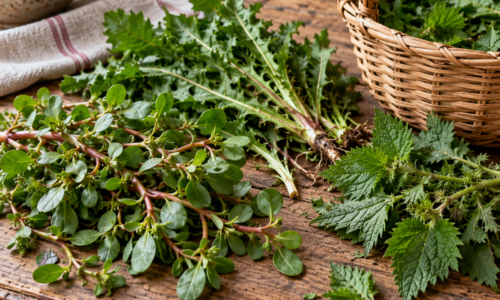
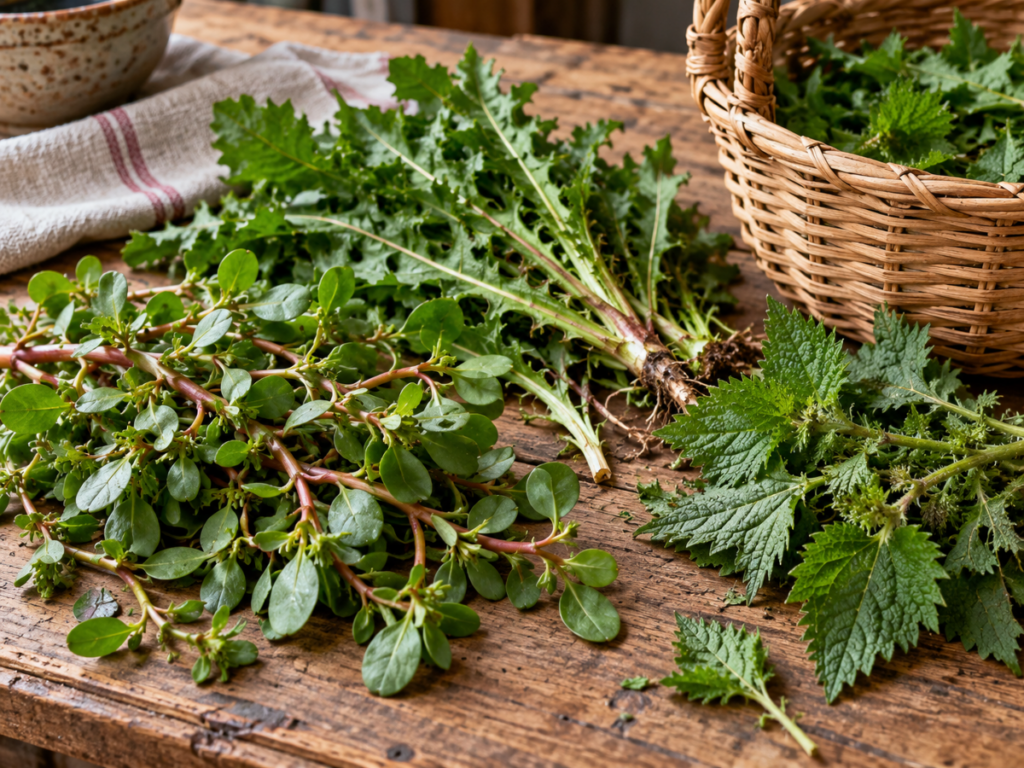
A patch of weeds at the edge of a garden can look very different once you know which plants are edible. Purslane sprawls low across warm soil, dandelion pushes up jagged leaves almost anywhere it can get a foothold, and nettles often gather in moist places where their sting keeps casual hands away. All three have long histories as food, yet they also fit a modern interest in eating a wider range of plants, paying attention to digestive tolerance, and getting more value from simple ingredients.
For someone following a low-lectin lifestyle, wild greens raise a useful question. They are plant foods, but they are not interchangeable with beans, wheat, or other foods that commonly dominate conversations about dietary lectins. At the same time, “wild” does not automatically mean safer, more nutritious, or easier to digest. The most sensible approach is to look at each plant on its own, consider the edible part, prepare it appropriately, and treat personal tolerance as useful information rather than an afterthought.
Gut Support Starts with Fiber, Variety, and Tolerance
The phrase “gut support” can easily become larger than the evidence behind it. Purslane, dandelion greens, and nettles contain fiber and a range of plant compounds, and adding edible plants to the diet can increase botanical diversity. Fiber can also provide substrate for intestinal microbes, depending on the type of fiber and the person eating it. What these greens have not been shown to do in ordinary culinary amounts is heal the intestinal lining, correct a microbiome imbalance, or treat a digestive disease.
That distinction matters because laboratory and animal studies often explore concentrated extracts or isolated compounds at doses that do not resemble a serving of cooked greens. For example, recent animal research has found that purslane preparations can influence the gut microbiota and intestinal barrier markers in mice with experimentally induced colitis, but that is not the same as evidence that a purslane salad treats inflammatory bowel disease in people. Dandelion research follows a similar pattern, with interesting preclinical findings but limited direct human evidence for gastrointestinal benefits.
A more grounded reason to eat these plants is that they can help expand the range of vegetables in a meal. Different plant foods bring different fibers, textures, polyphenols, minerals, and flavors to the table. That variety may be useful for people who have narrowed their food choices while trying to identify digestive triggers, especially when new foods are introduced one at a time and in realistic portions.
Purslane Brings Tender Texture and Plant-Based Omega-3 Fat
Purslane, or *Portulaca oleracea*, is a succulent green with fleshy leaves and stems. It has a lightly tart, fresh flavor that can work raw in salads or cooked into soups, eggs, and vegetable dishes. Its texture is part of what makes it unusual, because the plant holds water well and can become slightly mucilaginous when cooked, which helps thicken soups and stews. Extension sources describe the entire young plant as edible and note that it has a long culinary history in many parts of the world.
Nutritionally, purslane is especially interesting for its alpha-linolenic acid, or ALA, a plant form of omega-3 fat. Reviews have consistently identified purslane as unusually rich in ALA relative to many other leafy vegetables, although the absolute amount still depends on variety, growing conditions, and how much is eaten. A 2026 review also emphasized that its nutritional composition can shift considerably with genotype and growing environment, which is a good reminder that wild plants do not come with laboratory-standardized nutrient profiles.
Purslane also comes with an important preparation issue: oxalate. Published analyses have reported relatively high oxalate concentrations in the plant, and more recent food-processing work suggests that blanching and pickling can reduce total oxalate content. People who have been advised to limit oxalate, particularly because of a history of calcium oxalate kidney stones, may want to treat purslane differently from a low-oxalate leafy green.
In a low-lectin kitchen, purslane can be treated much like another leafy vegetable rather than automatically labeled “lectin-free.” Specific, useful data on the lectin content of ordinary purslane servings are limited. If the goal is a conservative approach, lightly cooking or blanching the greens has practical advantages anyway, including softening the plant and lowering oxalate.
Dandelion Greens Offer Bitterness, Fiber, and Culinary Flexibility
Dandelion leaves are often easiest to enjoy when they are young. Before flowering, the leaves tend to be more tender and less bitter, while mature leaves can become assertive enough that cooking makes them easier to use. University Extension guidance notes that young leaves can be eaten fresh, while older leaves can be cooked, with boiling or acidic dressings helping soften their bitter character.
The bitter flavor is part of dandelion’s identity, but bitterness should not be confused with proof of a digestive effect. Dandelion has a long history of traditional use for digestive complaints, and researchers have identified compounds such as polyphenols, sterols, and polysaccharides throughout the plant. Reviews of dandelion and gastrointestinal health describe promising mechanisms, but much of that work comes from laboratory or animal research rather than strong clinical trials in people eating dandelion greens as food.
Dandelion is also often discussed as a source of inulin, a fermentable carbohydrate that can act as a prebiotic. Human studies of purified inulin-type fructans show that these fibers can shift parts of the gut microbiota, including increases in some *Bifidobacterium* populations, and can alter stool characteristics in certain groups. The important detail is that fructan production and storage are concentrated much more heavily in dandelion roots than in the leaves, so findings about dandelion-root inulin should not automatically be transferred to a serving of dandelion greens.
From a practical food standpoint, the leaves are still useful because they add leafy vegetable fiber and a flavor that can keep meals from becoming repetitive. A small handful of young leaves can be mixed with milder greens, while older leaves can be sautéed in olive oil with garlic, folded into eggs, or added near the end of a soup. For someone with a sensitive digestive system, cooked leaves may be easier to trial than a large raw salad.
Nettles Need More Preparation, but Reward the Effort
Stinging nettle, *Urtica dioica*, asks for more respect in the kitchen because the fresh plant is covered with stinging hairs. Contact with those hairs can trigger burning, itching, and a skin reaction, so gloves and covered skin are sensible during harvest. Once properly blanched or cooked, however, nettles have a long history as a leafy food and can be used much like spinach in soups, pesto, fillings, and vegetable dishes. Oregon State University Extension recommends blanching the greens in boiling water for about one and a half to two minutes to neutralize the stinging hairs.
Nettles provide fiber, minerals, carotenoids, polyphenols, and other plant compounds, although exact values vary by growing conditions and preparation. Research on raw and processed nettles also shows that cooking changes their composition, with some nutrients decreasing while others remain available. That makes nettle a good example of why “raw is always better” is too simple a rule, especially for a plant that requires heat for comfortable handling and eating.
Nettle is especially interesting in a low-lectin discussion because *Urtica dioica* does contain a well-studied lectin called *Urtica dioica* agglutinin, or UDA. The strongest classic evidence places UDA in the roots and rhizomes, which are not the same part of the plant as the young leaves used as a cooked green. More recent reviews continue to discuss nettle roots as a significant source of these lectins, reinforcing the need to distinguish the plant part being studied from the leaves being eaten.
For a person who follows a strict low-lectin plan, that uncertainty may be enough reason to use nettle cautiously or skip it. For someone whose approach is based more on food preparation and individual tolerance, a small serving of well-cooked young leaves may be a reasonable food trial. The useful point is not to force nettle into a “good” or “bad” category, but to recognize that plant part, preparation, portion, and response all matter.
Safe Foraging Matters as Much as Nutrition
Wild greens are only useful food when the plant has been identified correctly and harvested from a clean location. Purslane can be confused with prostrate spurge, and Extension guidance warns that plant identification apps are not reliable enough on their own to establish that a wild plant is safe to eat. A better approach is to use multiple reliable identification references or learn directly from an experienced local forager before eating a plant for the first time.
Location matters too. Road edges, industrial areas, utility rights-of-way, treated lawns, and the margins of conventionally managed fields can expose plants to herbicides, pesticides, runoff, heavy metals, or other contaminants. Even an edible species should be left alone if its growing history is uncertain. Extension sources repeatedly advise harvesting only from areas known to be free of chemical treatment and other obvious contamination.
Young growth is usually the easiest place to begin. Tender purslane stems, young dandelion leaves, and nettle tops harvested before flowering tend to be more pleasant in texture and flavor. Harvesting small amounts also makes it easier to test tolerance instead of turning a new wild food into a large dietary experiment.
Building Wild Greens into a Low-Lectin Meal
The easiest way to use wild greens is to let them support a familiar meal rather than making them the entire meal. Purslane can be chopped into eggs with herbs, dandelion greens can be sautéed beside fish or chicken, and blanched nettles can be folded into a soup with garlic, olive oil, and low-lectin vegetables. Mixing a stronger wild green with a familiar vegetable also helps control bitterness and portion size.
For people who track digestive reactions, wild greens are best introduced one at a time. A meal containing purslane, nettle, dandelion, a new sauce, and a new protein may taste interesting, but it makes any later symptoms difficult to interpret. A smaller trial, repeated under ordinary conditions, gives more useful information about whether the food belongs in regular rotation.
That approach fits the broader purpose of a sustainable low-lectin lifestyle: practical guidance, careful observation, and enough flexibility to build a personal pattern rather than chase a perfect universal food list. Wild greens can earn a place in that pattern when they are correctly identified, cleanly sourced, prepared for the plant in question, and eaten in amounts that agree with the person eating them.
