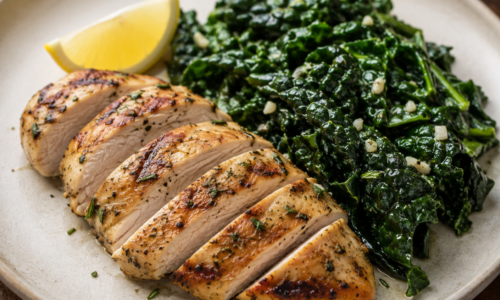
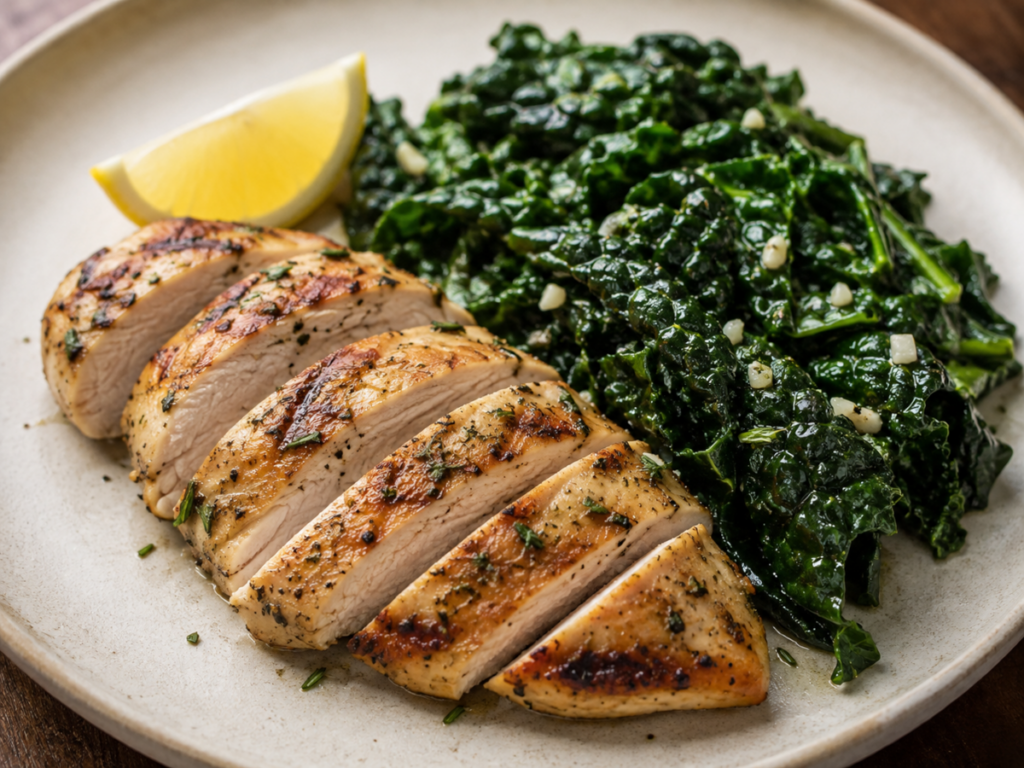
Some dinners earn a regular place in the kitchen because they are exciting. Others stay because they work. Pasture-raised chicken breast with garlic kale falls into the second category. It is straightforward enough for a weeknight, filling enough to feel like a complete meal, and flexible enough to cook indoors or outside on the grill. There are no complicated substitutes, no specialty flour blends, and no attempt to recreate a food that does not belong on the plate in the first place.
The chicken is marinated with olive oil, lemon, garlic, and herbs, then cooked until tender. Lacinato kale is sliced into ribbons and sautéed just long enough to soften its texture while preserving some body. The garlic mellows in the olive oil and coats the leaves without turning the side dish into a heavy pile of greens.
Simple food still requires technique. Chicken breast can become dry within minutes, kale can remain leathery, and garlic can go from fragrant to bitter while your attention is somewhere else. This recipe avoids those problems by treating each ingredient according to what it needs.
Why This Meal Fits a Low-Lectin Routine
Chicken breast is an animal protein, so it does not contain the plant lectins that receive most of the attention in low-lectin eating. Kale is a cruciferous vegetable rather than a legume, grain, or nightshade. It is not generally placed among the concentrated lectin sources that cause the greatest concern, such as improperly cooked kidney beans.
Lectins are carbohydrate-binding proteins found throughout nature, but their amount, activity, and relevance differ greatly from one food to another. Research has repeatedly shown that the clearest food-safety problem involves certain raw or undercooked legumes. Soaking and thorough boiling can greatly reduce their active lectin content. That does not mean every plant food carries the same risk or should be treated as nutritionally identical.
This meal also keeps the ingredient list controlled. That matters for people who are tracking personal food reactions. A plate containing chicken, kale, olive oil, garlic, lemon, and herbs produces far less confusion than a casserole filled with sauces, thickeners, sweeteners, spice blends, and packaged ingredients. You can eat the meal, record how you feel, and have a reasonable idea of what was actually on your plate.
Pasture-Raised Is a Quality Choice, Not a Magic Label
The phrase “pasture-raised” can suggest a chicken spent its entire life roaming through open fields under perfect blue skies. Real farming systems are more complicated. Standards, access to pasture, feed quality, stocking density, and animal-care practices can differ among producers.
For this recipe, pasture-raised chicken is a preference rather than a requirement. It does not make the chicken “lectin-free” while conventional chicken somehow is not. Both are animal proteins. The appeal is more closely connected to farming practices, animal welfare, flavor, and the way someone chooses to spend their food budget.
Buy from a producer whose practices you trust when that option is available and affordable. Read the package instead of relying only on the largest phrase printed across the front. Organic, free-range, pasture-raised, air-chilled, and antibiotic-related claims do not all mean the same thing. A good conventional chicken breast cooked at home is still a more practical choice than skipping dinner because the premium package costs too much.
Why Lacinato Kale Works So Well
Lacinato kale is sometimes sold as dinosaur kale, Tuscan kale, or cavolo nero. Its leaves are long, dark, and textured, but they are usually flatter than curly kale. Once the thick central stems are removed, the leaves slice neatly and cook evenly. Its flavor is earthy and slightly bitter. Garlic and olive oil soften that edge without covering it. A small squeeze of lemon at the end brightens the entire pan.
Kale belongs to the cruciferous vegetable family and contains fiber, carotenoids, phenolic compounds, and sulfur-containing glucosinolates. Those glucosinolates can be converted into other biologically active compounds during cutting, chewing, digestion, and cooking. Research into these compounds is promising, but a serving of kale should still be treated as food rather than medicine.
People with sensitive digestive systems sometimes tolerate cooked greens better than large raw salads. Cooking softens the leaf structure and reduces the amount of chewing required. It also shrinks the kale considerably, which can make portions deceptively large. Start with a moderate serving if cruciferous vegetables tend to cause gas or abdominal pressure for you.
The Marinade Does More Than Add Flavor
Boneless chicken breast has a mild flavor and very little internal fat. That makes it adaptable, but it also makes careless cooking obvious. The olive oil helps distribute the herbs and coats the surface. Lemon juice adds acidity and brightness. Garlic supplies depth, while rosemary, thyme, and oregano bring enough aroma to make the chicken taste intentional rather than merely plain.
Acid does not tenderize chicken without limits. A brief marinade can improve flavor, but leaving chicken breast in a strongly acidic mixture for an excessive amount of time may make the exterior texture unpleasant. For this recipe, 30 minutes is enough to season the meat. Two to four hours gives the herbs more time to work. Overnight is unnecessary.
The marinade that touched raw poultry should be discarded. Do not brush it onto cooked chicken unless you first boil it safely in a separate saucepan. Making a clean portion of marinade before adding the raw chicken is the easier approach if you want extra liquid for serving.
Pasture-Raised Chicken Breast with Garlic Kale
Ingredients
- 4 pasture-raised boneless, skinless chicken breasts, about 6 ounces each
- 3 tablespoons extra-virgin olive oil
- 2 tablespoons fresh lemon juice
- 3 garlic cloves, minced
- 1 teaspoon dried oregano
- 1 teaspoon dried thyme
- 1/2 teaspoon dried rosemary, lightly crushed
- 1 teaspoon sea salt
- 1/2 teaspoon freshly ground black pepper
- 1 teaspoon finely grated lemon zest, optional
Instructions
- Prepare the Chicken. Place each chicken breast between two sheets of parchment paper or inside a food-safe bag.
- Gently pound the thicker portion until each breast has a fairly even thickness of about 3/4 inch. This step prevents the narrow end from drying out while the thick end is still cooking. It also makes the cooking time more predictable.
- In a glass bowl or sealable container, combine the olive oil, lemon juice, garlic, oregano, thyme, rosemary, sea salt, black pepper, and lemon zest.
- Add the chicken and turn each piece until it is evenly coated.
- Cover and refrigerate for at least 30 minutes or up to 4 hours.
- Remove the chicken from the refrigerator about 15 minutes before cooking.
- Discard the used marinade.
- * Oven Method *
- * Preheat the oven to 425°F. Lightly grease a baking dish or line a rimmed baking sheet with parchment paper.
- * Arrange the chicken in a single layer with a little space between each piece. Bake for 17 to 22 minutes, depending on thickness.
- * Begin checking the temperature before the estimated cooking time ends. Insert an instant-read thermometer into the thickest portion of each breast. Poultry should reach a safe internal temperature of 165°F. Color alone is not a reliable measure of safety.
- * Transfer the chicken to a clean plate and let it rest for 5 minutes before slicing. Resting gives the hot juices time to settle inside the meat instead of running across the cutting board.
- ++ Grill Method ++
- ++ Preheat a clean grill to medium-high heat, around 400°F to 425°F. Oil the grates lightly to reduce sticking.
- ++ Place the chicken over direct heat and close the lid. Grill for about 5 to 7 minutes on the first side.
- ++ Flip once and continue cooking for another 5 to 7 minutes. Exact timing depends on the thickness of the chicken and the temperature of the grill.
- ++ Check the center of the thickest piece with a food thermometer and cook until it reaches 165°F.
- ++ Move the chicken to a clean plate and rest it for 5 minutes. Never return cooked chicken to the platter that held the raw meat.
- -- Cook the Garlic Kale--
- While the chicken cooks, wash the kale thoroughly and dry it. Hold the bottom of each stem with one hand and pull the leaf away with the other. You can also fold each leaf in half and slice along the stem with a knife. Stack several leaves, roll them loosely, and slice them into ribbons about 1/2 inch wide. Avoid cutting them too finely. The kale should retain some texture after cooking.
- Heat 2 tablespoons of olive oil in a large skillet over medium-low heat. Add the minced garlic and cook for about 30 seconds, stirring constantly. The garlic should smell fragrant but should not turn dark brown.
- Add the kale in batches, tossing each addition until it begins to wilt and creates room in the skillet. Sprinkle with sea salt and add the water or broth.
- Cover the skillet and cook for 3 minutes. Remove the lid, toss the kale, and continue cooking for another 2 to 4 minutes. The leaves should be tender but not reduced to a wet, shapeless mass.
- Taste and adjust the salt. Add black pepper or a small squeeze of lemon juice if desired.
- -- Assemble the Plate --
- Divide the garlic kale among four plates.
- Place one whole chicken breast beside the greens, or slice each breast across the grain and fan the pieces slightly over the edge of the kale.
- Spoon any clean juices from the resting plate over the chicken. Do not drown it in sauce. The olive oil, herbs, garlic, and lemon should support the meat rather than conceal it.
- For a larger meal, add roasted cauliflower, steamed broccoli, sautéed mushrooms, or roasted peeled sweet potato according to your personal low-lectin plan and tolerance.
Preventing Dry Chicken Breast
Chicken breast often gets blamed for being boring when the real problem is overcooking. Even thickness is the first defense. Temperature is the second. A meat thermometer removes the guesswork and prevents the repeated cutting, poking, and staring that usually releases juices without providing a reliable answer.
The chicken will continue heating slightly after it leaves the oven or grill. Still, it must reach the USDA-recommended safe temperature of 165°F. The goal is to reach that point without sailing far beyond it. Slicing direction matters too. Look for the faint lines running through the meat and cut across them. Shorter muscle fibers feel more tender when chewed.
Making Kale Tender Without Overcooking It
Raw kale can be sturdy enough to survive an afternoon inside a packed lunch container. That durability is useful, but it means the skillet needs both heat and moisture. Oil alone coats the leaves but may leave them chewy. A small amount of water or broth creates steam, which softens the dense structure more evenly. Covering the skillet briefly traps that steam. Removing the lid near the end allows excess moisture to evaporate.
Garlic should enter the pan before the kale, but only briefly. Burned garlic has a sharp bitterness that spreads through the entire dish. Keep the heat moderate, stir it constantly, and add the kale as soon as the garlic becomes fragrant.
Adjustments for Personal Tolerance
Garlic is well tolerated by many people, but it can cause digestive discomfort for those who react to fructans or follow a low-FODMAP plan. A low-lectin approach and a low-FODMAP approach are not the same diet, though some people follow elements of both.
For a gentler version, leave out the minced garlic and flavor the oil with a whole lightly crushed clove. Cook the clove briefly, remove it, and then add the kale. Garlic-infused oil may provide flavor with fewer fermentable carbohydrates, provided the product is appropriate for your dietary plan.
Lemon can also be reduced or omitted if acidic foods bother you. Replace it with a teaspoon of mild vinegar only if vinegar sits better with your digestion, or skip the acidic ingredient completely. The black pepper is optional. The herbs can be adjusted as well. Rosemary has a strong flavor, so reducing it is better than doubling it without tasting the recipe first.
Storing and Reheating Leftovers
Refrigerate leftover chicken and kale in separate airtight containers when possible. The chicken will keep its texture better when it is not sitting directly in moisture from the cooked greens. Slice only the amount of chicken you plan to eat. A whole cooked breast retains moisture better than one that has been sliced into thin pieces before storage.
Reheat the kale in a covered skillet over low heat with a teaspoon of water. Warm the chicken gently in the oven or in a covered skillet with a small splash of broth. High heat may warm it faster, but it also pushes lean breast meat toward the texture of packing material.
Cold sliced chicken can be served over leftover garlic kale, chopped romaine, avocado, or another tolerated vegetable for a fast lunch. Keep the dressing simple so yesterday’s controlled meal does not become today’s mystery mixture.