
Most people imagine that once they remove high-lectin foods and finally start feeling lighter, clearer, and less inflamed, the hard part is over. But surprisingly, the phase that comes after the initial reset, when you begin adding foods back in, can feel even trickier. It’s the stage where old favorites call your name, curiosity nudges you, and your body’s responses suddenly matter more than ever. And yet this is also the moment many people unintentionally blur the signals their body is trying to send.
Reintroducing foods should give you clarity: What can I tolerate? What still triggers symptoms? What belongs in my long-term rotation? But if handled recklessly, it can create more confusion than answers. The goal isn’t simply to “try foods again”, it’s to reintroduce them in a way that protects the integrity of your observations, so you can trust what you’re seeing.
And this is where the art of methodical eating comes in.
The Problem: Why Reintroductions Often Fail
When someone says, “I added tomatoes back and felt awful,” it’s rarely because tomatoes alone caused the problem. More often, the person also:
- tried multiple new foods the same week,
- introduced a food in too large a portion,
- had poor sleep or high stress that altered digestion,
- ate the food in a form that naturally irritates the gut,
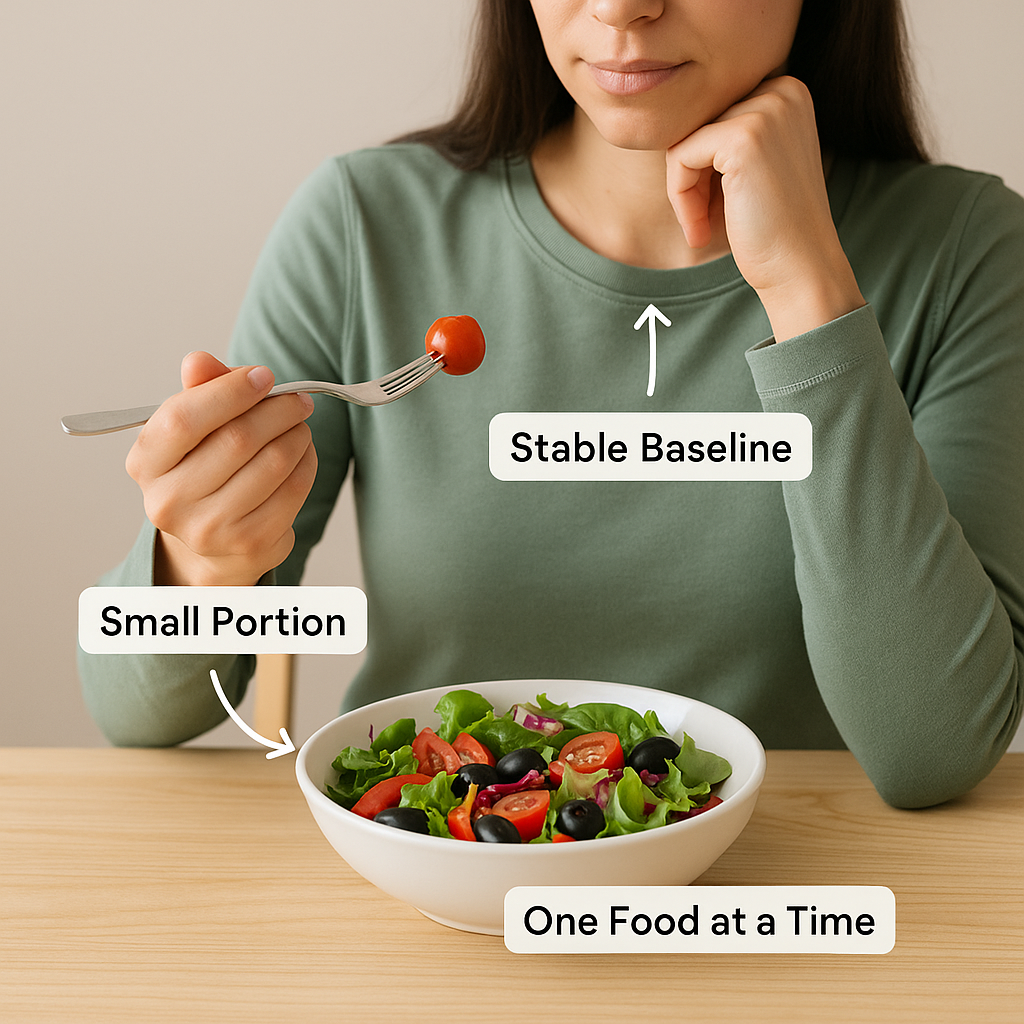
- or reintroduced it during a moment their baseline wasn’t stable.
Reintroductions are an experiment, your experiment, and like all good experiments, they depend on controlled variables. If your environment, meal composition, stress levels, and digestive rhythm are unpredictable, you can’t rely on the results.
This doesn’t mean living a rigid or joyless life. But when you’re asking your body a question, “Can I handle this food?”, you want conditions that allow your body to answer honestly.
Understanding the Body’s Timeline
A low-lectin reset calms inflammation, stabilizes blood sugar, and supports the microbiome, all of which improve how the digestive and immune systems communicate. But these systems don’t speak instantly. When you eat something new, your body may respond in stages:
- Immediate digestive feedback (bloating, discomfort, gas)
- Delayed inflammatory signals (joint stiffness the next morning)
- Neurological or mood-related responses (fatigue, irritability, brain fog hours later)
- Skin or immune responses (itchiness, flushing, breakouts over 24–72 hours)
This layered timeline means you must give each reintroduction space. If you eat three new foods in a 24-hour window, and symptoms show up 36 hours later, you’ll have no idea which food caused it or whether it was the combination.
Slow reintroduction isn’t about being cautious. It’s about being able to see what’s actually happening.
Stabilizing Your Baseline Before You Begin
It’s tempting to start reintroductions the moment you feel “pretty good,” but “pretty good” isn’t enough. You want a baseline that is consistent, predictable, and calm.
Ask yourself:
- Have I had stable digestion for a few days in a row?
- Are my sleep, hydration, and stress levels steady?
- Do I feel reasonably consistent from morning to night?
- Are my usual daily meals boring… but reliable?
If the answer is yes, you’re ready.
If not, wait. Starting from a shaky baseline makes interpretations shaky too.
A stable baseline doesn’t require perfection. It just means your body isn’t already juggling major disturbances, so when something does shift, the cause will be easier to trace.
The First Rule: One Food at a Time
This is the most obvious and the most ignored guideline. People often slip when a craving or convenience takes over. “I tried beans today… and also had a little sourdough because it was there… and I grabbed a handful of peanuts because why not.”
But your body isn’t a detective, and neither are you. You’re not meant to parse complicated combinations. The simpler the input, the clearer the output.
Reintroducing a food is like tuning a radio station. If the static is too loud, you’ll never hear the signal.
Start Small – Microdosing Your Way Up
When reintroducing, portion size matters more than people expect. Your immune and digestive systems are sensitive observers, and small doses provide cleaner data.
Start with a small testing amount: a few bites, a controlled spoonful, or a partial serving. The purpose isn’t to “enjoy” the food; the purpose is to see how your body reacts to contact.
Smaller amounts give you:
- cleaner observation windows
- fewer severe reactions if the food is troublesome
- the ability to build confidence gradually
- a clearer sense of thresholds (some foods are fine in small quantities but not large ones)
The best part? If a small amount is tolerated, you can test a slightly larger amount the next day while still focusing on that single food.
The Environment Matters More Than You Think
Believe it or not, the setting in which you reintroduce food influences how clearly you observe your symptoms. If you introduce a new food on a day when:
- you barely slept,
- your stress is high,
- your exercise is unusually intense,
- or you’re eating out at a restaurant with hidden ingredients,
your results will be clouded.
Your digestive system is deeply intertwined with your nervous system. Stress hormones, sleep quality, hydration levels, posture while eating, and even emotional state affect how the gut processes food.
When reintroducing, aim for a predictable environment. That doesn’t mean you need a perfect day. It just means avoid adding chaos to an already delicate experiment.
How to Read Your Body Without Overreacting
One of the hardest parts of reintroducing foods is the interpretation phase. People often jump to extremes:
- “I felt something, so this food must be bad!”
- “I felt fine immediately, so it must be safe forever!”
Both are inaccurate.
Your body isn’t binary. It communicates in layers. Some foods create mild digestive chatter that resolves quickly; others create slow, cumulative responses that only appear after repeated exposures.
Here’s how to interpret feedback without spiraling:
Immediate digestive sensations
These usually reflect how your gut handles the food mechanically like fiber load, fermentation potential, fat content, but not necessarily the lectin content. A little bloating alone isn’t enough to declare a food incompatible.
Delayed symptoms
These are the ones that matter most. Joint stiffness, foggy thinking, body heaviness, changes in bowel patterns, or a subtle increase in inflammation usually appear within 24–48 hours. These are the symptoms that reveal compatibility.
Patterns across multiple exposures
A single day is not the whole story. You learn more from repeated, controlled instances. A food that causes mild discomfort once may be perfectly tolerable when your gut strengthens. A food that causes consistent discomfort three times in a row is sending a clearer message.
Reintroduction is less about judgment and more about curiosity.
Spacing Your Tests: Give Each Food Its Own Window
To avoid overlapping signals, give yourself a buffer period between foods. This provides clarity: if symptoms flare during a buffer, you already know the trigger. If everything stays smooth, you can move on confidently.
The length of this buffer depends on your sensitivity level:
- Mildly sensitive people may only need 24 hours.
- Moderately sensitive individuals usually need 48 hours.
- Highly reactive individuals may need 72 hours or longer.
Think of it as gentle breathing room or space for your body to return to balance before the next question is asked.
Avoid Reintroduction Stacking
A hidden pattern that confuses a lot of people is stacking reintroductions too close together. Just because a food didn’t create an immediate reaction doesn’t mean your body is ready for the next test.
For example:
Day 1: Try tomatoes
Day 2: Try potatoes
Day 3: Try sourdough
Day 4: Feel bloated, foggy, and stiff
Which food caused it? Was it the combination? Was it the timing? Was it a threshold issue that built gradually?
This stacking effect is one of the biggest reasons people abandon reintroductions prematurely or make incorrect conclusions.
When Symptoms Get Murky: What to Do
At some point, everyone experiences a confusing reaction. Maybe symptoms show up late. Maybe they’re mild but persistent. Maybe they don’t match the type of food you introduced. Or maybe something outside of food triggered them.
When symptoms get murky:
- Pause. Stop introducing new foods temporarily.
- Return to your stable baseline meals. Give your body a familiar rhythm that calms inflammation and digestion.
- Wait for several symptom-free days. Let your system reset fully.
- Retest the food later. Sometimes timing, not the food, was the issue.
Reintroductions aren’t linear; they’re exploratory. It’s normal to need a reset.
Why Mood, Stress, and Hormones Matter
Many people overlook the fact that their digestive system is deeply responsive to their emotional and hormonal landscape.
For example:
- Poor sleep can reduce digestive enzyme activity.
- High stress tightens the intestinal muscles and slows motility.
- Hormonal shifts can alter sensitivity and inflammation.
- Emotional tension can amplify symptoms that feel food-related.
When reintroducing foods, it’s wise not to do so on days when you’re overwhelmed, exhausted, or dysregulated. Your body will interpret new stimuli differently under different internal conditions, which can distort your results.
Think of reintroductions as communication. To hear the message clearly, the static must be low.
Cumulative Load: The Hidden Factor No One Talks About
Some foods don’t trigger symptoms immediately or by themselves. Instead, they contribute to a cumulative inflammatory burden. You might tolerate small amounts of dairy, tomatoes, or certain nuts individually but when eaten in combination or repeatedly, they can overwhelm your system.
This is why spacing, portion sizes, and observation windows are essential. A reintroduced food may be perfectly tolerable once a week but problematic when eaten daily. Understanding this threshold is key to reintroducing foods without confusing your patterns.
Building Your Long-Term Food Map
The purpose of reintroductions isn’t simply to expand your diet. It’s to build a personalized map of what nourishes you, what challenges you, and what requires moderation. Over time, patterns become clearer:
- Foods that consistently cause problems
- Foods that work in small amounts but not large ones
- Foods that are only problematic before sleep or during stress
- Foods that become easier to tolerate after gut healing progresses
- Foods that cause no issues and can become staples again
This evolving map becomes a living, breathing guide. One that reflects your body’s changing needs instead of a rigid rulebook set in stone.
Reintroductions Are a Skill Not a Sprint
If there’s one thing worth remembering, it’s this: reintroducing foods is a skill that strengthens with practice. It requires patience, curiosity, and deliberate pacing. Most of the confusion people experience doesn’t come from the foods themselves. It comes from the process being rushed or layered with too many variables at once.
When approached methodically, reintroductions don’t feel scary or chaotic. They feel empowering. You begin to see your body not as unpredictable but as consistent, communicative, and responsive when given the right conditions.
Each reintroduced food becomes a conversation rather than a gamble.
Each symptom becomes information rather than frustration.
Each step becomes clearer, slower, and more confident.
The end goal isn’t just knowing what you can tolerate. It’s learning how to listen, gently and accurately, to the signals your body has been giving all along.