
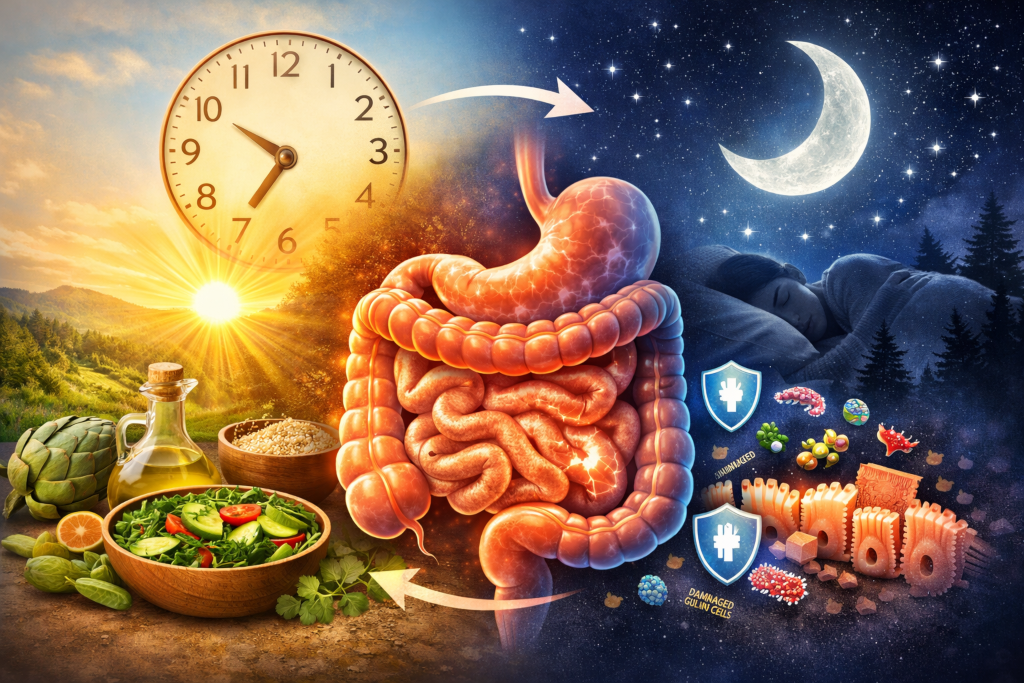
Most people think of digestion as something that happens only when food enters the body. Eat a meal, feel full, absorb nutrients, move on. But digestion is not a simple on-off process. It is part of a deeply timed biological system that follows a daily rhythm, one that influences everything from hormone release to immune repair. At the center of that system is the circadian rhythm, the internal clock that tells your body when to be alert, when to rest, and crucially, when to heal.
For individuals struggling with digestive discomfort, inflammation, or food sensitivities, including reactions to lectins, this timing often matters just as much as what is on the plate. The gut is not designed to operate at full capacity around the clock. It needs predictable cycles of activity and rest. When those cycles are disrupted, the gut becomes more vulnerable, less efficient, and slower to repair itself.
Understanding how circadian rhythm interacts with gut repair helps explain why some dietary changes work inconsistently, why symptoms fluctuate without obvious triggers, and why lifestyle factors like sleep timing, light exposure, and meal schedules can either support or sabotage healing, even when food choices are technically “right.”
The Gut Has Its Own Clock
Circadian rhythm is often described as a single master clock located in the brain, regulated by light entering the eyes. While that central clock does exist, modern research shows that nearly every organ in the body has its own peripheral clock. The gut is one of the most active and complex of these.
Cells lining the digestive tract follow daily patterns in enzyme production, mucus secretion, immune surveillance, and cellular turnover. The gut barrier itself, the thin but critical lining that separates the contents of the digestive tract from the bloodstream, becomes more permeable or more tightly sealed depending on the time of day.
Under normal conditions, digestion and absorption are optimized during daylight hours, when humans historically ate most of their food. Repair processes, including regeneration of gut lining cells and recalibration of immune responses, peak during nighttime rest.
When food intake, sleep, and light exposure align with this rhythm, the gut operates efficiently and recovers from daily stressors. When they do not, repair becomes incomplete.
Why Modern Life Disrupts Gut Timing
Human biology evolved under conditions that no longer resemble modern life. Artificial lighting extends daylight indefinitely. Meals are eaten late at night. Screens replace sunsets. Sleep becomes fragmented. Even when food quality improves, the timing of consumption often remains chaotic.
These disruptions confuse the gut’s clock. Digestive enzymes may be released at suboptimal times. The gut barrier may remain more permeable longer than intended. Immune cells in the intestinal lining may stay in a heightened state of alert instead of transitioning into repair mode.
For people sensitive to lectins, this timing mismatch can amplify reactions. Lectins interact with the gut lining and immune system. When the gut barrier is compromised or repair cycles are interrupted, those interactions can become more inflammatory, even at doses that might otherwise be tolerated.
This is one reason why two people can eat the same lectin-containing food and have vastly different outcomes, or why the same person may react differently depending on stress, sleep, or timing.
Gut Repair Is Not Constant
One of the most overlooked facts about digestive health is that repair is not continuous. The gut does not regenerate evenly throughout the day. Stem cells in the intestinal lining divide more actively at night. Tight junction proteins, which help seal gaps between gut cells, are upregulated during rest periods. The immune system shifts away from threat detection and toward maintenance.
If the body is consistently kept in a “daytime” state through late-night eating, blue light exposure, or chronic sleep deprivation, these nighttime repair signals are blunted.
This does not mean that the gut cannot heal at all under imperfect conditions, but it does mean that healing becomes slower, less complete, and more fragile. People may experience partial improvement without reaching full stability, leading to the frustrating cycle of progress followed by relapse.
Lectins and Circadian Vulnerability
Lectins are not inherently new to the human diet. What has changed is the context in which they are consumed. Modern diets often combine higher lectin exposure with disrupted circadian rhythms, ultra-processed foods, and reduced gut resilience.
Lectins bind to carbohydrate structures on gut cells. In a healthy, well-regulated gut, the mucus layer and tight junctions act as buffers, reducing unnecessary immune activation. When circadian rhythm is disrupted, mucus production can decrease, gut permeability can increase, and immune reactivity can rise.
In this state, lectins may act less like minor irritants and more like stress multipliers. They do not necessarily cause damage on their own, but they add pressure to a system already struggling to repair itself.
This helps explain why lectin sensitivity often improves when people prioritize sleep and routine alongside dietary changes. The food did not change. The gut’s capacity to handle it did.
The Role of Meal Timing
When meals are eaten matters as much as what they contain. Digestive capacity follows a daily rhythm. Insulin sensitivity, bile flow, stomach acid production, and gut motility are all higher earlier in the day.
Late-night eating forces the gut to work during a phase intended for repair. This is particularly taxing for people already dealing with inflammation or sensitivity. Food that might be tolerated at noon may cause bloating, reflux, or discomfort at 9 p.m., not because the food changed, but because the digestive environment did.
Consistent meal timing helps synchronize the gut clock. Predictability allows digestive processes to anticipate food intake, improving efficiency and reducing stress on the gut lining. Irregular schedules keep the gut in a reactive state, never fully shifting into repair mode.
Sleep as a Digestive Intervention
Sleep is often framed as a mental health or energy issue, but it is also one of the most powerful digestive interventions available. During deep sleep, inflammatory signaling decreases, cortisol drops, and tissue repair accelerates.
Poor sleep increases intestinal permeability. It alters gut microbiome composition. It raises inflammatory markers that directly affect digestion. Even a single night of sleep deprivation can measurably impact gut barrier function.
For individuals managing lectin sensitivity, sleep is not optional background noise. It is an active participant in tolerance and healing. Without adequate sleep, dietary interventions must work against the current.
Stress, Rhythm, and the Gut-Brain Loop
Circadian rhythm does not operate in isolation. It interacts constantly with the nervous system. Chronic stress shifts the body toward sympathetic dominance, the “fight or flight” state, which suppresses digestion and repair.
Stress also disrupts sleep timing and quality, further destabilizing circadian rhythm. This creates a loop where stress worsens digestion, poor digestion increases stress, and neither system gets the downtime it needs to recover.
Breaking this loop often requires addressing rhythm before perfection. Regular sleep and wake times, gentle morning light exposure, and consistent meal patterns can calm the nervous system enough to allow gut repair to resume.
Why Healing Feels Nonlinear
Many people expect gut healing to be a straight line. Eat better, feel better, repeat. In reality, healing follows the rhythm of the body. Progress often comes in waves, improving during periods of alignment and regressing during disruption.
Travel, illness, emotional stress, or schedule changes can temporarily derail circadian rhythm, and with it, digestive stability. This does not mean the gut is broken again. It means the environment changed.
Understanding this helps reduce the fear response that often accompanies symptom flare-ups. Instead of chasing new eliminations or assuming failure, the focus can shift to restoring rhythm and letting repair catch up.
Supporting Gut Repair Through Rhythm Awareness
Gut repair does not require perfection. It requires consistency. Small, repeatable habits aligned with circadian biology often produce more lasting results than aggressive interventions applied inconsistently.
Eating during daylight hours, prioritizing sleep, reducing late-night stimulation, and allowing the gut predictable rest windows all support repair. These changes create a foundation where dietary strategies, including lectin reduction, can work more effectively.
The gut wants to heal. It just needs the right timing.
The Bigger Picture
Circadian rhythm reminds us that health is not only about substances but about systems. Food interacts with timing. Biology responds to patterns. Healing emerges when inputs make sense to the body.
In the context of lectins, this perspective offers relief. It shifts the narrative away from fear and toward understanding. Lectins become one variable in a larger equation, not a constant enemy.
By respecting the rhythm built into human biology, gut repair becomes less mysterious and more manageable. The body does not need to be forced into healing. It needs to be given the space and timing to do what it already knows how to do.