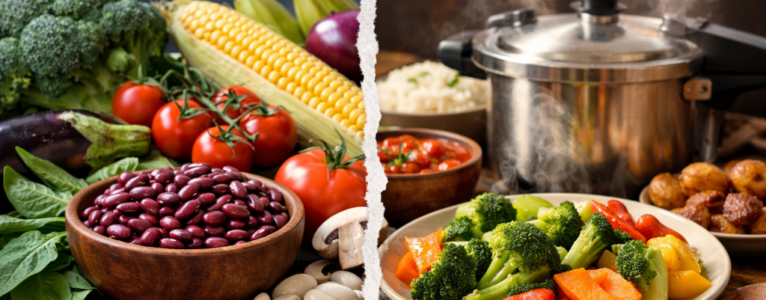
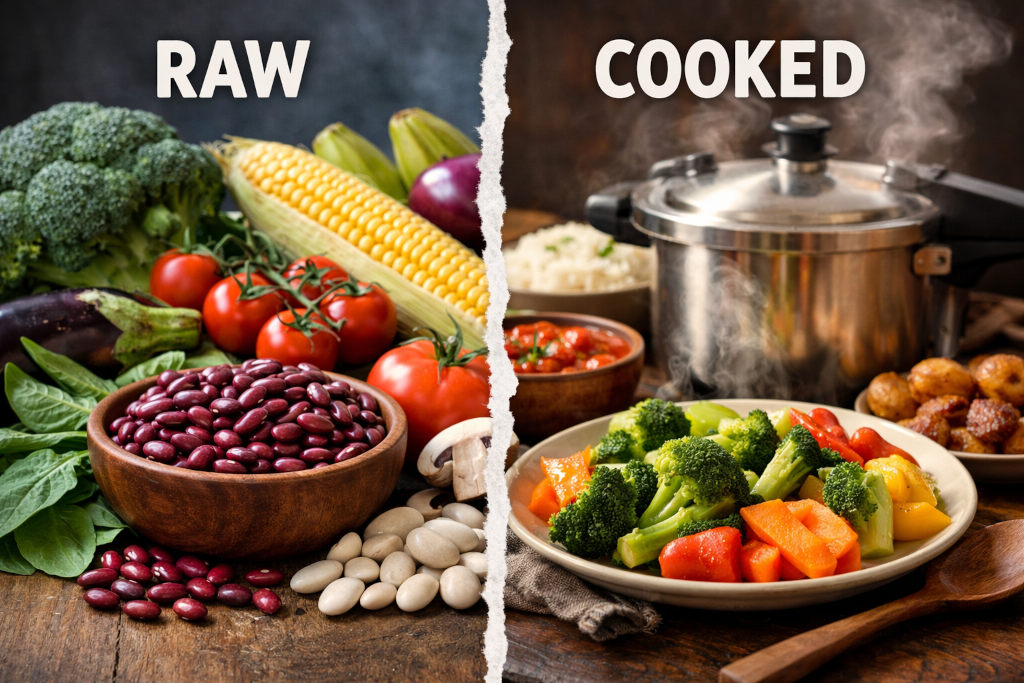
For decades, raw food has carried an almost untouchable reputation. Raw means natural. Raw means pure. Raw means healthy. From grocery store marketing to social media wellness culture, uncooked foods are often framed as the gold standard, while cooking is portrayed as something that strips nutrition away or damages what nature intended.
Yet human digestion does not operate on slogans. It operates on chemistry, biology, and context. And when lectins enter the conversation, the assumption that raw is always better begins to fall apart.
This does not mean raw foods are bad or that cooking is always superior. It means that the relationship between food and the human body is more nuanced than raw-versus-cooked narratives allow. In some cases, cooking does not reduce nutritional value at all. In other cases, it actively makes food safer, more digestible, and less inflammatory.
For people exploring lectins and their role in digestion, inflammation, and immune activation, understanding when raw foods are riskier than cooked ones is essential. Not because fear should drive food choices, but because clarity should.
Why Humans Cooked Food in the First Place
Cooking is not a modern invention. It is a defining feature of human evolution. Long before agriculture, humans used fire to soften roots, break down fibrous plants, and neutralize naturally occurring toxins. This allowed access to calories and nutrients that would otherwise have passed through the digestive tract largely untouched.
From an evolutionary perspective, cooking was not a downgrade. It was an upgrade.
Many plant foods evolved defense mechanisms to discourage animals from eating them. Lectins are one of those defenses. They bind to carbohydrates, interfere with digestion, and in some cases disrupt the gut lining or immune signaling. Cooking does not destroy all lectins, but it often weakens them enough for the body to manage safely.
Raw food trends tend to ignore this context. They assume that because a food is edible in its natural state, it is optimal in that state. Human digestion, however, is not the same as that of herbivores or insects. We do not ferment raw plant matter in multiple stomach chambers. We rely on preparation to bridge the gap between plant defense and human digestion.
Lectins Are Not Evenly Distributed
One of the biggest misunderstandings about lectins is the assumption that they are uniformly present across all plant foods and equally harmful in all forms. In reality, lectin content varies dramatically depending on the plant, the part of the plant, and how it is prepared.
Seeds, grains, legumes, and nightshades tend to contain higher concentrations. These are the parts of plants most crucial to reproduction, so it makes sense they would be heavily protected. Leafy greens, roots, and fruits generally contain lower levels, though not zero. Even within these categories, preparation matters. The same vegetable can behave very differently raw versus cooked.
This variability is why blanket dietary rules often fail. A raw carrot and raw kidney beans are not remotely comparable from a lectin perspective, yet they are often discussed as if “raw” were a single category.
Raw Legumes: A Clear Risk
If there is one area where raw food ideology collapses entirely, it is legumes.
Raw or undercooked beans are not just difficult to digest. They can be dangerous. Certain lectins found in beans are biologically active enough to cause acute gastrointestinal distress when consumed without proper cooking. Symptoms can include nausea, vomiting, cramping, and diarrhea, even in otherwise healthy individuals.
This is not speculation or fringe theory. It is well-documented food science. Cooking, especially pressure cooking, dramatically reduces lectin activity in legumes. Soaking helps. Sprouting helps somewhat. But thorough cooking is what makes beans edible for humans in the first place.
Eating raw legumes is not a return to ancestral wisdom. It is a misunderstanding of it.
Raw Nightshades and Digestive Stress
Nightshades such as tomatoes, peppers, eggplants, and potatoes often generate mixed reactions. Many people tolerate them well, while others notice joint discomfort, digestive issues, or skin reactions. Raw nightshades tend to be more problematic for sensitive individuals because cooking alters their protein structure and reduces lectin activity. Heat also softens fibers that can irritate an already compromised gut lining.
This does not mean everyone must avoid raw tomatoes or peppers. It does mean that if symptoms appear, switching to cooked versions is often a simpler and more effective solution than complete elimination.
In this way, cooking becomes a tool, not a restriction.
Raw Grains and the Illusion of “Whole”
Whole grains are often praised for being less processed, but raw or minimally cooked grains retain lectins and other anti-nutrients that interfere with mineral absorption and digestion. Traditional cultures rarely consumed grains raw. They soaked, fermented, sprouted, and cooked them extensively. These methods were not accidental. They were survival strategies refined over generations.
Modern raw grain products often skip these steps, relying instead on the assumption that “whole” equals safe. For some people, it does. For others, especially those with autoimmune conditions or chronic digestive symptoms, raw or lightly cooked grains can quietly contribute to inflammation.
Cooking is not what made grains problematic. Industrial shortcuts did.
Vegetables: Where Raw Can Be Misleading
Vegetables are where the raw-versus-cooked debate becomes most confusing. Many vegetables contain valuable nutrients that are sensitive to heat, while others become more bioavailable after cooking. Cruciferous vegetables like broccoli and cauliflower contain compounds that can be hard on digestion when eaten raw in large quantities. Cooking reduces this burden without eliminating nutritional value.
Spinach contains oxalates that bind minerals. Cooking reduces oxalate content significantly. Raw spinach smoothies may look virtuous, but they are not always gentle on the body.
Even lettuce and leafy greens can be problematic for people with compromised digestion. Cooking or lightly wilting them can make a surprising difference. This is not an argument against raw vegetables. It is an argument against assuming raw is universally superior.
The Myth of Nutrient Destruction
One of the strongest arguments for raw food diets is the idea that cooking destroys nutrients. While heat can degrade certain vitamins, it can also increase the availability of others. Cooking breaks down cell walls, allowing nutrients to be absorbed more easily. Fat-soluble compounds often become more bioavailable after heat exposure. In many cases, the net nutritional gain outweighs the losses.
What matters is not the nutrient content on paper, but what your body can actually use.
If a raw food passes through undigested or triggers inflammation that interferes with absorption, its theoretical nutritional superiority becomes irrelevant.
The Gut Barrier and Immune Signaling
Lectins matter because of how they interact with the gut lining and immune system. In susceptible individuals, they can contribute to increased intestinal permeability, sometimes referred to as “leaky gut.” When the gut barrier is compromised, proteins that should remain in the digestive tract can enter circulation, triggering immune responses. Cooking reduces the likelihood of this by denaturing lectins and making food easier to break down.
This is why some people feel dramatically better when they switch from raw-heavy diets to cooked, even if the ingredients remain largely the same. The difference is not psychological. It is physiological.
Modern Food Distribution Changes the Equation
Another factor often overlooked is how modern food distribution alters lectin exposure. Foods are bred for yield, shelf life, and appearance, not digestibility. They are harvested early, stored long-term, and transported globally.
A raw vegetable today is not the same as a raw vegetable a few generations ago. Its lectin profile, ripeness, and fiber structure may differ significantly. Cooking helps offset these changes by restoring a degree of digestibility that modern systems have quietly removed.
Individual Tolerance Matters More Than Ideology
Some people thrive on raw foods. Others struggle profoundly. Neither experience invalidates the other. What matters is recognizing that human bodies are not identical. Genetics, gut health, immune history, stress levels, sleep quality, and prior antibiotic exposure all influence how someone responds to lectins.
Cooking is not a failure of discipline. It is a form of adaptation. For those navigating lectin sensitivity, the question is not whether raw foods are good or bad, but whether they are appropriate right now.
Cooking as a Skill, Not a Compromise
Low-lectin living reframes cooking as a protective skill rather than a nutritional loss. Pressure cooking, slow cooking, roasting, and steaming are not about stripping food of life. They are about making it compatible with human physiology. This perspective shifts the emotional tone of dietary change. Instead of mourning raw foods, people learn to work with their bodies rather than against them.
The goal is not purity. The goal is function.
Listening to the Body Without Fear
One of the most damaging aspects of food ideology is the tendency to override bodily signals in favor of rules. If raw food causes bloating, fatigue, joint pain, or brain fog, those signals deserve attention, not dismissal. Cooking does not mean giving up on health. In many cases, it is how health becomes sustainable.
The human body is remarkably resilient, but it is also honest. When raw foods are riskier than cooked ones, it will usually tell you. Learning to listen without judgment is one of the most valuable skills in any dietary approach.
A More Grounded Way Forward
Raw foods are not villains. Cooked foods are not cheats. They are tools. Understanding when raw foods are riskier than cooked ones allows for flexibility, personalization, and long-term success. It replaces dogma with discernment and fear with function.
Low-lectin living is not about rejecting nature. It is about understanding it deeply enough to work with it. Sometimes, the most nourishing choice is not the one that looks the purest, but the one your body can actually use.