

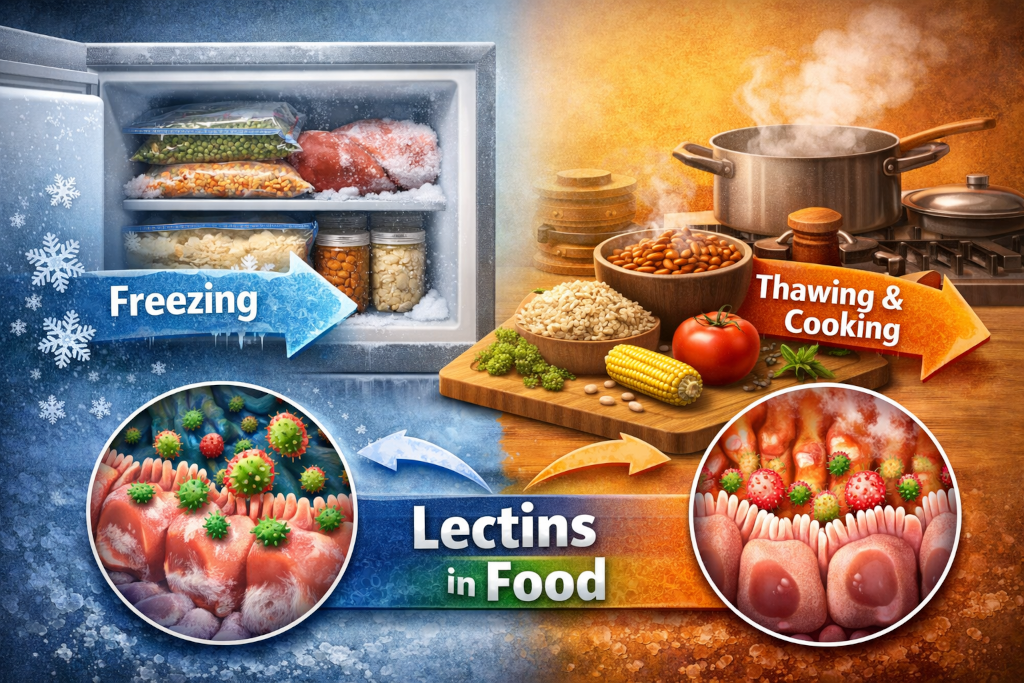
Freezing is one of the most common food preservation methods in the modern world. It is quiet, convenient, and largely invisible once food is tucked away behind a freezer door. For people navigating a low-lectin lifestyle, however, freezing raises an important and often misunderstood question: does freezing food change lectins in any meaningful way?
The short answer is that freezing does affect food, but not always in the ways people expect. The longer answer is more nuanced and far more useful. To understand what freezing can and cannot do to lectins, it helps to look at what lectins are, how they behave inside food, and how freezing interacts with biological structures at a molecular level.
This is not about chasing another food hack or miracle solution. It is about understanding how everyday kitchen practices quietly shape digestion, tolerance, and long-term health.
Lectins Are Proteins With a Job
Lectins are proteins produced by plants as part of their survival strategy. Their role is not nutritional. They exist to bind to carbohydrates on the surfaces of cells, particularly in animals that might eat the plant. This binding ability can interfere with digestion, disrupt gut lining cells, or trigger immune responses in susceptible individuals.
Not all lectins behave the same way. Some are fragile and easily destroyed by heat. Others are stubborn and remain active unless exposed to very specific conditions. Their stability depends on their structure, the food matrix they are embedded in, and how the food is processed before it reaches your plate.
This matters because freezing does not work the same way as cooking, fermenting, or pressure cooking. It does not denature proteins through heat. Instead, it changes water.
What Freezing Actually Does to Food
When food freezes, the water inside it forms ice crystals. Those crystals expand, puncture cell walls, and alter the physical structure of plant and animal tissues. Anyone who has thawed a frozen strawberry knows this effect well. Fresh strawberries are firm and intact. Thawed ones are soft, watery, and structurally broken down.
This physical disruption can influence how nutrients and proteins behave, but it does not automatically deactivate them. Freezing slows chemical reactions. It does not fundamentally change protein structures in the same way heat does.
Lectins are proteins, and most proteins remain chemically intact at freezing temperatures. The freezer is excellent at pausing biological activity. It is not designed to dismantle it.
Does Freezing Destroy Lectins?
In most cases, freezing alone does not destroy lectins. This is an important distinction because freezing is often lumped into the same mental category as cooking. They are both forms of food processing, but they work through entirely different mechanisms.
Heat causes proteins to unfold and lose their functional shape, a process called denaturation. When lectins denature, they can no longer bind to carbohydrates effectively, which reduces or eliminates their biological activity.
Freezing does not reliably cause this unfolding. Most lectins tolerate freezing temperatures quite well. When the food is thawed, the lectins are still there and often still active. That said, freezing can influence lectins indirectly, and this is where the topic becomes more interesting.
Structural Damage Can Change How Lectins Interact With the Body
Although freezing does not reliably deactivate lectins, it does disrupt plant cell walls. This can affect how lectins are released during digestion and how they interact with the gut.
In some foods, lectins are bound within intact plant cells. When those cells are damaged through freezing and thawing, digestive enzymes may gain easier access to certain components. Depending on the food and the individual, this can either increase or decrease perceived sensitivity.
For example, some people notice that frozen-then-cooked vegetables feel easier to digest than fresh-cooked versions. This is not because the freezing destroyed lectins, but because the overall structure of the food has changed. Fiber is softer. Cells are broken. Digestion requires less mechanical effort.
This is not universal. For others, the same process may increase symptoms, particularly if the lectins remain active and are released more efficiently.
Freezing Versus Freezing Plus Cooking
Where freezing becomes more relevant in a low-lectin context is when it is combined with other preparation methods. Freezing followed by high-heat cooking, pressure cooking, or fermentation can produce different outcomes than cooking alone. The structural damage caused by freezing can allow heat or microbial activity to penetrate food more thoroughly.
Legumes are a useful example. Beans contain some of the most studied dietary lectins. Proper cooking is essential to reduce their activity. Freezing cooked beans does not re-activate lectins, because once a protein is denatured by sufficient heat, freezing cannot reverse that process.
Freezing raw or undercooked beans, however, does not make them safer. Thawing and cooking them improperly later does not change the fundamental risk. In this way, freezing is neutral. It preserves the state of the food at the moment it enters the freezer. It does not improve unsafe food, nor does it undo proper preparation.
What About Freeze-Thaw Cycles?
Repeated freezing and thawing can further damage cell structures and degrade overall food quality. This is one reason refreezing is discouraged from a texture and flavor standpoint. From a lectin perspective, repeated freeze-thaw cycles may slightly alter how lectins are distributed within the food, but there is no strong evidence that this meaningfully reduces lectin activity on its own.
What repeated cycles can do is increase water loss, oxidation, and nutrient degradation. These changes can influence digestion indirectly by affecting how the gut responds to the food as a whole. For individuals already dealing with digestive sensitivity or inflammation, degraded food quality can matter even if lectin content remains unchanged.
Frozen Foods Versus Fresh Foods
Frozen foods are often assumed to be nutritionally inferior, but this is not always true. Many frozen vegetables are processed at peak ripeness and frozen quickly, preserving vitamins and minerals effectively. From a lectin standpoint, frozen vegetables are not inherently higher or lower risk than fresh ones. The determining factors are the type of food, how it is prepared, and how your body responds.
Frozen spinach, for example, still contains lectins, but its overall lectin load is relatively low compared to legumes or grains. Cooking method matters more than whether the spinach was frozen. Frozen berries retain their lectins, but freezing makes their skins softer, which can improve tolerance for some people with sensitive digestion. Again, freezing changes structure, not protein identity.
The Gut Perspective Matters More Than the Freezer
Lectins do not exist in isolation. Their effects depend heavily on gut integrity, microbiome composition, immune sensitivity, and overall diet context.
Someone with a resilient gut lining and diverse microbiome may tolerate lectins far better than someone dealing with leaky gut, autoimmune conditions, or chronic inflammation. For the latter group, even small changes in food structure can influence symptoms.
Freezing can make foods easier to chew, softer to digest, and faster to break down. For some people, this reduces mechanical stress on the gut. For others, it increases exposure to active lectins that were previously trapped within intact cells. This is why blanket statements about freezing and lectins are rarely helpful. Individual response matters.
Freezing as a Tool, Not a Solution
Freezing should be viewed as a storage tool, not a lectin-reduction technique. If a food requires pressure cooking, fermentation, peeling, or soaking to reduce lectins, freezing does not replace those steps. It can support them by preserving properly prepared food and making meal planning easier.
For people following a low-lectin lifestyle, freezing can be extremely useful. It allows batch cooking, reduces reliance on processed foods, and makes consistent eating habits more achievable. Those benefits often outweigh the minor and variable effects freezing may have on lectin exposure.
The key is freezing foods after they have been prepared in a lectin-aware way.
Practical Takeaways Without Overcomplication
Freezing does not neutralize lectins on its own. It does not make high-lectin foods safe if they were not prepared properly to begin with. It does not undo the benefits of proper cooking either. What it does do is preserve food in its current state and subtly alter texture and structure. Those changes can influence digestion, sometimes positively, sometimes negatively, depending on the person.
In the broader picture, freezing is neither friend nor foe. It is a neutral tool that becomes helpful or unhelpful based on how it is used.
Understanding this removes unnecessary fear and replaces it with informed choice. You do not need to avoid frozen foods out of concern for lectins. You also do not need to rely on freezing as a workaround for foods your body does not tolerate.
The Bigger Lesson Behind the Freezer Door
The question of freezing and lectins highlights a larger truth about dietary health. No single technique exists in isolation. Cooking methods, storage practices, gut health, and individual biology all interact. Lectins are part of a complex system, not a switch that flips on or off with one action. Learning how they behave across real-world food practices empowers people to make calmer, more sustainable decisions.
Freezing is one small piece of that system. Used wisely, it supports consistency and reduces stress. Misunderstood, it becomes another source of confusion. The goal of a low-lectin lifestyle is not perfection. It is awareness, adaptability, and long-term health grounded in understanding rather than fear. And sometimes, that understanding starts with something as ordinary as what happens to food when the freezer door closes.