

When people begin paying attention to lectins, cooking quickly becomes part of the conversation. It is not just what you eat, but how you prepare it. Two foods with identical ingredients can affect the body very differently depending on whether they were boiled, baked, roasted, pressure cooked, or fermented. Among these methods, baking and roasting often get lumped together. They both use dry heat. They both happen in an oven. They both brown food and intensify flavor. Because of this, it is easy to assume they have similar effects on lectins.
They do not.
Baking and roasting may look alike on the surface, but at a molecular level they expose food to heat in very different ways. Those differences matter when we are talking about lectins, which are not destroyed simply by “getting hot.” Lectins are proteins, and proteins respond to temperature, moisture, time, and structure in ways that are subtle but important.
Understanding why baking reduces lectins differently than roasting requires stepping back from recipes and into how heat actually moves through food, how proteins unfold, and how the body ultimately interacts with what is left behind.
Lectins Are Not Fragile, but They Are Not Invincible
Lectins evolved as part of plant defense systems. Their role is not to nourish the animal eating the plant, but to discourage it. They do this by binding to carbohydrates on cell surfaces, interfering with digestion, nutrient absorption, and in some cases immune signaling. This binding ability is what makes lectins resilient. They are designed to survive harsh environments, including the digestive tract.
However, resilience does not mean indestructible. Like all proteins, lectins have a three-dimensional structure that allows them to function. When that structure is altered enough, their binding ability weakens or disappears. Heat can cause this alteration, but heat alone is not the whole story. Moisture, pressure, and duration determine whether heat merely warms a lectin or actually denatures it.
This is where baking and roasting part ways.
Dry Heat Is Not a Single Thing
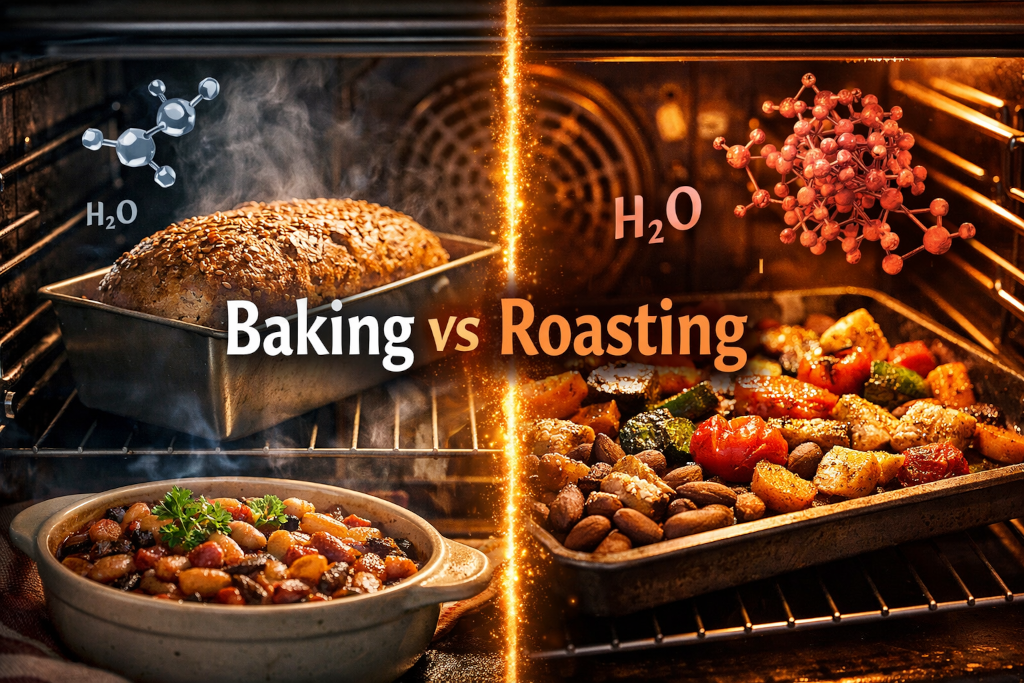
Both baking and roasting are considered dry-heat cooking methods, but “dry” does not mean identical. Baking generally uses lower, more stable temperatures and often involves foods with higher internal moisture. Roasting typically uses higher temperatures, more direct exposure, and intentionally drives moisture out of food to create browning and crispness.
From a lectin perspective, this difference is critical.
Lectins are more likely to denature when heat penetrates evenly and is accompanied by sufficient moisture. Water acts as a conductor, allowing heat to move through the food matrix and reach proteins that would otherwise remain insulated. Without moisture, heat tends to concentrate on the surface, leaving the interior less affected even when the exterior appears well cooked.
Baking, especially in foods like bread, casseroles, or baked legumes, often maintains internal steam. Roasting, particularly with vegetables spread on a pan or nuts exposed directly to hot air, prioritizes dehydration and surface reactions over internal heat saturation.
Baking Encourages Internal Heat Penetration
In baking, food is usually enclosed in a structure. Doughs, batters, covered dishes, and dense ingredients trap moisture as they heat. Steam builds inside the food rather than escaping immediately. This creates a more uniform temperature gradient, allowing heat to reach deeper layers over time.
From a lectin standpoint, this slow, penetrating heat is more effective at disrupting protein structure. The lectins inside the food are exposed not just to high temperature, but to sustained heat in a hydrated environment. This combination increases the likelihood of partial denaturation.
This does not mean baking eliminates lectins completely. It means that baking often reduces their biological activity more consistently throughout the food rather than concentrating effects only at the surface.
This is why baked goods made from lectin-containing ingredients often feel more tolerable to some people than lightly roasted versions of the same foods. The difference is not psychological. It is structural.
Roasting Prioritizes Surface Chemistry
Roasting is designed to create flavor. High heat, dry air, and exposed surfaces encourage caramelization and Maillard reactions. These reactions produce complex flavors and appealing textures, but they also pull moisture away from the food.
As moisture escapes, the interior of the food becomes insulated. Heat energy goes into browning rather than penetrating. Proteins on the surface may denature or even degrade, but lectins deeper inside the food can remain relatively intact, especially if roasting time is short or the food is dense.
This leads to an uneven lectin profile. The outside may be significantly altered, while the inside retains much of its original protein structure. For people sensitive to lectins, this unevenness can matter. The body does not interact only with the browned exterior. It digests the entire food.
This is one reason roasted nuts, seeds, and legumes are often reported as more problematic than baked or pressure-cooked versions, even though they appear more intensely cooked.
Time Matters More Than Temperature
One of the biggest misconceptions about lectins is that higher heat automatically means fewer lectins. In reality, time at temperature is often more important than peak temperature.
Baking typically exposes food to moderate heat for longer periods. Roasting often uses higher heat for shorter durations. Lectin denaturation is not an instantaneous event. Proteins need time to unfold, lose their binding sites, and settle into a less active form.
A short blast of high heat may brown a surface beautifully while leaving lectins functionally unchanged deeper inside. A longer bake at a slightly lower temperature may quietly do more work on the proteins that matter.
This is counterintuitive in modern cooking culture, which tends to equate intensity with effectiveness. Lectins do not follow that logic.
Moisture Changes How Lectins Behave
Water does more than conduct heat. It changes how proteins fold and unfold. In hydrated environments, proteins are more flexible and more susceptible to structural change. In dry environments, proteins can become rigid and resistant, even when exposed to heat.
Baking preserves more internal moisture than roasting. Even when the final product appears dry, the cooking process itself often involves steam and water retention early on. This gives lectins more opportunity to lose their functional shape.
Roasting strips moisture early and aggressively. Once dehydrated, proteins can become heat-stable in ways that make them harder to fully denature without extreme conditions.
This helps explain why some roasted foods feel “harder” on digestion, even when thoroughly cooked.
The Food Matrix Matters
Lectins do not exist in isolation. They are embedded within complex food structures composed of fiber, starch, fat, and other proteins. Baking tends to transform this matrix more completely. Starches gelatinize, fibers soften, and proteins interact with one another.
These changes can physically limit lectins’ ability to bind to intestinal surfaces, even if some of their structure remains intact. Roasting often preserves the rigidity of the matrix, particularly in foods like nuts and seeds, allowing lectins to remain accessible during digestion.
In other words, baking does not just affect lectins directly. It changes the environment they live in.
Why This Matters for a Low-Lectin Lifestyle
Understanding the difference between baking and roasting is not about fear or elimination. It is about choice and awareness. Living low-lectin is not about achieving perfection. It is about reducing unnecessary biological friction where possible.
For some people, roasting may be perfectly tolerable. For others, baked versions of the same foods may feel gentler and more forgiving. The difference is not imaginary. It reflects how cooking methods interact with protein chemistry and digestion.
This knowledge empowers experimentation. It explains why two people can eat the same ingredient prepared differently and have completely different experiences. It also reinforces the idea that lectins are not a binary problem. They exist on a spectrum shaped by preparation, context, and individual biology.
Cooking as a Biological Interface
Cooking is often framed as a cultural or culinary act, but it is also a biological interface between plants and humans. Baking and roasting represent two different negotiations with plant chemistry. One favors penetration and transformation. The other favors intensity and surface change.
Neither is inherently right or wrong. But they are not interchangeable.
When we understand why baking reduces lectins differently than roasting, we move away from rigid rules and toward informed decisions. That shift is at the heart of living low-lectin. It is not about eliminating foods. It is about learning how to work with them.
Over time, these small distinctions add up. They shape how food feels in the body, how digestion unfolds, and how sustainable a way of eating becomes. And in that sense, understanding heat may be just as important as understanding ingredients.