

One of the most persistent myths in nutrition is the idea that food safety, digestibility, and tolerance are mostly a function of how long something is cooked. Recipes reinforce it. Advice columns repeat it. Even many health discussions frame cooking as a simple clock problem: cook it long enough and the troublesome parts disappear.
But when it comes to lectins, this framing quietly misleads people.
Cooking time matters, but it is rarely the decisive factor. What matters far more, and far more consistently, is whether a food crosses specific temperature thresholds that change its molecular structure. This distinction explains why some people can simmer a food for hours and still react to it, while others tolerate the same ingredient after a much shorter but hotter cooking method. It also explains why traditional food cultures developed certain techniques long before modern nutrition science could explain why they worked.
Understanding temperature thresholds reframes cooking from a mechanical routine into a biological interaction between heat, proteins, and the human digestive system.
Lectins Are Proteins, Not Toxins on a Timer
Lectins are carbohydrate-binding proteins produced by plants as part of their survival strategy. They are not poisons in the dramatic sense, and they are not uniformly harmful. Some are benign. Some are beneficial in certain contexts. Others are resistant to digestion and capable of interacting with the gut lining, immune system, or microbiome in ways that can create inflammation or discomfort in susceptible individuals.
The critical point is that lectins are proteins, and proteins do not behave like bacteria that simply die after a certain amount of time under heat. Proteins exist in folded, three-dimensional shapes. Their biological activity depends on that shape. Change the shape enough, and the protein loses its function. Fail to change it sufficiently, and it remains active no matter how long it was exposed to mild heat.
This is why the question is not “How long was it cooked?” but rather “Did it get hot enough, in the right way, to denature the lectin?”
Denaturation Is a Threshold Event, Not a Gradual Fade
Protein denaturation sounds complicated, but the concept is simple. Heat causes proteins to unfold. When they unfold past a certain point, they can no longer bind to other molecules the way they once did. For lectins, this often means losing their ability to bind to carbohydrates on intestinal cells.
What is crucial here is that denaturation does not happen smoothly over time like sand wearing down a rock. It happens more like ice melting. Below a certain temperature, the structure remains largely intact. Once a threshold is crossed, the structure rapidly collapses.
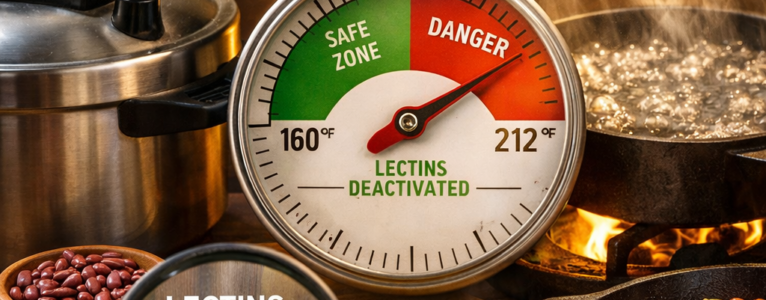
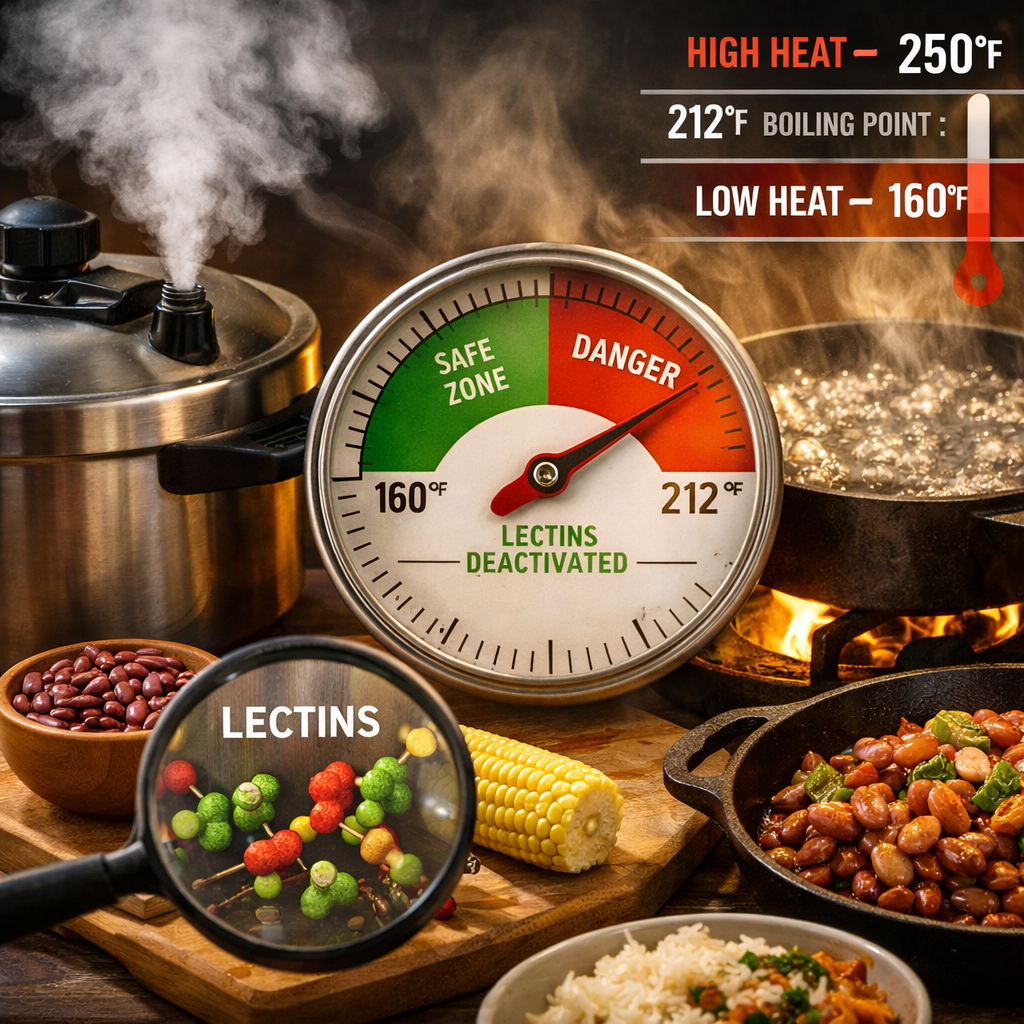
This is why low-heat, long-duration cooking can fail where high-heat, shorter cooking succeeds. A slow simmer may keep a food safely below the temperature needed to meaningfully denature a lectin, even after hours. Meanwhile, pressure cooking or high-temperature boiling can cross that threshold quickly and decisively.
Cooking time without sufficient temperature is often just prolonged exposure to ineffective heat.
Why Some Traditional Methods Work So Well
Long before lectins were named or studied, traditional cultures figured out which foods caused problems and how to make them tolerable. These methods were not arbitrary. They consistently involved techniques that reliably exceeded key temperature thresholds, often in combination with soaking, fermenting, or sprouting.
Pressure cooking is a perfect example. By increasing pressure, water is allowed to exceed its normal boiling point. This pushes cooking temperatures well beyond what open-pot boiling can achieve. For many lectin-rich foods, especially legumes, this difference is not subtle. It is transformative.
The same logic explains why some cultures roasted or baked certain foods rather than gently simmering them, and why others combined cooking with acidic or enzymatic pre-treatments that weakened protein structures before heat was applied.
The lesson is not that traditional cultures were perfect, but that their survival depended on methods that worked consistently. Temperature thresholds mattered whether they knew the word “lectin” or not.
The Illusion of “Thoroughly Cooked”
One of the most frustrating experiences for people exploring a low-lectin approach is doing everything “right” according to common advice and still feeling symptoms. The food was cooked. It was cooked for a long time. It was cooked according to the recipe. And yet, the reaction happens anyway.
This often leads to confusion or self-doubt. People assume the problem must be psychological, unrelated, or unsolvable.
In reality, the issue is often that the food never crossed the temperature threshold required to meaningfully alter the lectins involved. From the outside, the dish looks done. From a protein chemistry standpoint, it may still be biologically active.
This disconnect between culinary appearance and molecular reality is one reason lectins remain so controversial. Two people can prepare the “same” food and have entirely different physiological outcomes depending on the heat profile of the cooking process.
Temperature Shapes Digestibility Beyond Lectins
While lectins are a focal point, they are not the only reason temperature matters. Heat affects starch structure, fiber solubility, enzyme inhibitors, and even how fats interact with the digestive system. Many of the improvements people notice when switching cooking methods are not due to a single compound being eliminated, but to a cascade of structural changes that occur once certain heat thresholds are crossed.
Starches gelatinize at specific temperatures, making them easier to digest. Enzyme inhibitors lose activity when denatured. Fibers soften in ways that alter fermentation patterns in the gut. These changes can collectively reduce digestive stress, even if no single factor explains the entire improvement.
This reinforces a core idea of living low-lectin: the body responds to patterns, not isolated variables. Temperature thresholds act as gatekeepers that determine which biological interactions are possible downstream.
Why Individual Sensitivity Still Matters
Even when foods are cooked in ways that exceed key temperature thresholds, not everyone responds the same way. Genetics, gut integrity, microbiome composition, immune regulation, and overall metabolic health all influence how the body reacts.
This does not undermine the importance of temperature. It explains why temperature is necessary but not always sufficient. A person with a compromised gut barrier may react to lectin fragments that another person tolerates easily. Someone with robust digestive resilience may handle a broader range of preparation methods without issue.
The goal is not perfection. It is risk reduction. Crossing temperature thresholds reduces the biological activity of problematic compounds, lowering the burden placed on the digestive and immune systems. For many people, that reduction is enough to shift symptoms from disruptive to manageable, or from noticeable to absent.
Cooking Time Still Has a Role, Just Not the Leading One
None of this means cooking time is irrelevant. Time matters in how evenly heat is distributed, how fully internal temperatures are reached, and how thoroughly structural changes propagate through a food. Time supports temperature. It does not replace it.
A pressure cooker still needs time to allow heat to penetrate. A roasted vegetable still needs time to soften. But without sufficient temperature, additional time often yields diminishing returns.
This distinction helps explain why people can obsess over exact cooking durations without seeing results, while a simple change in method produces immediate improvement.
Reframing Cooking as a Biological Tool
When cooking is viewed purely as flavor development or food safety, important dimensions are missed. Cooking is also a form of biological negotiation. Heat is a signal that tells proteins whether they remain active participants in digestion or become inert passengers.
Once you see cooking this way, choices become more intentional. It becomes less about following rigid rules and more about understanding what your body needs and how different methods influence the outcome.
This perspective also removes much of the anxiety around perfection. You are not trying to eliminate every lectin from your life. You are learning how to reduce unnecessary biological stressors while preserving nourishment, enjoyment, and sustainability.
Why This Matters for Long-Term Health
Chronic low-grade inflammation rarely comes from a single dramatic cause. It builds quietly from repeated, manageable stressors that never quite resolve. Lectins, when problematic, tend to operate in this subtle range. They are not catastrophic, but they are persistent.
Reducing their activity through proper temperature exposure is one way to lower the background noise the body is constantly processing. Over time, this can influence energy levels, digestive comfort, immune balance, and even sleep quality.
Importantly, this approach respects the reality that modern diets are global, complex, and deeply cultural. It does not demand elimination of entire food groups or adherence to extreme restrictions. It asks for awareness, experimentation, and a willingness to adjust techniques rather than identities.
Living Low-Lectin Is About Understanding, Not Fear
At its core, the low-lectin approach is not about demonizing foods or chasing purity. It is about understanding how the modern food chain intersects with human biology, and how small, practical changes can produce meaningful improvements.
Temperature thresholds matter because they sit at the intersection of science and daily life. They are measurable, repeatable, and actionable. They turn vague advice into something tangible.
When people stop asking how long something cooked and start asking whether it got hot enough in the right way, the conversation shifts. Confusion gives way to clarity. Frustration gives way to agency.
And cooking becomes what it has always been at its best: a bridge between nature, culture, and health rather than a battleground of rules.