


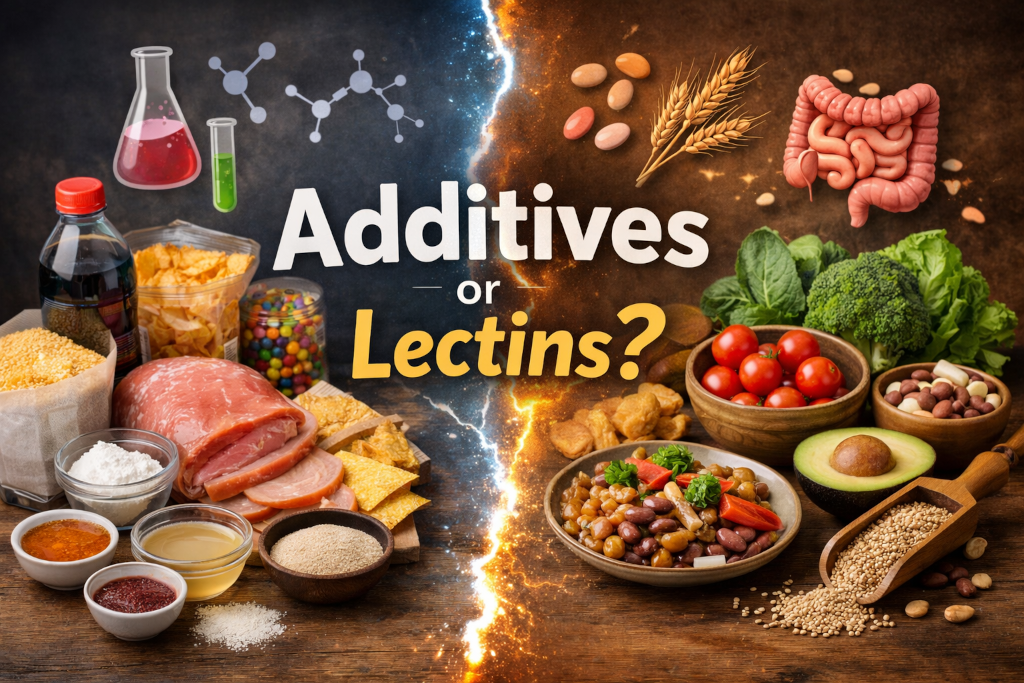
One of the most confusing moments for people exploring a low-lectin lifestyle comes when they do “everything right” and still feel wrong. The ingredients check out. The food is technically low-lectin. Preparation methods were careful. And yet the familiar symptoms return. Bloating. Joint stiffness. Brain fog. Fatigue. Sometimes even skin or sinus reactions.
When this happens, the immediate assumption is often that lectins are hiding somewhere, or that the body has suddenly become more sensitive. But in many cases, the reaction is not being driven by lectins at all. It is being driven by additives that behave in similar ways inside the body.
Understanding how food additives can mimic lectin reactions is one of the most important steps toward avoiding unnecessary restriction, frustration, and confusion. Lectins are not the only compounds capable of irritating the gut, triggering immune responses, or interfering with digestion.
Modern food manufacturing introduces a wide range of substances that interact with the gut lining, immune system, and nervous system in ways that overlap with lectin effects. This overlap is why so many people feel like they are “reacting to everything” before they learn to separate the signal from the noise.
Why Lectin Reactions Feel So Broad
Lectins affect the body primarily through interaction with the gut lining. They can bind to carbohydrates on intestinal cells, interfere with nutrient absorption, increase gut permeability in susceptible individuals, and activate immune responses. These effects do not stay confined to the digestive tract. Once immune signaling and inflammation increase, symptoms can appear in joints, skin, energy levels, and cognition.
The key point is that lectin reactions are systemic, not just digestive. That makes them easy to confuse with other triggers that also create widespread effects. Additives often operate through similar pathways, even though their chemistry is very different.
Many people come into low-lectin eating after years of eating ultra-processed or convenience foods. Their baseline gut environment may already be inflamed, stressed, or dysregulated. When they remove high-lectin foods but continue consuming additives that irritate the same systems, the body does not get the clear signal it needs to stabilize.
This leads to a false conclusion that lectins are everywhere and unavoidable, when in reality the reaction is being driven by something else riding along with the food.
Additives Are Not Neutral Passengers
Food additives are often described as inert, supportive, or purely functional. They stabilize texture, extend shelf life, enhance flavor, or improve appearance. From a manufacturing standpoint, they work exactly as intended. From a biological standpoint, however, “approved for use” does not mean “invisible to the body.”
The gut is not a passive tube. It is a highly sensitive interface between the outside world and the immune system. Anything that repeatedly contacts the gut lining has the potential to influence how that system behaves.
Some additives interact directly with gut mucus layers. Others alter microbial populations. Some affect tight junctions between intestinal cells. Others stimulate immune signaling or alter neurotransmitter activity. None of these mechanisms are exclusive to lectins.
What makes additives particularly tricky is that they are often consumed in small amounts, spread across many foods, every single day. The body may tolerate them briefly but struggle under constant exposure.
Texture Modifiers and Gut Irritation
One of the most common classes of additives that mimic lectin reactions are texture modifiers. These include emulsifiers, thickeners, and stabilizers. Their job is to make foods creamy, smooth, or shelf-stable. In the gut, however, they can interfere with the protective mucus layer that lines the intestines.
The mucus layer exists to separate gut bacteria from direct contact with intestinal cells. When this barrier is compromised, bacteria can move closer to the gut wall, increasing immune activation. This process looks remarkably similar to what happens in lectin sensitivity.
People experiencing this often report bloating, gas, abdominal discomfort, and changes in stool consistency. Over time, fatigue and systemic symptoms can develop as immune signaling increases.
What makes this confusing is that these reactions can occur even when the base ingredients are low-lectin. A low-lectin soup thickened with certain additives may provoke symptoms that feel indistinguishable from a lectin reaction.
Flavor Enhancers and Neurological Symptoms
Another area of overlap appears with flavor enhancers and certain amino-acid-based additives. These compounds are designed to amplify taste signals, particularly savory flavors. While they do not directly affect lectins, they can influence neurotransmitter activity.
For some individuals, this results in headaches, brain fog, anxiety, rapid heart rate, or a sense of overstimulation. These symptoms are often mistakenly attributed to lectins because they appear shortly after eating and can feel systemic rather than digestive.
The nervous system and immune system are deeply interconnected. When one becomes overstimulated, the other often follows. A person already dealing with lectin sensitivity may find that additives push their system past its tolerance threshold. This does not mean that everyone will react, but it explains why sensitivity varies so widely and why reactions can seem inconsistent.
Preservatives and Immune Activation
Preservatives serve an obvious role in modern food distribution. They slow spoilage and prevent microbial growth. The problem is that some preservatives are biologically active in ways that extend beyond their antimicrobial function.
Repeated exposure to certain preservatives may influence immune cell behavior, oxidative stress levels, or inflammatory signaling. For individuals with existing gut irritation or immune sensitivity, this can amplify symptoms that resemble lectin responses.
Joint discomfort, sinus congestion, skin flare-ups, and general malaise are frequently reported. Because these symptoms are not immediately digestive, they are often attributed to food intolerances without clarity on the actual trigger. When preservatives are layered on top of foods that already challenge digestion, the combined effect can feel overwhelming.
Sweeteners and Metabolic Confusion
Artificial and alternative sweeteners introduce another layer of complexity. While they are often used to reduce sugar intake, they can alter gut microbiota and metabolic signaling in ways that influence inflammation and insulin response.
Changes in blood sugar regulation and gut bacteria composition can indirectly affect how the body responds to lectins. A person may tolerate a food in its whole form but react when it is paired with certain sweeteners.
The resulting symptoms may include energy crashes, cravings, bloating, and cognitive fog. Because these effects occur hours after eating, they are often misattributed to lectins or dismissed as unrelated. Understanding timing becomes critical here. Lectin reactions often have a delayed onset, but additive-driven reactions can follow similar timelines.
Why Label Reading Alone Is Not Enough
Many people assume that avoiding “processed foods” automatically eliminates additives. Unfortunately, this is not always the case. Additives appear in products marketed as healthy, natural, or compliant with specific dietary frameworks.
This is why a purely ingredient-based approach can fall short. Two foods with nearly identical ingredient lists may produce very different responses depending on processing methods and additive combinations. The body responds to patterns, not isolated ingredients. Repeated exposure to low-level irritants can create a background of inflammation that makes genuine lectin sensitivity harder to identify.
This is one reason why elimination diets sometimes fail. The offending compound was never removed, even though lectins were.
Differentiating Lectin Reactions From Additive Reactions
While there is overlap, there are subtle clues that help distinguish between the two. Lectin reactions are often dose-dependent and linked to specific food families. Additive reactions tend to be more inconsistent and can appear across unrelated foods.
Lectin sensitivity often improves with proper preparation techniques such as pressure cooking or fermentation. Additive reactions do not respond to these methods because the trigger remains unchanged.
Another difference is accumulation. Additive reactions frequently worsen over days or weeks rather than appearing immediately. People often describe feeling “off” without being able to pinpoint a specific meal.
Tracking patterns rather than single events is essential. When reactions seem random, additives are often involved.
Why This Matters for Long-Term Success
Misidentifying additive reactions as lectin reactions can lead to unnecessary restriction and dietary burnout. People may remove entire food groups that were never the problem, narrowing their diet without relief. A sustainable low-lectin lifestyle depends on precision, not fear. Understanding the role of additives allows people to make targeted changes rather than broad eliminations.
This clarity also reduces anxiety around food. When reactions are understood, they become manageable rather than mysterious.
The Bigger Picture
Lectins are part of a much larger conversation about how modern food interacts with the human body. Additives did not exist in meaningful quantities for most of human history, yet they now appear in a large percentage of what people eat daily.
This does not mean that all additives are harmful or that everyone must avoid them completely. It does mean that sensitive individuals need to account for their presence when troubleshooting symptoms.
Low-lectin eating is not just about removing specific proteins. It is about reducing unnecessary stress on the gut and immune system so the body can function as intended. When additives are mistaken for lectins, progress stalls. When they are recognized for what they are, the path forward becomes much clearer.
Moving Forward With Awareness
The goal is not perfection. It is awareness. By understanding how additives can mimic lectin reactions, people gain another tool for interpreting their body’s signals. This awareness empowers experimentation rather than restriction. It allows people to distinguish between foods that genuinely cause harm and those that were unfairly blamed.
In the end, clarity is what makes a low-lectin lifestyle sustainable. And clarity begins with knowing that lectins are not always the culprit, even when the symptoms feel familiar.