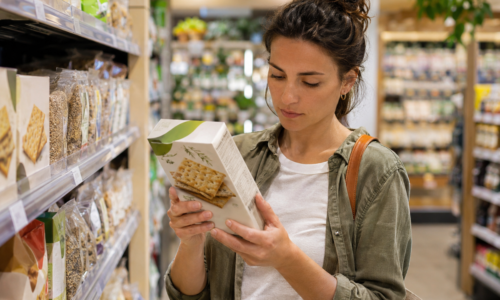

Two packages of gluten-free crackers can look nearly identical from the front. Turn them over, however, and one may begin with brown rice flour and cornmeal while the other relies on cassava flour, tapioca starch, and almond flour. The gluten-free claim applies to both, but their ingredients raise different questions for someone trying to limit particular lectin-containing foods.
The distinction matters because manufacturers replace wheat with combinations of cereal grains, legumes, pseudocereals, refined starches, and nut or seed flours. Those ingredients differ in their naturally occurring proteins and in how they behave after processing. Reading the label carefully provides a better starting point than assuming gluten-free also means low-lectin.
What the Gluten-Free Claim Covers
In the United States, the Food and Drug Administration sets conditions for foods voluntarily labeled gluten-free. Its gluten-free labeling rules generally require that unavoidable gluten be below 20 parts per million, along with restrictions on the use of wheat, barley, rye, and ingredients derived from them. The standard addresses gluten, not every protein naturally present in a plant.
Lectins are a varied family of proteins that bind to carbohydrates. They occur in many plants, including some foods that naturally contain no gluten, but their activity and potential effects differ greatly. A gluten-free certification offers assurance about gluten under that program’s criteria; it does not certify that a product is low in lectins. There is also no broadly accepted food-labeling threshold for a product marketed as low-lectin.
For people with celiac disease, avoiding gluten remains a separate medical requirement. A low-lectin preference should never be used as a substitute for checking gluten labeling and cross-contact controls, particularly with grain-based products such as oats.
Start With the Main Grain, Not the Marketing Description
Rice, corn, oats, millet, teff, and sorghum are cereal grains that may appear in gluten-free foods. Quinoa, buckwheat, and amaranth are pseudocereals, meaning they are seeds used much like grains. A package that advertises ancient grains or whole grains does not tell the shopper how much of any specific ingredient it contains, or whether its measurable lectin activity is high.
Rice flour is common in bread, pasta, and crackers because its relatively neutral flavor works in many recipes. Brown rice flour retains more of the grain’s outer components than white rice flour, which typically changes its fiber content and baking characteristics. That nutritional difference does not establish a consistent ranking of active lectins in the finished products.
A 2021 laboratory study of lectin activity in plant foods detected activity in an uncooked rice sample using a particular red-blood-cell assay, but not after the tested boiling treatment. The results provide information about that sample and method, not a prediction of symptoms from commercial rice bread. People who exclude rice under a chosen low-lectin plan can identify it readily on labels without treating properly cooked rice as a demonstrated health hazard.
Corn appears as maize flour, corn flour, cornmeal, masa harina, and corn starch. These names are worth distinguishing: cornmeal and corn flour contain more of the original grain material, whereas corn starch is produced by separating and concentrating the starch fraction. Although various proteins associated with corn have been studied, there is insufficient evidence to rank every corn-based packaged food as high in harmful active lectins. For a shopper avoiding corn, the ingredient name is useful regardless of how much lectin activity remains.
Quinoa appears in multigrain crackers, cereals, and pasta blends, sometimes in small amounts behind rice or corn. In the 2021 laboratory study, the quinoa samples showed relatively low measurable lectin activity compared with some legumes, and activity was not detected after the preparation used in the experiment. This does not make every quinoa-containing product lectin-free. Quinoa’s bitter-tasting saponins are a different class of compounds, so removing them by washing should not be confused with a verified method of eliminating lectins.
Oats, millet, teff, sorghum, buckwheat, and amaranth add further variety to gluten-free formulations. Their inclusion does not give a dependable measure of active lectins because relevant measurements across products and processing methods are sparse. Oats deserve an additional check for anyone with celiac disease: they are naturally gluten-free, yet cross-contact with wheat, barley, or rye can occur before packaging. A product bearing a compliant gluten-free claim must meet the applicable FDA requirements even when oats are among its ingredients.
Watch for Legume Flours and Protein Ingredients
The most informative change in a label may be the substitution of a legume for a cereal grain. Chickpea flour, lentil flour, pea flour, soy flour, and bean flour appear in pasta, crackers, baking mixes, and higher-protein snack products. A grain-free label can therefore describe a food made largely from legumes rather than from nuts or roots.
Some legume lectins are well studied because inadequately cooked beans can cause acute gastrointestinal illness. In its January 2026 assessment of plant lectins, the European Food Safety Authority identified a clear concern with insufficiently prepared beans, especially involving phytohaemagglutinin in certain beans. The agency also found that information was too limited for similarly detailed risk assessments of most other plant lectins. It would be inaccurate to transfer the hazard from undercooked kidney beans to every properly manufactured chickpea or lentil product.
Nevertheless, someone deliberately restricting legumes may want to look for more than the word flour. Pea protein, soy protein concentrate, chickpea protein, and similar ingredients can appear farther down the label to improve protein content or structure. A protein concentrate is not equivalent to a whole-legume flour, and the label alone cannot establish its residual active lectin content; it does establish the source ingredient. Shoppers avoiding soy for allergy reasons must follow appropriate allergen labeling and precautions independently of any lectin considerations.
Understand What Flour and Starch Tell You
Gluten-free baking commonly combines flours with purified starches to produce a texture closer to conventional bread or pasta. A flour generally retains more components of the source food, while a refined starch has had much of the protein, fat, and fiber separated out. Since lectins are proteins, that separation could reduce their presence, but it is not a measurement of what remains in a specific brand.
Tapioca starch, arrowroot starch, potato starch, corn starch, and rice starch may appear in the same product. Cassava flour is typically made from more of the processed cassava root than tapioca starch, although product naming can vary, including the use of tapioca flour as another name for tapioca starch. These distinctions matter when someone is avoiding whole-grain or legume flours, but the refined starches should not be casually described as proven lectin-free.
Starch-heavy recipes present a nutritional tradeoff worth checking on the Nutrition Facts panel. A cracker consisting mostly of refined starch may contain less protein and fiber than one made with chickpea or whole-grain flour, even when both are gluten-free. Fiber, protein, sodium, added sugars, and serving size help assess the product as food rather than as a single-ingredient restriction.
Read Ingredients in Their Listed Order
The FDA’s ingredient-labeling guidance explains that ingredients generally appear in descending order by weight. The leading ingredients therefore provide a useful picture of the recipe, although they do not disclose exact percentages. Water may appear first in bread because the list reflects ingredient weights in manufacturing, not the relative weight of dry ingredients after baking.
Consider a hypothetical loaf labeled water, brown rice flour, tapioca starch, potato starch, psyllium husk, yeast, salt. Brown rice is the main named flour, while two starches contribute much of the remaining structure. Someone avoiding rice can rule out this loaf quickly; someone primarily interested in nutritional composition should also compare its fiber and protein with other breads.
Now compare a second hypothetical loaf labeled water, cassava flour, almond flour, coconut flour, psyllium husk, olive oil, yeast, salt. It contains neither a listed cereal flour nor a legume flour, which may make it preferable within some low-lectin plans. Its baking characteristics and nutrition will differ from those of the rice-based loaf, and the ingredient list does not supply laboratory information about lectin activity.
Watch the parentheses in blended ingredients. A statement such as gluten-free flour blend (rice flour, chickpea flour, tapioca starch) reveals grains and legumes that might otherwise be missed by someone scanning for the words flour blend. A front-of-package claim such as made with quinoa may also describe a recipe in which rice flour or corn starch is much more prominent.
How Processing Changes the Question
The ingredient list identifies what went into a food but seldom reveals the full thermal history of each component. Flour may have been pretreated, extruded into pasta, baked into crackers, or combined with other ingredients before heating. Those processes affect food proteins differently, and the words baked or roasted are not reliable substitutes for direct testing of active lectins.
Moist heat is particularly relevant to the established safety hazard from certain raw or insufficiently cooked beans. EFSA’s assessment emphasizes adequate processing and cooking for these foods; it does not provide a universal cooking rule for every grain, seed, or commercial flour. Dry beans that require cooking should be prepared according to reliable instructions for that bean, rather than assuming a slow cooker or brief heating is sufficient. Properly processed commercial ready-to-eat foods should not be judged as though their ingredients were still raw beans.
Laboratory tests further complicate simplistic rankings. The 2021 study found that its detection method could change whether activity was observed, and some prepared chickpea samples still registered activity without establishing corresponding human illness. A positive laboratory result indicates a measured interaction in that assay, not a demonstrated health effect after an ordinary serving of food.
Make Ingredient Substitutions That Work in the Kitchen
Replacing a flour for dietary reasons is easier in some recipes than others. Almond flour contributes fat and tenderness, coconut flour absorbs considerable moisture, and tapioca starch can help with elasticity and chewiness. Cassava flour can be useful in certain flatbreads, while sorghum flour provides a mild grain flavor in blends that allow it.
These ingredients are not interchangeable cup for cup. A batter formulated around rice flour and tapioca starch may become dry or fragile if the rice flour is replaced entirely with coconut flour. Eggs, psyllium husk, water, and other binders may also need adjustment, depending on the recipe. Starting with a tested recipe for the chosen flour combination is more reliable than guessing at substitutions.
A 2021 comparison of gluten-free flours documented substantial differences in composition and functional properties among rice, maize, oat, millet, teff, quinoa, buckwheat, chickpea, and other flours. Those differences affect moisture absorption and dough behavior, which is why a substitute that works for pancakes may fail in a yeast bread. The study examined nutritional and baking characteristics; it did not certify any of these flours as low-lectin.
Separate Ingredient Preferences From Digestive Symptoms
Discomfort after eating gluten-free products can have several explanations beyond lectins. Some breads and bars contain added inulin, chicory root fiber, or sugar alcohols that may cause gas or bloating in susceptible people. Concentrated portions of legumes also supply fermentable carbohydrates that can affect digestion, regardless of their lectin content.
Comparing ingredient lists can help make food observations more specific. If two similar breads use different main flours but contain the same added fibers, it may be difficult to attribute a reaction to either flour alone. Keeping a brief record of the food, portion, and symptoms can identify repeatable patterns without claiming that a particular biological mechanism has been proven.
Persistent or severe digestive symptoms deserve appropriate clinical assessment, especially when accompanied by bleeding, unexplained weight loss, or significant pain. Anyone being evaluated for celiac disease should avoid starting a gluten-free diet before discussing testing with a clinician, since removing gluten beforehand can affect diagnostic test results.
Build a Shortlist of Products You Can Check Quickly
For repeat purchases, examine the foods that appear most often in the kitchen: sandwich bread, crackers, pasta, tortillas, and breakfast cereal. Write down the main flours in two or three suitable options for each category, along with any legume ingredients you prefer to avoid. A shortlist based on recognizable ingredients is easier to maintain than a rule that treats all alternative grains alike.
Recheck the ingredients when a package is redesigned or its flavor or texture changes. Manufacturers may reformulate products without replacing the familiar product name, and a new protein ingredient or flour blend can materially change the recipe. Comparing the ingredient list with the Nutrition Facts panel helps identify those changes while retaining enough dietary variety to meet everyday cooking needs.