

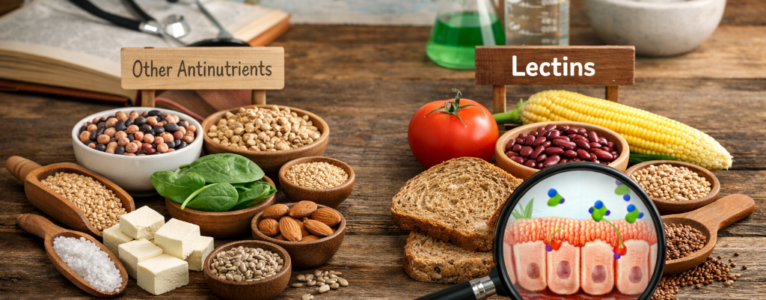

The word antinutrient has become a catch-all term in modern nutrition discussions. It appears in podcasts, blog posts, comment sections, and food debates, often framed as something to fear, eliminate, or ignore entirely. Lectins are frequently grouped into this category alongside compounds like phytates, oxalates, tannins, and enzyme inhibitors. At first glance, this grouping makes sense. These substances are found in plant foods and can interfere with digestion or nutrient absorption under certain conditions. But stopping there misses something important.
Lectins are not just another antinutrient. They behave differently, interact with the body in unique ways, and raise different questions about tolerance, preparation, and individual response. Understanding how lectins differ from other antinutrients is essential for anyone trying to make sense of confusing food reactions, conflicting nutrition advice, or why two people can eat the same meal and have very different outcomes.
This distinction is not about demonizing plants or promoting fear around food. It is about clarity. When we lump all antinutrients together, we flatten meaningful biological differences. When we separate them, patterns begin to emerge that help explain why lectins deserve special attention in both research and real-world experience.
What “Antinutrient” Really Means
The term antinutrient is often misunderstood. It does not mean “poison” or “toxin.” In scientific terms, antinutrients are compounds that can reduce the absorption or utilization of certain nutrients in the body. They evolved primarily as defense mechanisms in plants, discouraging insects, animals, and microbes from eating them.
This evolutionary context matters. Plants cannot run, bite, or fight. Instead, they produce chemical strategies that make consumption less appealing or less rewarding. Some bind minerals. Some interfere with enzymes. Some irritate tissues. Others pass through mostly unnoticed unless intake is excessive or preparation is poor.
The key point is that antinutrients are not inherently harmful. Their impact depends on dose, preparation, overall diet, gut health, and individual sensitivity. This is where lectins begin to diverge from the rest.
How Most Antinutrients Work
Most antinutrients affect nutrition indirectly. Phytates bind minerals like iron, zinc, and calcium, making them harder to absorb during digestion. Oxalates can bind calcium and contribute to kidney stone formation in susceptible individuals. Tannins interfere with protein digestion and mineral uptake. Enzyme inhibitors reduce the activity of digestive enzymes, slowing the breakdown of proteins or carbohydrates.
These compounds tend to act chemically. They form complexes with nutrients or enzymes and are usually broken down, neutralized, or excreted without directly interacting with human tissues. Their effects are often localized to the digestive tract and largely reversible through traditional food preparation methods such as soaking, fermenting, sprouting, or cooking.
In populations with diverse diets and adequate nutrient intake, these antinutrients rarely cause overt problems. In fact, some have benefits. Phytates have antioxidant properties. Tannins can modulate gut bacteria. Oxalates may play signaling roles in plants that indirectly benefit human health.
Lectins do not fit neatly into this pattern.
What Makes Lectins Different
Lectins are carbohydrate-binding proteins. Instead of binding minerals or enzymes, they bind to sugar molecules found on the surfaces of cells. This ability allows lectins to interact directly with biological tissues rather than simply interfering with nutrient chemistry.
This distinction is fundamental.
When lectins enter the digestive tract, some are broken down by cooking and digestion. Others resist degradation. Certain lectins can bind to the lining of the gut, attach to epithelial cells, and influence how those cells behave. In some cases, lectins can increase intestinal permeability, disrupt cell signaling, or trigger immune responses.
Unlike many antinutrients, lectins are biologically active in a way that goes beyond nutrient absorption. They can act more like messengers or irritants than passive binders.
This does not mean all lectins are dangerous. It means their mechanism of action is different enough to warrant separate consideration.
Lectins and the Gut Barrier
One of the most important differences between lectins and other antinutrients lies in how they interact with the gut lining. The intestinal barrier is not just a passive tube for food. It is a highly selective interface between the outside world and the immune system.
Lectins can bind to glycoproteins on intestinal cells. This binding can interfere with normal cell turnover, mucus production, and tight junction integrity. In susceptible individuals, this may contribute to increased intestinal permeability, sometimes referred to as “leaky gut,” though that term is often oversimplified.
Other antinutrients generally do not bind to gut cells in this way. They may reduce mineral absorption or slow digestion, but they do not typically alter the structure or signaling of the intestinal lining itself.
This difference helps explain why some people experience digestive discomfort, inflammation, or systemic symptoms after consuming lectin-rich foods, even when nutrient intake appears adequate.
Immune Interaction and Individual Sensitivity
Another major distinction is immune involvement. Because lectins can bind to cell surfaces, they can also interact with immune cells located in the gut-associated lymphoid tissue. This interaction may influence immune signaling, antibody production, or inflammatory pathways.
Most antinutrients do not directly engage the immune system. Their effects are mechanical or chemical rather than immunological.
This helps explain why lectins are often implicated in autoimmune discussions, while other antinutrients are not. It also explains why individual responses vary so widely. Immune systems are shaped by genetics, environment, microbiome composition, and prior exposure. What is harmless for one person may be problematic for another.
The variability of lectin response is not a failure of science. It is a reflection of biological diversity.
Heat Stability and Preparation Differences
Traditional food preparation methods reduce antinutrients to varying degrees. Phytates are reduced through fermentation and sprouting. Oxalates can be lowered through boiling and discarding cooking water. Enzyme inhibitors are generally heat-sensitive.
Lectins occupy a mixed category. Some are easily destroyed by cooking. Others are remarkably heat-stable. Pressure cooking can significantly reduce lectin activity in legumes, while simple boiling may not be sufficient for certain foods. Fermentation helps in some cases, but not all.
This uneven response to preparation is another reason lectins stand apart. With most antinutrients, preparation reliably reduces impact. With lectins, preparation must be specific, consistent, and sometimes aggressive to achieve meaningful reduction.
This is why blanket statements like “just cook your food” often fail to resolve lectin-related issues for certain individuals.
Why Lectins Became So Controversial
Lectins sit at the intersection of nutrition, immunology, and gastroenterology. This alone makes them difficult to study and easy to misunderstand. Add to that the rise of elimination diets, anecdotal symptom relief, and polarized nutrition messaging, and controversy becomes inevitable.
Other antinutrients rarely inspire this level of debate because their effects are narrower and easier to quantify. Lectins challenge the assumption that all whole plant foods are universally benign when prepared traditionally.
This does not invalidate plant-based diets or traditional cuisines. It simply suggests that modern food systems, altered preparation methods, and individual susceptibility have changed the context in which lectins are consumed.
Antinutrients Are Context-Dependent
A crucial point often missed in antinutrient discussions is context. Nutrient density, dietary diversity, gut health, and metabolic status all influence how antinutrients behave in the body.
In a nutrient-rich diet with adequate protein, minerals, and calories, most antinutrients pose little risk. In restricted diets, compromised digestion, or chronic inflammation, their effects can become more noticeable.
Lectins amplify this context sensitivity because they interact directly with tissues and immune pathways. Their impact scales not just with quantity, but with vulnerability.
Why Grouping Lectins With Other Antinutrients Is Misleading
When lectins are treated as interchangeable with phytates or oxalates, important nuances are lost. Strategies that work for one may fail for another. Dismissing lectin concerns because “antinutrients are harmless” oversimplifies the issue.
At the same time, portraying lectins as uniquely toxic ignores the fact that many people tolerate them well, especially when foods are properly prepared and diets are diverse.
The reality sits in between. Lectins are distinct enough to deserve their own category, but not so dangerous that they require universal avoidance.
A More Useful Way to Think About Antinutrients
Rather than asking whether antinutrients are good or bad, a better question is how they behave under specific conditions. Lectins ask different questions than other antinutrients. They push us to consider gut integrity, immune signaling, and cumulative exposure rather than just mineral absorption.
This perspective aligns with modern nutrition science, which increasingly recognizes that health outcomes are shaped by systems, not single compounds.
Bringing It Back to Real Life
For people exploring a low-lectin approach, understanding this distinction offers relief rather than restriction. It explains why certain foods cause problems even when they are nutrient-dense. It validates personal experience without rejecting science. It encourages experimentation grounded in biology rather than ideology.
For others, it provides reassurance that not all antinutrients are equal and that lectin awareness does not require fear or extremism.
The Takeaway
Lectins are often grouped with other antinutrients, but they are biologically distinct. While most antinutrients interfere with nutrient absorption in predictable, preparation-dependent ways, lectins interact directly with cells, tissues, and immune pathways. This difference helps explain their outsized role in digestive and inflammatory discussions.
Recognizing this distinction does not mean eliminating lectins across the board. It means understanding their behavior, respecting individual variability, and using preparation and awareness as tools rather than dogma.
In that sense, lectins are not a contradiction to good nutrition. They are a reminder that nutrition is personal, contextual, and still evolving.