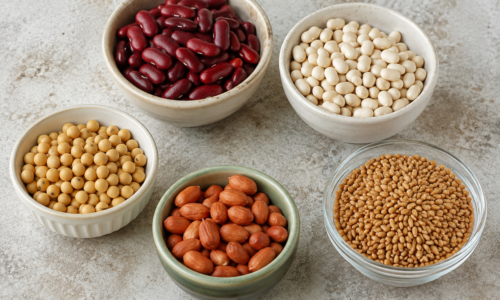
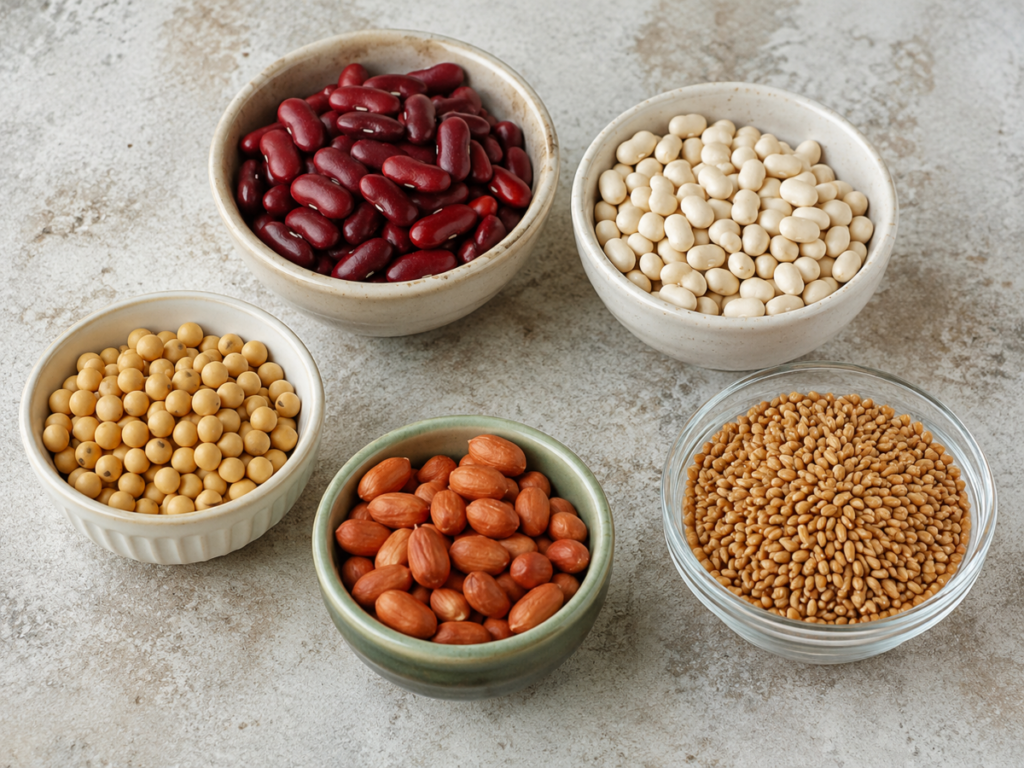
Lectins are often discussed as though they were a single substance, but the word actually covers a large family of carbohydrate-binding proteins. That matters in a low-lectin kitchen because a label such as wheat germ agglutinin, soybean agglutinin, peanut agglutinin, or phytohemagglutinin does not tell you that all of those proteins behave the same way in food, survive cooking to the same degree, or carry the same evidence for human effects.
The terminology becomes easier once the names are separated by what they describe. “Lectin” is the broad category, “agglutinin” describes the ability of some lectins to clump cells or particles together, and “hemagglutinin” refers more specifically to agglutination involving red blood cells. Add the prefix “phyto,” meaning plant, and phytohemagglutinin literally describes a plant-derived hemagglutinin. Historically, the ability of plant extracts to agglutinate red blood cells helped lead scientists toward the modern concept of lectins as carbohydrate-binding proteins.
Agglutinin Describes an Activity, Not One Single Food Compound
Agglutination happens because certain lectins can bind carbohydrate structures on more than one surface at once. If a lectin has multiple binding sites, it can act a bit like a molecular connector, attaching to glycans on neighboring cells and bringing those cells together into a visible clump. This behavior became useful in laboratory work, especially in blood typing and glycobiology, long before dietary lectins became a popular nutrition topic.
The key point is that “agglutinin” is not a chemical family name with one predictable effect. Wheat germ agglutinin, soybean agglutinin, peanut agglutinin, and many other proteins carry the word because they can agglutinate under certain experimental conditions, yet they differ in structure and in the carbohydrates they prefer to bind. Plant lectins are classified in several ways, including by structure, carbohydrate-binding domain, and evolutionary family, which is one reason a simple label can be misleading if it is treated as a full safety profile.
Some lectins do not agglutinate cells at all. A lectin with only one carbohydrate-binding domain may bind to a target without cross-linking multiple targets, while multivalent lectins are much more capable of producing agglutination. In other words, lectin activity and agglutinin activity overlap, but the terms are not interchangeable in every case.
Phytohemagglutinin Has the Clearest Food-Safety Evidence in Common Beans
In food discussions, phytohemagglutinin is usually shortened to PHA and most often refers to the lectin fraction found in common beans, *Phaseolus vulgaris*. Red kidney beans are the best-known source from a food-safety standpoint, although related common bean varieties can also contain PHA. The concern is not that properly prepared beans are automatically harmful, but that raw or inadequately cooked beans can retain enough active PHA to cause acute gastrointestinal illness. The FDA lists nausea, severe vomiting, and diarrhea among the effects associated with high exposure from raw or undercooked beans.
PHA deserves separate attention because the evidence for acute effects from poorly cooked beans is much stronger than many broader claims made about dietary lectins. In its 2026 assessment of plant lectins in food, the European Food Safety Authority reported that sufficient data for a formal risk characterization were available only for PHA. EFSA linked the main public-health concern to inadequately prepared beans and stated that proper processing and cooking can deactivate the lectin so that properly prepared pulses do not present that lectin-related concern.
That distinction helps keep low-lectin eating grounded. Evidence that undercooked kidney beans can produce a short-term foodborne illness does not automatically prove that every dietary lectin causes chronic intestinal injury, autoimmune disease, or another long-term condition in people eating ordinarily prepared foods. Some laboratory, animal, and mechanistic research explores how lectins interact with intestinal cells, immune pathways, and nutrient transport, but translating those findings into broad human dietary rules requires much stronger human evidence than is currently available for many individual food lectins.
PHA-E and PHA-L Explain Why One Lectin Can Have More Than One Laboratory Behavior
Phytohemagglutinin itself is not a single uniform protein particle. In common beans, PHA occurs as tetrameric isolectins assembled from two related subunits commonly called E and L. Those subunits can combine in five arrangements, often written as E4, E3L1, E2L2, E1L3, and L4.
The E subunit is associated more strongly with erythroagglutination, meaning clumping of red blood cells. The L subunit is associated more with binding to leukocytes and with mitogenic activity in lymphocytes, which is why purified PHA-L has long been used as a laboratory reagent in immunology. Mixed PHA isolectins can show a blend of these activities because they contain both types of subunit.
For a home cook, those subunit names are mostly useful for understanding why scientific papers may discuss “PHA-E,” “PHA-L,” “erythroagglutinin,” or “leukoagglutinin” as though they are related but distinct materials. They are related forms within the PHA system of common beans, not completely unrelated lectins. The terminology comes from how researchers separated and tested the proteins, rather than from separate categories a shopper needs to track on a grocery list.
Other Familiar Agglutinins Are Different Proteins With Different Binding Preferences
Wheat germ agglutinin, often abbreviated WGA, is one of the better-known non-bean examples. Soybean agglutinin and peanut agglutinin are others, while concanavalin A from jack bean is another classic laboratory lectin with agglutinating activity. These proteins recognize different carbohydrate patterns, so their biological behavior cannot be inferred simply from the shared word “agglutinin.”
That is also why ranking foods by whether their lectin happens to have “agglutinin” in its name is not very useful. A practical evaluation has to consider which lectin is present, how much is present in the edible portion, whether the protein remains biologically active after normal preparation, how much of the food is eaten, and what human evidence exists for meaningful effects. A dramatic laboratory property at a concentrated dose does not necessarily describe what happens after a food has been soaked, boiled, fermented, pressure-cooked, peeled, sprouted, or otherwise processed.
Food allergy adds another layer that should remain separate from general low-lectin concerns. Some plant lectins have been studied as potential allergens or as proteins capable of binding IgE, but allergenicity is not equivalent to lectin activity, and a person with a suspected food allergy needs a different kind of evaluation than someone simply experimenting with lower-lectin meal choices. Reviews of dietary lectins describe this as an area with specific proteins and individual immune responses rather than a reason to classify every lectin-containing food as an allergen.
Cooking Method Matters More Than the Name on the Protein
The clearest practical lesson from PHA research is that preparation can change biological activity substantially. EFSA’s 2026 guidance describes soaking beans in water for about 6 to 12 hours, replacing the soaking water, and then boiling the beans at 100°C for at least 30 minutes, with cooking continued until the beans are soft. The agency also notes that steaming, microwaving, and roasting are less dependable for deactivating lectins in pulses when used as the main treatment.
The FDA likewise warns about raw or undercooked kidney beans and distinguishes them from properly cooked or canned beans, where PHA levels are low enough not to create the same concern. This is one reason canned beans can be a useful option for someone who chooses to include legumes while trying to reduce active lectin exposure. Commercial canning involves substantial moist heat, and the beans arrive already cooked rather than merely softened.
Slow cookers deserve extra care with dried kidney beans because their low-temperature cooking pattern may not provide the same dependable high-heat treatment as a full boil. The FDA’s older food-safety guidance has specifically warned against relying on slow cooking alone for kidney beans, while current EFSA guidance centers on soaking followed by boiling. For anyone who uses a pressure cooker, a tested bean recipe and the appliance manufacturer’s instructions are the sensible baseline, since pressure, hydration, bean variety, and cooking time all affect the final result.
A Low-Lectin Approach Works Better When It Separates Hazard From Tolerance
Someone following a low-lectin lifestyle may choose to avoid common beans, use them only occasionally, select canned versions, or prepare dried beans with soaking and high-heat cooking. Those are practical choices based on goals and personal tolerance. They are different from the food-safety issue of eating raw or undercooked kidney beans, where the concern is active PHA at a level capable of causing acute illness.
This separation becomes especially useful when tracking symptoms. Bloating after a large serving of beans, for example, can also be influenced by fermentable carbohydrates, fiber load, resistant starch, portion size, or a sudden change in diet, so the symptom alone does not identify PHA as the cause. Keeping the food, portion, preparation method, and surrounding meal reasonably consistent makes personal observations more informative than simply labeling a reaction as “lectins.”
The same logic applies when comparing foods with very different lectins. A person who does poorly with wheat does not automatically have the same response to properly cooked lentils, soy foods, or a vegetable that contains a structurally unrelated lectin. If a lower-lectin pattern seems to help, the most useful long-term strategy is usually to identify repeatable food and preparation patterns rather than turning every scientific lectin name into a new forbidden category.
Reading Lectin Names Without Letting the Terminology Run the Kitchen
Agglutinin, hemagglutinin, phytohemagglutinin, PHA-E, and PHA-L sound like a stack of separate warnings when they first appear in research papers. In reality, the names often tell you something about origin, binding preference, or laboratory behavior, and several of them can describe overlapping parts of the same protein family.
For everyday food decisions, the label is only the starting point. Kidney bean PHA has a well-documented preparation issue, so soaking and adequate moist heat deserve attention; other agglutinins need to be judged by their own food source, processing behavior, evidence base, and the individual eating them. That approach leaves room for a low-lectin diet to stay practical, flexible, and focused on the foods and cooking methods that actually make a difference in day-to-day eating.