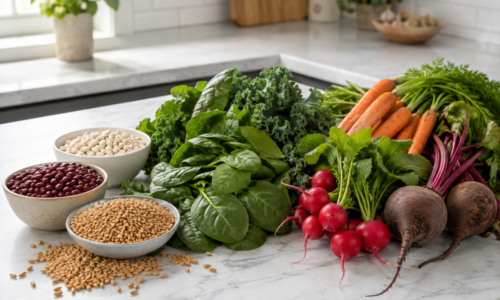
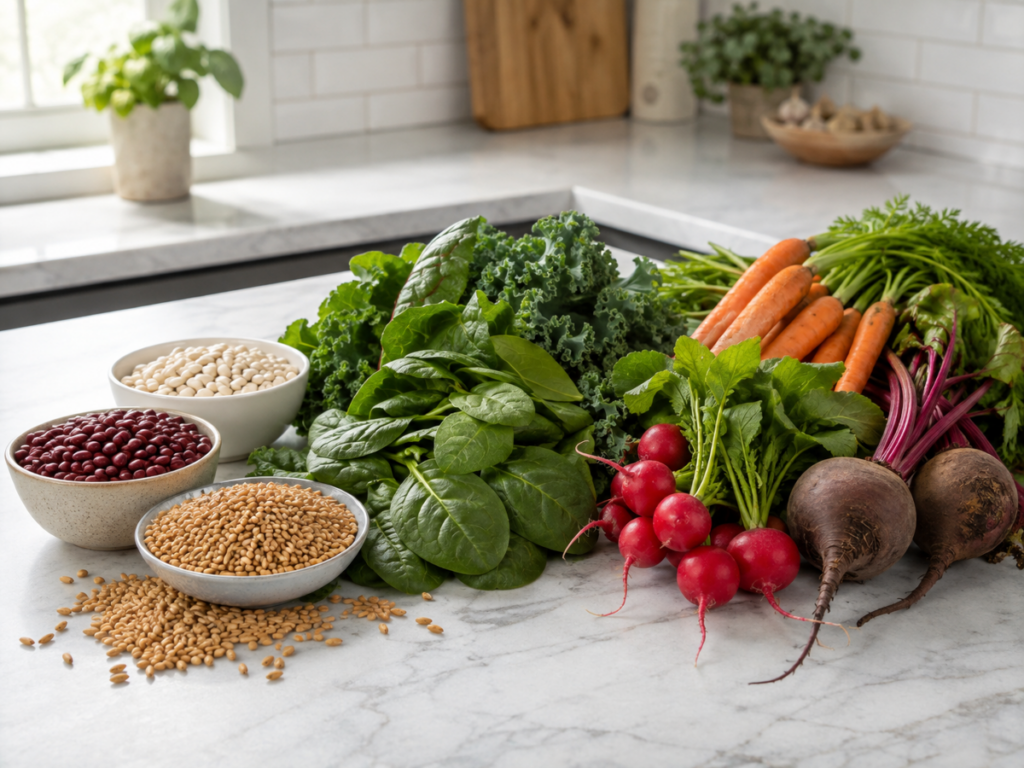
A kidney bean, a spinach leaf, and a carrot root may all come from plants, but the proteins inside them are distributed very differently. Lectins are a good example. These carbohydrate-binding proteins occur throughout the plant kingdom, yet a plant does not spread them evenly through every seed, leaf, stem, and root.
That uneven distribution matters to anyone trying to understand lectins in food. The part of the plant we eat can influence which lectins are present, how concentrated they are, and what happens to them during cooking. Seeds receive much of the attention because several well-known food lectins accumulate there in relatively large amounts, but roots, leaves, bulbs, stems, and other tissues can contain their own lectins serving very different biological jobs.
A Plant’s Protein Map Is Built Around Function
Saying that a plant “decides” where to put lectins is useful shorthand, although no conscious choice is involved. Genes are switched on and off according to the plant’s developmental stage, tissue type, environmental conditions, and interactions with insects, fungi, bacteria, and other organisms. Those genetic instructions determine which lectin proteins are produced and where they are transported within the plant.
Lectins themselves are a large and varied group of proteins that can recognize particular carbohydrate structures. Some are produced continuously and accumulate in substantial quantities. Others remain at very low levels until the plant encounters drought, injury, insects, pathogens, or another stress that changes gene expression.
Researchers commonly distinguish between abundant “classical” plant lectins and lower-abundance lectins whose production may increase during stress. Classical lectins are especially common in seeds and vegetative storage tissues such as bulbs and rhizomes. Stress-responsive lectins are found in tissues including roots, shoots, leaves, and flowers, often inside the cytoplasm or nucleus rather than packed into storage structures.
That distinction immediately explains why asking whether a plant “contains lectins” gives an incomplete picture. The more useful questions are which lectin, in which tissue, at what concentration, during which stage of growth, and after what kind of food preparation.
Why Seeds Often Carry the Heaviest Lectin Load
Seeds occupy a special position in a plant’s life cycle. They contain an embryo along with enough stored nutrients to support early growth before a young plant can fully support itself through photosynthesis and an established root system. Because a seed represents the plant’s next generation, losing it to insects or microorganisms carries a significant biological cost.
Many seed lectins appear to perform more than one job. Some accumulate alongside other storage proteins and can later contribute amino acids as the seed germinates. Their carbohydrate-binding properties may also contribute to defense against organisms attempting to consume or infect the seed. Researchers continue to study exactly how these functions overlap, so describing every seed lectin purely as a defense chemical would go beyond the evidence.
Common beans provide one of the clearest food examples. Phytohemagglutinin, or PHA, is a major lectin in *Phaseolus vulgaris*, the species that includes kidney beans and several other familiar beans. During seed development, much of this lectin is produced in the cotyledons, the thick seed structures that store nutrients for the developing plant. Research has found substantially greater PHA synthesis in bean cotyledons than in the embryonic axis.
This helps explain why legumes feature so prominently in discussions of dietary lectins. We are eating the plant tissue where some species intentionally accumulate large quantities of certain lectins and other seed proteins. That pattern does not mean every seed contains the same lectins, or that every lectin behaves like kidney bean PHA.
Wheat Shows How Specific the Location Can Be
Wheat gives us an especially useful example of how narrowly a lectin can be distributed within a food. Wheat germ agglutinin, commonly abbreviated WGA, gets its name from its association with the germ, which contains the wheat embryo.
Laboratory localization studies have found WGA in the embryo of dry wheat grain rather than the starchy endosperm. Researchers have also detected it in particular embryonic tissues and, as the plant develops, around root tips and other tissues that come into contact with soil.
That is quite different from imagining WGA spread evenly through a wheat kernel. A whole grain contains the bran, germ, and endosperm, while refined white flour contains primarily endosperm after much of the bran and germ have been removed. Milling therefore changes the composition of the grain before cooking even begins.
This does not make refined wheat automatically appropriate for someone following a low-lectin diet. Wheat introduces other dietary considerations, including gluten and individual tolerance. It does demonstrate why the physical location of plant proteins can matter when comparing whole grains, refined flours, sprouts, and other forms of the same plant.
Leaves Often Use Lectins as Responsive Defense Proteins
Leaves face a different set of problems from dormant seeds. They are metabolically active tissues exposed to insects, fungi, bacteria, sunlight, changing temperatures, dehydration, and physical damage. Packing every leaf with large quantities of storage lectins would be an expensive strategy for many plants, so some lectin systems work more like responsive biological tools.
Certain plant lectins occur at low levels under normal conditions but increase after environmental or biological stress. Nictaba-related lectins in tobacco are a well-studied example. Their production can increase following signals associated with insect feeding and plant defense, and the proteins accumulate within leaf cells.
This helps explain why leaves cannot simply be classified as “lectin-free” while seeds are classified as “lectin-containing.” Both tissues can contain lectins, but the types, concentrations, locations, and biological roles may be very different.
For someone planning meals, this distinction is more useful than trying to eliminate every botanical trace of lectin activity. Many commonly eaten leafy vegetables are consumed as relatively young vegetative tissues rather than concentrated reproductive or storage structures. Their lectin profile cannot be predicted merely from the fact that another part of the same plant family contains a well-known lectin.
Roots Sit at a Busy Plant-Microbe Border
Roots live in one of the most biologically active environments surrounding a plant. Soil contains bacteria, fungi, microscopic animals, decaying organic material, and organisms capable of either helping or harming the plant. Root surfaces therefore need ways to detect and respond to what they encounter.
Lectins and proteins containing lectin-like domains participate in some of these interactions. In legumes, lectin-related activity has been studied in connection with rhizobia, the bacteria involved in nitrogen-fixing root nodules. Certain legume lectins can interact with carbohydrates on bacterial surfaces and may assist early stages of root-microbe recognition, although modern research shows that this relationship involves a much larger signaling system than lectins alone.
The distribution can also be extremely localized. Studies of wheat found WGA around caps and tips of developing roots rather than uniformly throughout every mature plant tissue. In soybeans, researchers have likewise identified lectin-related proteins in roots even when the major seed lectin itself was absent or present in a different form.
This distinction matters at the grocery store. Eating a carrot, beet, radish, or other root does not mean consuming the same lectin system found at the microscopic root tips of a growing plant. Botanical categories provide clues, but they do not provide a direct measurement of the lectin activity in the portion sitting on the dinner plate.
Storage Organs Complicate the Seed, Leaf, and Root Categories
Seeds are famous lectin storage sites, but they are not the only parts of plants built to hold resources for future growth. Bulbs, corms, rhizomes, bark, and other vegetative storage tissues can also contain abundant lectins.
Researchers have isolated lectins from plants including onion, garlic, leek, snowdrop, daffodil, and other species with specialized underground storage structures. Some of these belong to entirely different lectin families from the lectins found in common beans or wheat.
This is another reason that simple rules such as “seeds are high in lectins and roots are low” break down quickly. A swollen underground storage organ has a different biological purpose from a fine absorbing root. Plants allocate proteins according to tissue function and evolutionary history, not according to the food categories people use in the kitchen.
Even within a single species, cultivar differences can matter. Soybean varieties have been identified with dramatically different expression of the major seed lectin, while related lectin-like proteins remain detectable elsewhere in the plant.
Plant Location Does Not Equal Human Exposure
Knowing where a lectin is concentrated helps explain the raw ingredient, but it still does not tell us exactly how much biologically active lectin reaches the digestive tract. Food preparation can substantially change that picture.
Kidney beans are the clearest example because improperly cooked beans can contain enough active PHA to cause acute gastrointestinal illness. The FDA specifically identifies raw and undercooked kidney beans as a food safety concern and notes that properly cooked beans contain much lower active PHA levels.
Moist heat is particularly effective against the PHA in common beans when sufficient temperature and cooking time are reached. This is why thoroughly boiling beans, or using another reliable high-temperature method such as pressure cooking, is very different from eating them raw or cooking dried kidney beans only at low slow-cooker temperatures.
The lesson should not be generalized to every plant lectin. Lectins differ in structure and heat stability, and preparation methods such as boiling, pressure cooking, fermentation, sprouting, milling, soaking, and peeling can affect foods differently. A low-lectin kitchen works better when preparation is matched to the specific ingredient rather than treating every vegetable, grain, and legume as chemically identical.
Using Plant Anatomy to Make Better Food Choices
Plant anatomy can serve as a practical screening tool. Seeds and concentrated storage structures deserve more attention because several well-studied dietary lectins accumulate there. Leaves and ordinary root tissues often contain different lectins at lower levels or in more specialized locations, although there are plenty of exceptions.
For someone experimenting with a low-lectin lifestyle, that pattern can help explain why ingredient selection and preparation matter as much as the name of the plant. A pressure-cooked legume, a refined grain product, a peeled vegetable, a sprouted seed, and a raw seed may start with related plant material but deliver very different mixtures of proteins and other compounds.
Individual tolerance adds another layer. Digestive responses cannot reliably be predicted from lectin concentration alone because meals also contain fiber, fermentable carbohydrates, fats, proteins, gluten in some grains, and many other compounds capable of affecting how someone feels. Symptoms attributed to “lectins” may sometimes have more than one dietary explanation, which is why controlled food reintroduction and careful tracking can be more informative than assuming a single mechanism.
A useful food journal can record the plant part being eaten along with the preparation method, portion size, and response. Over time, those details may reveal distinctions that broad labels miss, such as tolerating pressure-cooked beans but not lightly cooked ones, handling leafy vegetables comfortably while reacting to certain seeds, or finding that preparation makes more difference than the botanical family itself.