


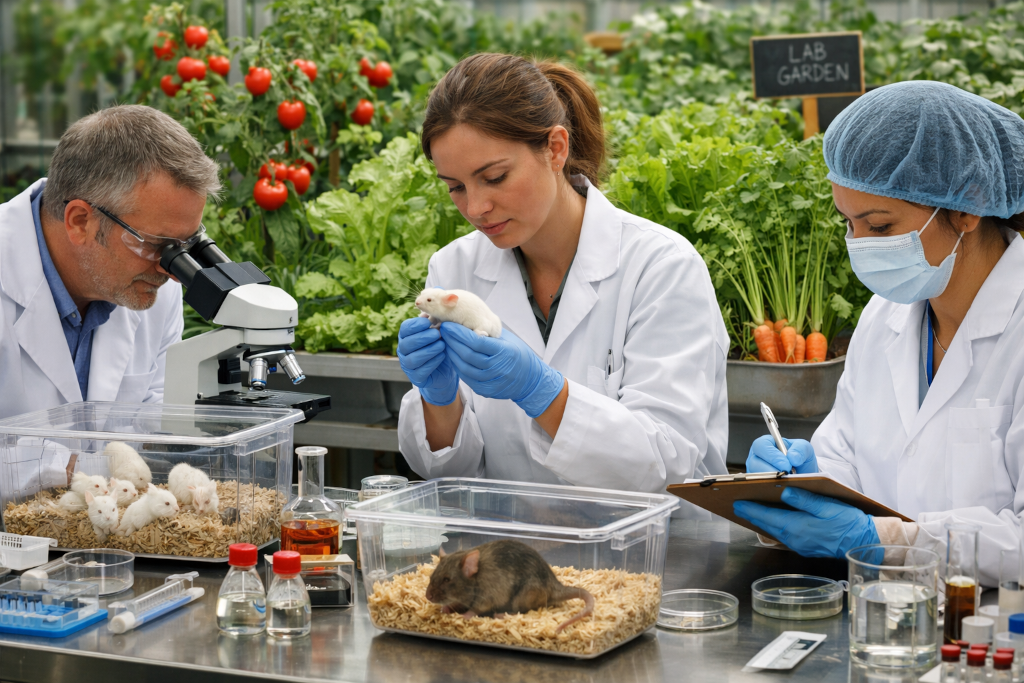
When people begin researching lectins, they often encounter bold claims backed by dramatic laboratory findings. A rat develops intestinal damage after being fed a purified plant protein. A mouse shows changes in immune signaling. A petri dish of human cells responds to a lectin in a way that looks alarming under a microscope. It is easy to assume that these findings map directly onto human health.
But science does not move in straight lines. What happens in a rodent model under tightly controlled laboratory conditions does not always unfold the same way inside a free living human eating real meals. Understanding that gap is essential if we want to make thoughtful, grounded decisions about lectins and our diet.
In Living Low-Lectin, the goal is not fear of food. It is clarity. And clarity begins with understanding how evidence works.
Why Animal Studies Exist in the First Place
Animal studies are not designed to confuse us. They are designed to answer early stage questions safely and efficiently. Researchers often begin with animals because it allows them to isolate variables that would be difficult or unethical to manipulate in humans.
If scientists want to know whether a specific lectin can bind to gut tissue, alter nutrient absorption, or stimulate immune cells, they can administer precise doses to animals and measure outcomes in ways that would be invasive for human volunteers. They can examine tissue under microscopes, track molecular changes, and control every aspect of the animal’s diet.
These studies are incredibly valuable. Without them, we would know far less about how plant defense proteins behave biologically. Much of what we understand about lectins binding to carbohydrate structures, altering gut permeability in certain contexts, or stimulating immune responses comes from this foundational research.
But the key word is foundational. Foundational does not mean final.
Dose Makes the Difference
One of the most important distinctions between animal studies and human experience is dose. In laboratory settings, animals are often given concentrated, purified lectins in amounts that do not reflect normal dietary patterns.
For example, researchers may isolate a lectin from raw legumes and feed it to rodents at levels proportionally far higher than what a person would consume in properly prepared beans. These studies are useful for understanding biological mechanisms. They help answer the question, “What could this protein do under extreme exposure?”
In real life, humans rarely consume purified lectins in isolation. We eat foods. And foods are complex matrices of fiber, fat, protein, polyphenols, and other compounds that interact with each other. Cooking methods such as soaking, boiling, pressure cooking, fermenting, and sprouting can significantly reduce lectin activity in many foods.
When evaluating a study, the question is not simply whether a lectin caused a reaction in an animal. The more important question is whether the exposure level and preparation method resemble human eating patterns.
Species Differences Matter
Rodents are not small humans. Their digestive systems, immune responses, and microbiomes differ from ours in meaningful ways.
Mice and rats have shorter digestive tracts relative to body size. Their gut microbiota composition differs. Their metabolic rates are higher. Even subtle differences in intestinal cell receptors can influence how lectins bind and what downstream effects occur.
A lectin that strongly binds to a specific carbohydrate structure in a rodent gut may interact differently in a human intestine. Some lectins are species specific in their binding affinity. Others are partially degraded by human digestive enzymes in ways that differ from animal models.
This does not invalidate animal research. It simply limits direct translation. When we see a dramatic finding in a mouse study, it should spark curiosity and further investigation, not immediate dietary panic.
The Role of In Vitro Studies
Before animal studies, there are often in vitro studies. These involve isolated cells in laboratory dishes. Scientists may expose intestinal epithelial cells to purified lectins and observe changes in cell permeability, inflammatory signaling, or protein expression.
These experiments are powerful because they reveal mechanistic details. They show how lectins bind to glycoproteins, how they may cluster receptors, and how signaling pathways activate in response.
However, in vitro systems are simplified models. Cells in a dish lack the buffering effects of digestion, mucus layers, immune modulation, microbiome interactions, and food matrices that exist in a living organism.
A lectin interacting with a single layer of isolated cells does not experience stomach acid, pancreatic enzymes, bile salts, or competitive binding with other dietary components. What looks dramatic in vitro may be muted in a complex human digestive environment.
In vitro data are like looking at a single gear in a clock. You learn what that gear does, but not how the whole clock keeps time.
What Human Studies Actually Show
Human evidence is more limited than many people expect. Long term randomized controlled trials isolating lectin intake are rare. It is difficult to design studies where lectins are manipulated independently of other dietary changes.
Most human data come from observational studies, small clinical trials, and research on specific food groups such as legumes or whole grains. Interestingly, many population studies associate properly prepared legumes and whole grains with positive health outcomes including improved metabolic markers and reduced cardiovascular risk.
This does not mean lectins are irrelevant. It suggests that preparation methods, total diet context, individual variation, and overall dietary patterns matter more than the presence of lectins alone.
There are also case reports and small studies showing that certain individuals with autoimmune conditions, inflammatory bowel disorders, or heightened gut permeability may react differently to specific foods. The challenge is distinguishing whether lectins themselves are the primary driver or whether other compounds such as FODMAPs, gluten, glycoalkaloids, or general food sensitivities are involved.
Human biology is layered. Rarely is a single molecule the entire story.
Gut Integrity and Context
One area where animal studies often raise concern is gut permeability. Some lectins have been shown in rodents to alter tight junction proteins under specific conditions. This has fueled discussions around “leaky gut” and systemic inflammation.
In humans, intestinal permeability is influenced by many factors. Stress, sleep deprivation, alcohol intake, infections, medications, microbiome composition, and overall diet quality all play roles. It is not a binary state. It fluctuates.
If someone has an already compromised gut barrier, certain foods may exacerbate symptoms. That does not automatically mean those foods are harmful to everyone. It means context matters.
A healthy digestive system with diverse microbiota and adequate stomach acid may handle properly cooked legumes differently than a system under chronic stress and inflammation. This nuance is often lost when animal data are presented without context.
Preparation Changes the Equation
One of the most practical bridges between animal research and human application is food preparation.
Many lectins are heat labile, meaning they lose activity when exposed to sufficient heat. Soaking beans, discarding soaking water, boiling thoroughly, and especially pressure cooking can dramatically reduce lectin activity. Fermentation alters protein structures and can further decrease certain lectins.
Animal studies frequently use raw or purified lectins to demonstrate potential effects. In contrast, traditional human diets evolved alongside preparation techniques that reduce anti nutrient activity. Across cultures, beans were soaked. Grains were fermented. Tubers were cooked thoroughly.
When we examine research, we must ask whether the food was prepared in a way that mirrors traditional culinary practice. Raw kidney beans are not the same as pressure cooked kidney beans. The difference is not subtle.
The Microbiome as a Mediator
Modern research increasingly highlights the gut microbiome as a key mediator between dietary compounds and health outcomes. Some lectins may reach the colon partially intact. There, they encounter trillions of microbes.
Certain gut bacteria can degrade or modify plant proteins. Others may respond to dietary fiber and polyphenols present in lectin containing foods, producing short chain fatty acids that support gut integrity.
Animal models often have simplified or controlled microbiomes. Humans have highly individualized microbial ecosystems shaped by birth history, antibiotics, environment, and long term diet.
This variability helps explain why two people can eat the same meal and report very different experiences. It also means that translating findings from a standardized rodent microbiome to diverse human populations requires caution.
When Animal Data Should Influence Us
Animal studies become particularly important when they reveal plausible mechanisms that align with human observations. If a lectin demonstrates strong binding affinity to intestinal cells and small human trials show symptom improvement when that food is reduced, the combination of evidence becomes more compelling.
Mechanistic data help explain why certain individuals may feel better after adjusting their intake. They provide biological plausibility. However, animal data alone should not drive sweeping dietary elimination for entire populations without supporting human evidence.
Science moves forward by layering evidence. Mechanism, animal data, small human trials, larger human trials, and long term observational patterns all contribute pieces to the puzzle.
Individual Variation Is Not a Weakness
One reason lectin discussions become polarized is that people seek universal answers. Is this food good or bad? Safe or dangerous? The reality is more complex. Genetic variation affects immune sensitivity. Microbiome diversity affects digestion. Existing health conditions change how the body responds to dietary proteins.
Some individuals may thrive on diets rich in properly prepared legumes. Others may notice symptom relief when reducing certain high lectin foods, especially during periods of inflammation or gut repair. Animal research can highlight potential pathways of irritation. Human experience reveals how those pathways express in real life. Neither should be dismissed outright.
The Practical Takeaway
If we step back, the message is less dramatic than headlines suggest. Animal and in vitro studies help us understand what lectins can do under specific conditions. They illuminate mechanisms. They warn us against consuming certain foods raw. They guide safe preparation practices.
Human evidence reminds us that context, dose, preparation, and overall dietary patterns shape real world outcomes. It encourages moderation rather than extremism.
In Living Low-Lectin, the emphasis is on practical strategies that respect both sides of the evidence. Proper cooking methods. Paying attention to personal response. Supporting gut health through sleep, stress management, and microbiome diversity. Avoiding unnecessary fear while remaining informed.
The bridge between animal studies and human health is not automatic. It requires interpretation, humility, and ongoing research. When we understand what transfers and what does not, we gain something far more valuable than rigid rules. We gain discernment.
And discernment is what allows us to build a dietary approach that is both scientifically grounded and individually responsive.