Aquaporins rarely come up in everyday conversations about food, yet they sit at the center of an interesting scientific question about immune cross-reactivity. These proteins act as channels that help move water, and in some cases small solutes, across cell membranes. They are found throughout biology, including in humans, plants, bacteria, and other organisms. Because related proteins can share portions of their amino acid sequence or three-dimensional shape, researchers have asked whether an immune response directed at an aquaporin from one source might sometimes recognize an aquaporin from another.
That possibility is usually discussed under the term molecular mimicry. The basic idea is straightforward: if a foreign protein resembles part of a human protein closely enough, an antibody or immune cell originally directed toward the foreign target may also bind the human target. The concept is biologically plausible and has support in several areas of immunology, especially in research involving infections and autoimmunity. What matters for food discussions, however, is the gap between showing similarity in a laboratory and showing that eating a particular food causes a clinically meaningful autoimmune reaction. Current evidence does not justify treating those two things as equivalent.
What Aquaporins Actually Do
Aquaporins are membrane proteins that form channels through which water can move rapidly across cell membranes. Different aquaporins appear in different tissues and perform different jobs. In the human nervous system, aquaporin-4, usually shortened to AQP4, is highly expressed in astrocytes, including the specialized endfeet of these cells that surround blood vessels in the brain and spinal cord.
AQP4 has become especially well known because it is a major autoantigen in neuromyelitis optica spectrum disorder, or NMOSD. In many people with AQP4-IgG-positive NMOSD, antibodies bind AQP4 on astrocytes and participate directly in tissue injury through immune mechanisms that can include complement activation and other forms of antibody-mediated damage. Modern reviews continue to describe AQP4-IgG as both a disease marker and a pathogenic antibody in this disorder.
That established relationship is one reason aquaporin cross-reactivity gets attention. If the immune system can make harmful antibodies against human AQP4, researchers naturally want to know what started that response. Genetics, immune regulation, infections, environmental exposures, and other factors have all been investigated. Dietary proteins are one proposed environmental factor, but that proposal sits much earlier in the evidence chain than the established role of AQP4-IgG in NMOSD.
Molecular Mimicry Requires More Than a Similar Sequence
Molecular mimicry begins with similarity, but similarity alone does not prove disease causation. Antibodies recognize specific molecular surfaces called epitopes, while T cells recognize peptide fragments presented by major histocompatibility complex molecules. A foreign protein can share an amino acid sequence with a human protein without creating a meaningful immune problem, because the shared segment may never be exposed, may be processed differently, or may not bind the relevant immune receptor strongly enough.
The immune system also has multiple layers of self-tolerance that normally limit reactions against the body’s own tissues. Reviews of molecular mimicry emphasize that shared antigens are common across organisms and that cross-reactive sequences by themselves are usually insufficient to break healthy immune tolerance. Autoimmune disease generally requires a combination of susceptibility, immune activation, antigen presentation, tissue access, and other biological conditions rather than one isolated resemblance between proteins.
This distinction helps explain why laboratory cross-reactivity should be interpreted carefully. A finding that one antibody binds two similar peptides is evidence of cross-recognition. It does not automatically show which antigen triggered the antibody first, whether the same reaction happens against the native proteins inside the body, whether the antibody reaches the relevant tissue, or whether the interaction is strong enough to produce symptoms.
Why Plant Aquaporins Entered the Discussion
Interest in food-related aquaporin mimicry grew after researchers compared human AQP4 with aquaporins from plants and microorganisms. A 2013 study identified a segment of corn aquaporin, ZmTIP4-1, with substantial similarity to a known human AQP4 epitope. Serum from a small group of people with neuromyelitis optica reacted with both the human AQP4 peptide and the corn peptide, and the investigators also found reactivity with plant tissue. The authors described the findings as a reason for further investigation, rather than proof that corn exposure caused the disease.
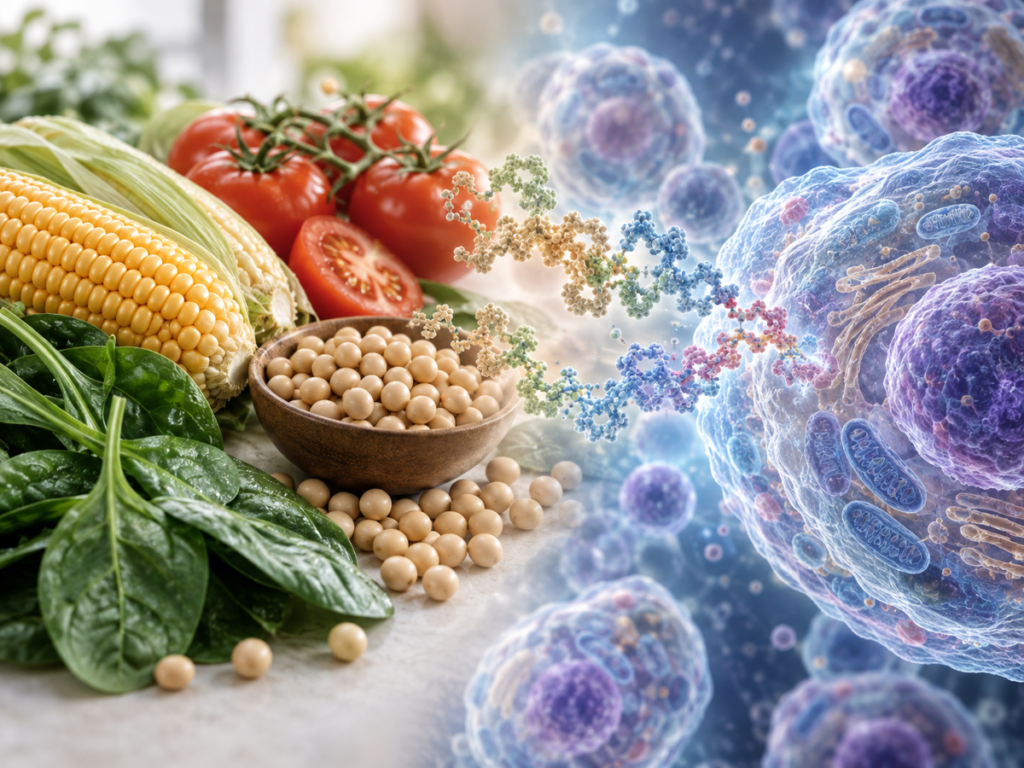
The size and design of that study matter. The work included only eight confirmed NMO cases, one probable case, and nine non-NMO controls, and much of the testing focused on selected peptide fragments rather than the complete native AQP4 structure. A later study examined 47 people with relapsing-remitting multiple sclerosis and 47 healthy controls and reported increased antibody reactivity to human AQP4 peptides and aquaporin peptides from soy, corn, tomato, and spinach. The authors also reported inhibition experiments consistent with antibody cross-reactivity.
Those results are interesting, but they leave several unanswered questions. Detecting antibodies against similar peptides does not establish that eating those foods initiated the antibodies, nor does it establish that removing those foods changes the course of a neurologic autoimmune disease. The multiple sclerosis study also measured antibodies against linear peptide targets by ELISA, which is not the same thing as the clinical AQP4-IgG testing used to diagnose NMOSD.
Protein Shape Matters in AQP4 Autoimmunity
The difference between a peptide assay and the native AQP4 protein is especially relevant here. AQP4 sits inside a cell membrane as a folded protein, and multiple AQP4 units assemble into larger structures known as orthogonal arrays of particles. Recent structural work using patient-derived NMOSD antibodies has shown that pathogenic antibodies can recognize complex extracellular surfaces formed by several loops of AQP4, with contributions from more than one AQP4 molecule in the membrane assembly.
That means sequence similarity is only one part of antibody recognition. A plant peptide can resemble a short stretch of human AQP4 and still fail to reproduce the three-dimensional surface that a clinically relevant AQP4 autoantibody recognizes. Conversely, some antibodies can recognize linear peptide features, so peptide studies are still useful for generating hypotheses. They simply cannot answer the full clinical question by themselves.
This is also why modern NMOSD diagnosis relies heavily on cell-based AQP4-IgG assays that present the protein in a more native membrane context. Current consensus recommendations continue to emphasize cell-based testing, and recent laboratory reviews describe it as the preferred method for detecting clinically relevant AQP4 autoantibodies.
Eating a Protein Is Not the Same as Injecting an Antigen
Food adds another layer of complexity because dietary proteins first pass through the digestive system. Stomach acid, digestive enzymes, food processing, cooking, intestinal transport, and the gut immune system all affect how much of a protein remains intact and what the immune system sees. The intestine is designed to encounter large amounts of foreign food protein without reacting aggressively to every meal, a process commonly described as oral tolerance.
Human biology does allow dietary antigens and antigen fragments to interact with the intestinal immune system. Recent immunology reviews describe several routes by which food antigens can cross or be sampled through the intestinal epithelium, and failures of normal tolerance are clearly involved in conditions such as food allergy and celiac disease. At the same time, the mechanisms that turn ordinary dietary exposure into a harmful immune response are selective rather than automatic.
For aquaporins, researchers would need to show much more than the presence of homologous sequences to demonstrate a dietary cause of AQP4 autoimmunity. Stronger evidence would include prospective human studies, confirmation that relevant plant aquaporin fragments survive digestion in an immunologically active form, proof that exposure generates antibodies capable of binding native human AQP4, and evidence that altering exposure changes a meaningful clinical outcome. That chain has not been established.
Cross-Reactivity, Food Allergy, and Autoimmunity Are Different Questions
The word cross-reactivity can make several different immune phenomena sound like the same process. In allergy medicine, cross-reactivity is well established for some families of plant proteins. For example, IgE antibodies first formed against pollen proteins can recognize related proteins in foods, producing pollen-food allergy syndrome in susceptible people. Experimental inhibition studies have demonstrated this type of shared recognition for proteins such as Bet v 1-related allergens and profilins.
Autoimmune cross-reactivity is a different problem because the mistaken target is a person’s own tissue. AQP4-IgG-positive NMOSD provides strong evidence that antibodies against self AQP4 can be pathogenic, but it does not by itself tell us what first caused those antibodies to appear. Plant aquaporin similarity offers one possible explanation worth studying, while infection-related triggers, genetic predisposition, abnormal B-cell and T-cell responses, and other immune events remain part of the broader research picture.
For someone reading about food reactions, keeping these categories separate prevents a common mistake. A food can cause an IgE-mediated allergy, a nonimmune intolerance, a digestive symptom, or a suspected autoimmune cross-reaction through very different biological pathways. One test result or one shared protein family cannot be assumed to explain all of them.
What This Means in a Low-Lectin Lifestyle
Aquaporins are not lectins. Lectins are carbohydrate-binding proteins, while aquaporins are membrane channels primarily involved in water and small-solute transport. A food such as corn, soy, tomato, or spinach can contain many different proteins at the same time, so finding aquaporin homology in a food does not mean that aquaporins behave like lectins or that every concern associated with one protein class applies to the other.
There is also no established clinical basis for broadly removing every food that contains a plant aquaporin simply because sequence similarity with human AQP4 has been reported. Some of the foods studied in aquaporin research already overlap with foods that certain low-lectin eaters limit for separate reasons, while others may fit comfortably into an individual’s normal pattern. Those decisions can still be guided by personal tolerance, preparation method, nutritional value, and reproducible symptoms without turning a preliminary autoimmune hypothesis into a universal rule.
Food antibody panels deserve similar caution. Commercial testing sometimes measures IgG responses to many foods and presents higher values as evidence that those foods should be avoided. Major allergy organizations do not recommend food-specific IgG or IgG4 testing for diagnosing food allergy or intolerance because these antibodies can reflect normal exposure and immune tolerance rather than disease.
A more useful approach for someone who suspects a repeatable food reaction is to document the food, portion, preparation method, timing, symptoms, and other variables such as sleep, medications, exercise, or concurrent illness. That kind of record can reveal patterns without assuming the mechanism in advance. If reactions are immediate, severe, neurologic, or otherwise medically concerning, the appropriate next step is clinical evaluation rather than increasingly broad food restriction.
Where the Science Stands
The aquaporin story contains a solid center and a speculative outer edge. The solid center is that AQP4 is a major human water-channel protein, AQP4-IgG is strongly associated with AQP4-positive NMOSD, and those antibodies can directly participate in disease. The more tentative area is the proposal that exposure to plant aquaporins in foods can initiate those autoantibodies through molecular mimicry.
Laboratory studies have shown sequence similarity and antibody cross-reactivity between human AQP4 and selected plant aquaporin peptides, including proteins from corn and several other plants. Those findings support continued research, but they have not established that normal dietary exposure causes NMOSD, multiple sclerosis, or another autoimmune condition. The distinction is important because a plausible mechanism can guide good research while still being far from a dietary prescription.
For people using a low-lectin framework, the most practical use of this information is to keep molecular mimicry in its proper place. It can explain why scientists pay attention to structural similarities between food proteins and human proteins, while also reminding us that individual food decisions should rest on evidence, tolerance, and nutritional context rather than sequence matching alone. A carefully tracked food trial may help someone identify a personal pattern, but aquaporin research does not currently support treating plant aquaporins as a proven dietary trigger that everyone needs to avoid.