

There is something almost rebellious about building a meal around simplicity. In a world where food labels stretch for paragraphs and convenience often replaces craftsmanship, a bowl of greens topped with avocado and walnuts can feel almost radical. Not because it is trendy, but because it is intentional.
When I began paying closer attention to lectins and their potential role in digestion, immune signaling, and inflammation, I realized something important. The goal was never to create fear around food. The goal was to understand it. Lectins are not new. They have always been present in the plants humans have eaten for thousands of years. What has changed is our exposure, our preparation methods, and in many cases, the sheer volume and processing of modern foods.
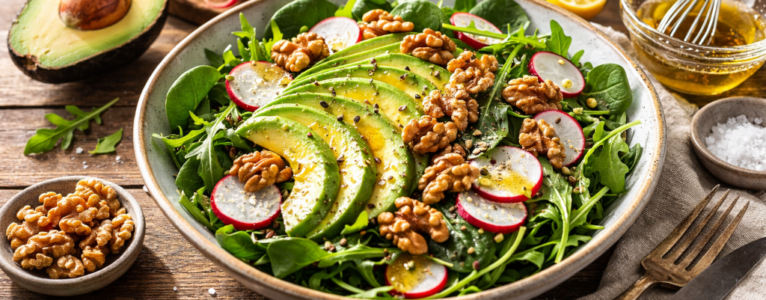
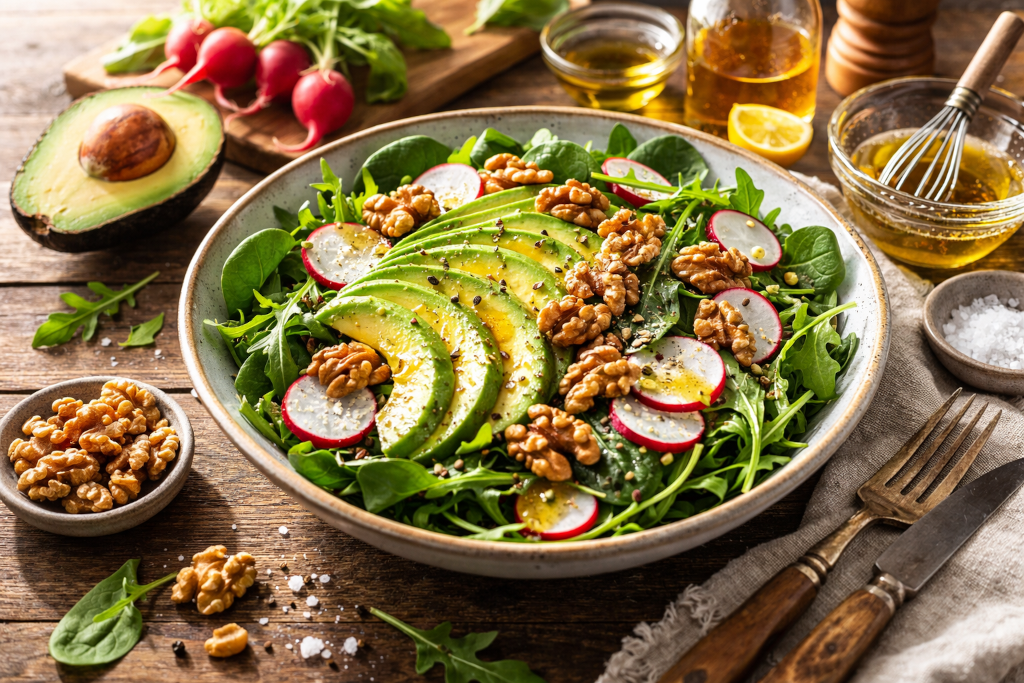
A meal like this Avocado and Walnut Power Salad reflects what I have learned through research and experience. It is not extreme. It is not restrictive in the dramatic sense. It is thoughtful. Every ingredient is selected for both its nutritional value and its low lectin profile. The result is a dish that feels nourishing rather than heavy, supportive rather than complicated.
Understanding Lectins Without the Hype
Lectins are proteins found in many plants. They bind to specific carbohydrate structures. That binding ability is what makes them biologically interesting. In laboratory settings, certain lectins can interact with gut lining cells, immune cells, and red blood cells. Some are heat sensitive and are largely deactivated by proper cooking. Others are more resistant.
Modern research continues to examine how dietary lectins may affect intestinal permeability, microbiome balance, and immune response in certain individuals. It is important to clarify that most people tolerate properly prepared lectin containing foods without obvious harm. However, some individuals report digestive discomfort, bloating, or inflammatory symptoms when consuming certain high lectin foods, especially if those foods are undercooked or heavily processed.
The focus of a low lectin approach is not to eliminate plant foods. It is to understand which foods contain higher concentrations of biologically active lectins and how preparation methods influence them. Beans, grains, and certain nightshades are often discussed because of their lectin content. On the other hand, many leafy greens, cruciferous vegetables, and fruits like avocados contain negligible or very low levels of lectins that are not typically associated with digestive distress.
This salad is built around that principle.
Why Avocado Matters
Avocados are often celebrated for their healthy fats, but their role in a low lectin framework is just as interesting. Unlike legumes or grains, avocados are not significant sources of problematic lectins. What they do provide is a rich concentration of monounsaturated fat, primarily oleic acid. Oleic acid has been associated in nutritional research with cardiovascular support and anti inflammatory signaling.
Fat also plays a practical digestive role. When you consume leafy greens on their own, many of the fat soluble nutrients such as certain carotenoids and vitamin K are not absorbed as efficiently. Pairing greens with healthy fats enhances bioavailability. In simple terms, your body can actually use more of what you eat.
In the context of lectin awareness, this matters. If someone is reducing certain high lectin foods, the overall quality and absorption of nutrients becomes even more important. Avocado acts as both a nutrient enhancer and a source of satiety. It turns a bowl of greens into a satisfying meal.
The Foundation: Arugula and Spinach
Arugula and spinach form the base of this salad. Both are generally considered low lectin vegetables, particularly when compared to legumes and grains. Leafy greens do contain various plant defense compounds, as all plants do, but they are not typically categorized among high lectin foods.
Spinach offers folate, magnesium, and a range of phytonutrients. Arugula brings a peppery flavor and contains glucosinolates, compounds studied for their role in cellular health and detoxification pathways. Together, they create depth without requiring heavy toppings or processed additions.
From a digestive perspective, these greens provide fiber that supports the microbiome. It is worth noting that fiber and lectins are not the same. Reducing lectins does not mean eliminating fiber. In fact, maintaining adequate fiber intake is important for gut health. Choosing lower lectin, fiber rich vegetables helps strike that balance.
Walnuts and the Role of Fats in Inflammation
Walnuts are another ingredient that align well with a low lectin approach when consumed in moderation. Most nuts contain some plant defense compounds, but walnuts are not typically flagged as high lectin foods in the same way as peanuts, which are legumes.
Walnuts are particularly interesting because they provide alpha linolenic acid, a plant based omega 3 fatty acid. Research into dietary fats and inflammation has evolved significantly over the past few decades. The simplistic idea that all fats are harmful has been replaced by a more nuanced understanding. The ratio of omega 3 to omega 6 fatty acids appears to influence inflammatory signaling pathways.
Including walnuts in a salad like this does more than add crunch. It creates a synergy of monounsaturated fats from avocado and polyunsaturated fats from walnuts. That combination supports satiety, metabolic health, and potentially balanced inflammatory responses.
Toasting the walnuts lightly enhances flavor and may improve digestibility for some individuals.
Radishes and Simplicity
Radishes might seem like a minor ingredient, but they bring more than color. They are low in lectins and contain compounds that support digestive function. Their crisp texture contrasts with the creaminess of avocado and the softness of greens.
There is something grounding about including vegetables that have not been processed, stripped, or reformulated. Whole radishes sliced thinly remind us that food does not need to be engineered to be satisfying.
The Dressing: Olive Oil, Apple Cider Vinegar, and Sea Salt
The dressing for this salad is intentionally minimal. Extra virgin olive oil provides additional monounsaturated fats and polyphenols. Apple cider vinegar adds acidity. Sea salt enhances flavor without introducing additives.
Acidity is more than a flavor enhancer. Acidic environments can influence protein structure. While this salad is not centered around high lectin foods that require deactivation through cooking, the presence of vinegar can support digestive processes by stimulating gastric acid production in some individuals.
This simple vinaigrette avoids seed oils, added sugars, and emulsifiers often found in commercial dressings. For those exploring lectin awareness, minimizing ultra processed ingredients is often as important as adjusting specific food categories.
The Recipe: Avocado and Walnut Power Salad
Servings: 2
Ingredients:
- 3 cups fresh arugula
- 3 cups fresh spinach
- 1 large ripe avocado, sliced
- 1 half cup raw walnuts
- 4 to 6 radishes, thinly sliced
- 3 tablespoons extra virgin olive oil
- 1 tablespoon apple cider vinegar
- 1 quarter teaspoon sea salt, or to taste
Instructions:
- Place the arugula and spinach in a large bowl. Rinse and dry thoroughly if needed.
- Toast the walnuts in a dry skillet over medium heat for 3 to 5 minutes, stirring frequently, until lightly fragrant. Remove from heat and allow to cool.
- Slice the avocado and radishes.
- In a small bowl, whisk together the olive oil, apple cider vinegar, and sea salt.
- Add the avocado, walnuts, and radishes to the greens.
- Drizzle the dressing over the salad and toss gently to combine.
- Serve immediately.
Every ingredient in this dish is considered low lectin or lectin minimal, especially when compared to beans, grains, and certain nightshade vegetables. It is a meal built on simplicity and research informed selection.
Beyond the Bowl: Lifestyle Context
Food does not exist in isolation. Lectin sensitivity, for those who experience it, often intersects with other lifestyle factors. Sleep quality influences immune regulation. Stress affects digestive function. Exercise modulates inflammation and insulin sensitivity.
One of the most overlooked aspects of dietary experimentation is context. A person may eliminate high lectin foods yet continue to experience symptoms due to chronic stress or inadequate sleep. Conversely, improving overall lifestyle habits may reduce sensitivity to certain foods.
A salad like this fits into a broader framework. It is nutrient dense. It avoids common triggers. It supports stable energy through healthy fats and fiber. But it works best when paired with adequate rest, movement, and mindful eating.
A Balanced Perspective on Lectins
It is important to remain grounded. Lectins are not toxins in the dramatic sense often portrayed in headlines. They are naturally occurring plant proteins with diverse biological functions. Some are beneficial. Some can be irritating in certain contexts. Most are reduced significantly through proper cooking methods such as soaking, pressure cooking, and fermenting.
A low lectin approach is best viewed as a tool rather than a dogma. It is particularly relevant for individuals exploring digestive discomfort, autoimmune patterns, or inflammatory symptoms under professional guidance. It is less about fear and more about observation.
The Avocado and Walnut Power Salad embodies that mindset. It does not rely on extreme restrictions. It does not depend on specialty products. It brings together whole foods that research suggests are generally well tolerated and nutrient supportive.
The Power of Intentional Simplicity
When you sit down with a bowl like this, something subtle shifts. There is no guessing about hidden additives. No complicated preparation steps that obscure the original ingredients. Just greens, healthy fats, a touch of acidity, and natural crunch.
In my own journey, I have found that meals like this serve as anchors. They remind me that nourishment does not need to be complicated to be effective. Modern lectin research continues to evolve. Scientists are still uncovering how these proteins interact with the gut lining, immune cells, and microbiota. But in the meantime, practical application matters.
Choosing low lectin whole foods, preparing them thoughtfully, and paying attention to how your body responds can be a powerful strategy. This salad is one example. It is not a cure. It is not a miracle. It is a small, deliberate step toward understanding how food interacts with biology.
And sometimes, that quiet, intentional step is exactly where real change begins.