


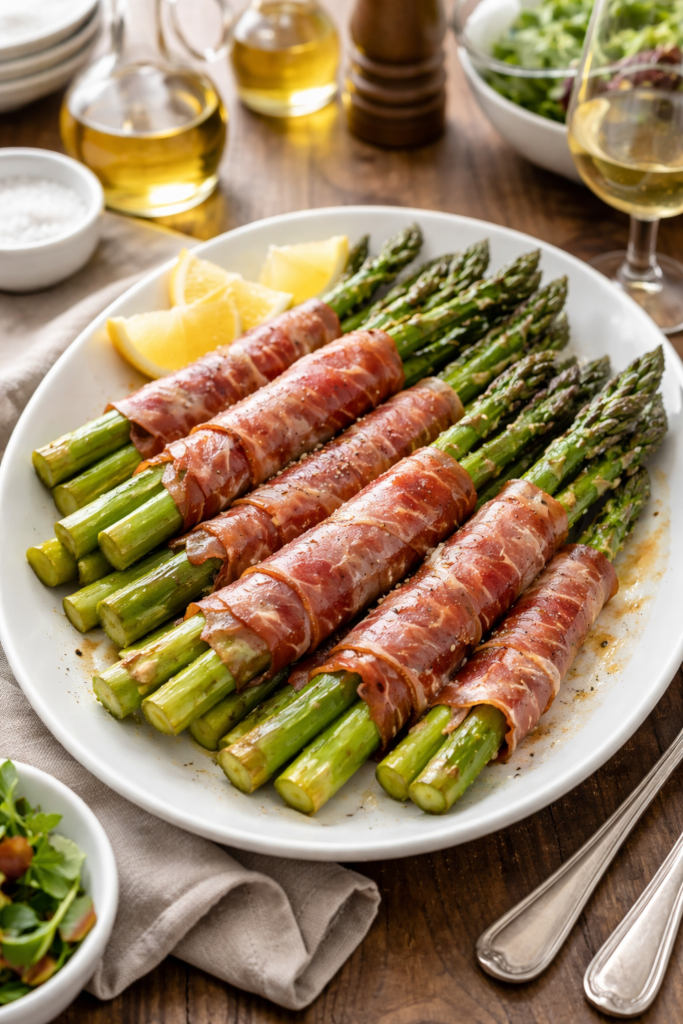
Just a few real foods, handled with care, transforming into something that feels both satisfying and intentional. Prosciutto-wrapped asparagus is one of those dishes. At first glance, it almost feels too simple to matter. A vegetable. A cured meat. A bit of heat.
Yet when you look closer, this kind of meal tells a much bigger story about how we interact with food, how we reduce lectin exposure without stress, and how modern nutrition does not always need to be complicated to be effective. This is where the low-lectin lifestyle often surprises people. It is not always about restriction. It is often about clarity.
Why This Dish Fits So Naturally Into a Low-Lectin Lifestyle
Asparagus is one of those vegetables that quietly fits into many dietary frameworks. From a lectin perspective, it tends to be well tolerated by most people. It does not carry the same concerns associated with legumes, grains, or nightshades. It is also nutrient-dense, providing fiber, folate, and antioxidants that support overall health.
Prosciutto, when sourced carefully, is another interesting piece of the puzzle. Traditional prosciutto is simply pork and salt, dry-cured over time. There are no binders, no fillers, and no hidden plant-based additives that often introduce lectins into processed foods. That simplicity matters.
When these two ingredients come together, something important happens. You are not just eating a “safe” meal. You are eating a meal that avoids many of the common pathways through which lectins sneak into modern diets. There are no sauces thickened with flour. No seed oils blended into dressings. No hidden soy derivatives or starch-based stabilizers. It is food in its most recognizable form.
Understanding Lectins in Context
To understand why a dish like this can feel so different for some people, it helps to zoom out for a moment.
Lectins are proteins found in many plants. They bind to specific carbohydrate structures on the surface of cells. This binding is not inherently harmful. In fact, plants use lectins as part of their natural defense systems. The issue arises when certain lectins resist digestion and interact with the gut lining in ways that can trigger irritation or immune responses in sensitive individuals.
Modern food systems have increased our exposure to these compounds. Grains, legumes, and processed foods often contain concentrated or improperly prepared lectins. Add to that the global distribution of food, where ingredients are processed, preserved, and reformulated, and it becomes easier to see how lectin exposure can quietly accumulate. This does not mean all lectins are dangerous. It means context matters.
Cooking methods, food combinations, and individual tolerance all play a role. Pressure cooking, soaking, fermenting, and peeling can significantly reduce lectin content in many foods. But there is also another approach. Choosing meals that naturally sidestep high-lectin ingredients altogether. That is where simple dishes like this one shine.
The Power of Ingredient Transparency
One of the biggest challenges people face when transitioning to a low-lectin lifestyle is not knowing what they are actually eating. Ingredient labels can be misleading. Foods marketed as clean or healthy often contain hidden components like soy protein isolates, pea protein, or gums derived from seeds. With prosciutto-wrapped asparagus, there is very little ambiguity.
You can hold each ingredient in your hand and understand it immediately. This kind of transparency reduces decision fatigue. It also builds confidence. Over time, that confidence becomes one of the most valuable tools in maintaining a consistent way of eating.
There is also a psychological shift that happens here. Instead of constantly asking, “Is this allowed?” the question becomes, “Do I recognize this food?” That is a much simpler question to answer.
Cooking Methods and Lectin Awareness
Cooking is not just about flavor. It is also about chemistry. Many lectins are sensitive to heat. Proper cooking can reduce or deactivate them. However, not all cooking methods are equal. Some lectins require higher temperatures or pressure to break down effectively. Others are more resilient.
In this recipe, the cooking method is straightforward. Roasting or baking at a moderate temperature allows the asparagus to soften while the prosciutto crisps slightly. There is no need for complex preparation because the ingredients themselves are already low in problematic lectins.
This highlights an important principle. Not every meal needs a workaround. Sometimes the best strategy is choosing foods that do not require one.
A Dish That Supports Real Life
One of the most overlooked aspects of any dietary approach is sustainability. It is easy to follow a plan when it feels exciting or new. It is much harder to maintain when it becomes complicated or restrictive. Prosciutto-wrapped asparagus works because it fits into real life.
It can be prepared quickly. It can be served as a side dish or a main component. It works for casual meals and for more formal settings. It does not require specialty ingredients or expensive substitutes.
This matters more than most people realize. The more a meal aligns with everyday routines, the more likely it is to become part of a long-term habit. And long-term habits are where real change happens.
The Role of Quality in a Low-Lectin Approach
Not all ingredients are created equal, even when they appear simple. When choosing prosciutto, quality matters. Traditional varieties that list only pork and salt are ideal. Some lower-cost options may include added sugars, preservatives, or flavor enhancers. While these additions are not always lectin-related, they can introduce unnecessary complexity into an otherwise clean dish.
Asparagus quality also plays a role. Fresh, firm stalks with tightly closed tips will provide the best texture and flavor. Thicker stalks tend to hold up better during roasting, while thinner ones cook more quickly. This attention to detail is not about perfection. It is about intention.
Prosciutto-Wrapped Asparagus
Servings: 4
Ingredients
- 1 pound fresh asparagus, trimmed
- 8 to 12 slices high-quality prosciutto
- 1 to 2 tablespoons extra virgin olive oil
- Optional: fresh lemon juice for finishing
- Optional: pinch of sea salt if needed
Instructions
- Preheat your oven to 400°F (204°C). Line a baking sheet with parchment paper or leave it unlined for more direct roasting.
- Rinse the asparagus and trim the woody ends. Pat dry thoroughly. Moisture can prevent proper roasting.
- Divide the asparagus into small bundles of 3 to 5 spears each, depending on thickness.
- Wrap each bundle with a slice of prosciutto, spiraling it gently from bottom to top. The natural saltiness of the prosciutto will season the asparagus as it cooks.
- Place the bundles on the baking sheet. Lightly drizzle with olive oil to support even roasting.
- Roast for 12 to 15 minutes, depending on thickness. The asparagus should be tender, and the prosciutto should be slightly crisp.
- Remove from the oven and finish with a light squeeze of fresh lemon juice if desired.
- Serve immediately.
What This Dish Teaches Beyond the Plate
It is easy to look at a recipe like this and see only the final result. A clean plate. A simple side dish. Something that pairs well with almost anything. But there is a deeper lesson here.
This dish represents a shift away from complexity and toward clarity. It shows that reducing lectin exposure does not always require elaborate preparation or strict rules. Sometimes it is about choosing foods that naturally align with your goals.
It also reinforces the idea that nutrition is not just about what you remove. It is about what you replace it with. When you replace processed, lectin-heavy foods with simple, whole ingredients, you are not just avoiding something. You are building a new foundation.
The Bigger Picture of Lectin Awareness
Lectin research is still evolving. There is ongoing debate about how much they matter, who they affect, and under what conditions. What is becoming increasingly clear, however, is that individual response plays a significant role.
Some people tolerate lectins without issue. Others notice changes in digestion, inflammation, or energy levels when they reduce them. This variability is not a flaw in the science. It is a reflection of human biology. A low-lectin lifestyle is not about universal rules. It is about observation.
Meals like prosciutto-wrapped asparagus provide a baseline. They offer a way to eat without many of the common confounding factors. From there, individuals can experiment, reintroduce foods, and pay attention to how their bodies respond. This is where the real value lies. Not in rigid guidelines, but in informed awareness.
Bringing It Back to the Table
At the end of the day, food is not just fuel. It is experience. It is memory. It is routine. A dish like this does not demand attention. It earns it quietly. You place it on the table, and it fits. It does not overwhelm the meal. It complements it. It reminds you that good food does not need to be complicated to be meaningful.
And in a world where nutrition often feels overwhelming, that simplicity is not just refreshing. It is powerful. Prosciutto-wrapped asparagus is more than a recipe. It is a small example of how thoughtful choices can lead to a more sustainable, more intuitive way of eating.