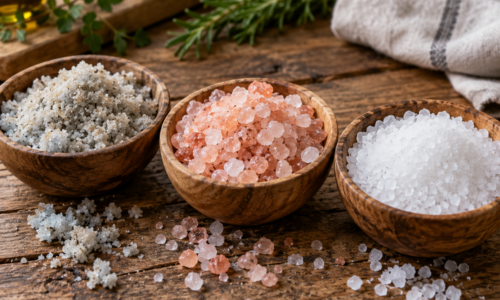
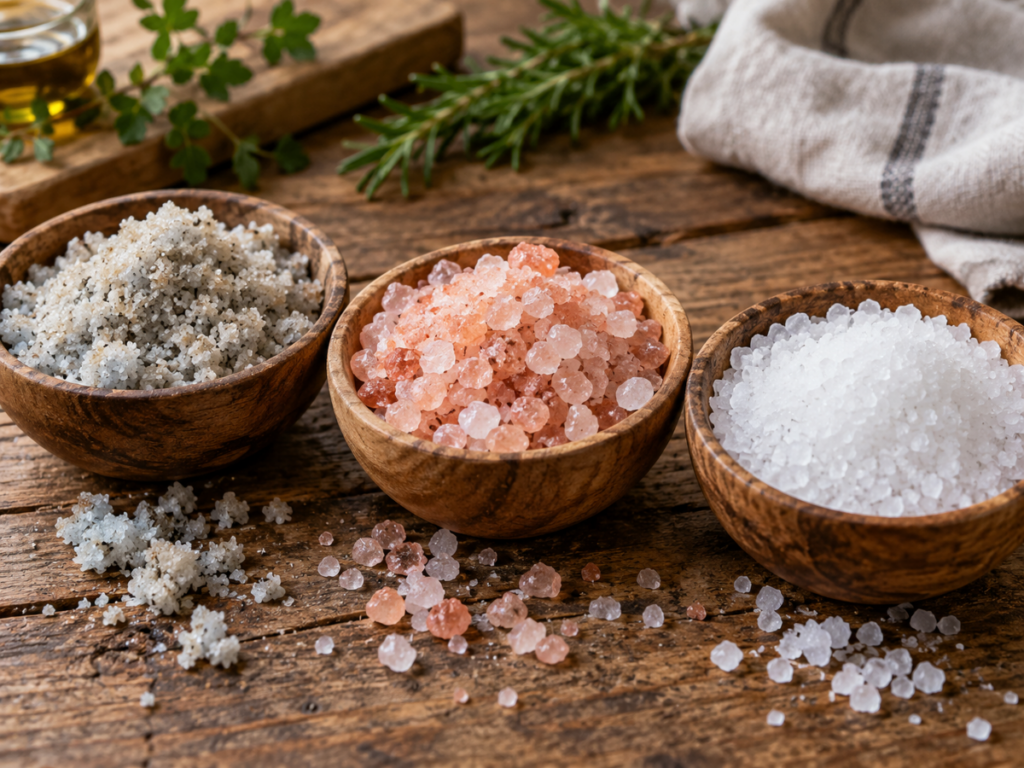
The salt aisle has become surprisingly complicated. Alongside familiar table salt, shoppers encounter damp gray Celtic sea salt, pink Himalayan crystals, delicate sea salt flakes, and products advertised for their natural mineral content. Some command premium prices, accompanied by claims about hydration, electrolyte balance, and nutritional advantages that make choosing a cooking salt seem more consequential than it once did.
These salts differ in their origins, processing methods, mineral composition, moisture, and culinary behavior. Yet the distinction between containing minerals and providing nutritionally meaningful amounts deserves closer examination. A salt may contain magnesium, calcium, potassium, and iron without supplying enough of these nutrients to make a substantial contribution to daily dietary requirements.
For someone following a low-lectin lifestyle, understanding these differences can simplify ingredient selection and seasoning decisions. Culinary salt is not a source of plant lectins, so choosing among these varieties generally comes down to flavor, texture, sodium intake, iodine availability, and the cooking method involved.
What Makes One Type of Salt Different from Another?
All three salt categories consist primarily of sodium chloride, the compound responsible for salt’s characteristic taste. In pure sodium chloride, sodium accounts for approximately 39.3% of the weight. Less-refined salts may contain additional minerals, residual moisture, and small quantities of other naturally occurring substances.
Their differences begin with where and how they are produced. Sea salt originates from evaporated seawater, while Himalayan pink salt is mined from ancient underground deposits. Celtic-style gray sea salt is a particular form of sea salt traditionally associated with coastal evaporation ponds along France’s Atlantic coast.
Processing further influences the finished product. Some salts are washed, dried, ground, or refined to create uniform crystals, while others retain more moisture and accompanying minerals. Even products sold under the same general category can differ in composition because of their source, harvesting conditions, and manufacturing practices.
A mineral analysis should therefore be understood as a measurement of a particular salt sample rather than a universal formula. The nutritional composition of one brand does not establish the precise mineral content of every other product bearing the Celtic, Himalayan, or sea salt designation.
Celtic Sea Salt: Gray Crystals and Residual Minerals
Celtic sea salt is commonly associated with sel gris, the traditional gray sea salt harvested from shallow, clay-lined evaporation ponds along the French Atlantic coast. Seawater gradually concentrates as sunlight and wind remove moisture, allowing salt crystals to form near the pond bottom. These crystals are collected and drained, producing the coarse, slightly damp salt associated with traditional harvesting methods.
Contact with the harvesting surface contributes to the characteristic gray appearance. Residual moisture and naturally occurring mineral salts also influence the product’s texture and tendency to clump. The resulting crystals feel noticeably different from dry, uniformly ground table salt.
Celtic-style gray salt contains sodium chloride along with varying amounts of magnesium, calcium, potassium, and other naturally occurring elements. Magnesium-containing compounds can contribute to moisture retention because some are hygroscopic, meaning they attract water. However, moisture and gray coloration do not provide a reliable measurement of a salt’s nutritional value.
The term Celtic sea salt also requires some attention when shopping. Celtic Sea Salt® is a commercial brand, while gray sea salt and sel gris describe a broader traditional product style. Different brands may sell salts with similar appearances but different moisture levels, crystal sizes, and mineral compositions.
In cooking, moist gray salt works particularly well as a finishing ingredient. A small pinch scattered over roasted winter squash, grilled fish, or cooked meat leaves individual crystals that provide noticeable bursts of saltiness. Its moisture can help crystals adhere to food surfaces, although the irregular texture makes precise volume measurements less consistent.
Fine versions are generally more convenient for soups, sauces, and recipes requiring uniform seasoning. Coarse, damp varieties may clump in conventional shakers and grinders, making a covered salt container or hand application more practical.
Himalayan Pink Salt: Ancient Deposits and Trace Elements
Himalayan pink salt is primarily mined from underground deposits in Pakistan, including those associated with the Salt Range. These geological deposits formed from ancient bodies of saline water that evaporated over time. Although packaging frequently features mountain imagery, the product is mined rock salt rather than salt collected from modern Himalayan glaciers.
Its pink, peach, and reddish colors are associated with naturally occurring impurities, including iron-containing compounds. Color intensity varies among deposits and individual crystals, sometimes even within the same package. The appearance is visually distinctive, but it does not establish that the salt provides a meaningful dietary source of iron.
Himalayan salt can contain measurable amounts of calcium, magnesium, potassium, and iron. These minerals participate in essential biological processes, which helps explain their prominence in specialty salt advertising. Their actual contribution depends on concentration and the quantity of salt consumed.
A 2020 study published in the journal Foods examined the mineral composition of 31 pink salt products purchased in Australia, comparing them with one iodized white table salt sample. Researchers found substantial differences in mineral concentrations among products, with darker pink salts generally associated with higher measured mineral levels in this particular sample group. The findings demonstrate variability within the category, although crystal color alone cannot predict the precise nutrient content of an individual purchase.
The researchers estimated that consuming more than 30 grams of pink salt daily would be necessary to obtain a meaningful nutritional contribution from its minerals. That amount would supply excessive sodium and substantially exceed recommended daily salt consumption. The findings were based on products available in the Australian market rather than a comprehensive global sampling of Himalayan salts.
From a culinary perspective, Himalayan salt is straightforward to use. Its dry crystals work well in adjustable grinders, while finely ground products can be incorporated into marinades, meat mixtures, and vegetable preparations. Its pink color remains most noticeable when coarse crystals are used as a finishing salt, since the visual distinction largely disappears after dissolving.
Sea Salt: A Broad Category with Different Characteristics
Sea salt is produced by evaporating seawater through sunlight, wind, mechanical heating, or combinations of these methods. The resulting crystals may be washed, dried, ground, refined, or packaged with relatively little additional processing. Consequently, the term sea salt identifies the ingredient’s source but reveals relatively little about its specific mineral composition.
Most sea salts contain sodium chloride as their dominant component, accompanied by varying quantities of magnesium, calcium, potassium, and other substances. Refining and washing can remove much of the residual mineral content, producing a white salt chemically similar to ordinary table salt. Less-refined products may retain additional minerals and moisture, although their concentrations depend on the original seawater and production conditions.
Crystal structure creates another distinction. Fine sea salt dissolves quickly and distributes evenly through recipes, while coarse varieties are suited to grinding or finishing. Flake salts have thin, fragile crystals that provide a noticeable texture when sprinkled over food shortly before serving.
Fleur de sel illustrates how harvesting methods influence culinary characteristics. These delicate crystals traditionally form at the surface of evaporation ponds and are collected separately from the coarser salt gathering below. Their light, irregular structure makes them particularly suitable for finishing dishes where the crystals remain perceptible.
Comparing Magnesium, Calcium, Potassium, and Iron
The mineral content of specialty salts receives considerable marketing attention, particularly when products advertise dozens of naturally occurring trace elements. Laboratory equipment can detect very small concentrations of minerals, but detection alone does not establish nutritional importance. A useful comparison considers how much of each nutrient is delivered by an ordinary seasoning portion.
Magnesium participates in muscle and nerve function, energy metabolism, and numerous enzyme reactions. Some unrefined salts contain more magnesium than highly refined table salt, but typical culinary servings contribute little compared with daily nutritional requirements. Magnesium-rich foods provide considerably larger quantities without requiring additional sodium chloride.
Calcium contributes to bone structure, muscle contraction, and nerve signaling. Himalayan and unrefined sea salts may contain measurable calcium, although the quantities consumed through normal seasoning are usually minor. Foods such as dairy products and suitable calcium-rich vegetables offer more substantial dietary sources.
Potassium supports fluid regulation, muscle activity, and normal nerve transmission. Although specialty salts sometimes contain more potassium than refined table salt, sodium remains overwhelmingly dominant. Avocados, cooked leafy greens, and winter squash provide more meaningful potassium contributions without delivering comparable amounts of salt.
Iron is necessary for hemoglobin formation and oxygen transport throughout the body. Himalayan pink salt can contain detectable iron, but its concentration is generally too low to make ordinary seasoning portions nutritionally significant. Products should not be evaluated as iron sources based on crystal color or claims about natural mineral richness.
These differences help explain why salts can have genuinely different mineral profiles without offering substantially different nutritional benefits. The amounts consumed during ordinary cooking are simply too small for most accompanying minerals to contribute much to daily nutrient intake.
Iodine: An Important Difference Between Specialty and Table Salt
One mineral deserves particular attention because it is intentionally added to many conventional table salts: iodine. The thyroid gland needs iodine to produce hormones involved in metabolism, growth, and development. Iodized salt has long been used as a public health measure to reduce iodine deficiency.
Most Celtic, Himalayan, kosher, and specialty sea salts are not iodized unless the manufacturer specifically states otherwise. Some may contain naturally occurring iodine, but concentrations are generally too low or inconsistent to provide a dependable dietary source. The presence of ocean-derived minerals does not establish adequate iodine content.
The National Institutes of Health iodine fact sheet identifies 150 micrograms per day as the recommended dietary allowance for most adults, with higher requirements during pregnancy and breastfeeding. It lists approximately 78 micrograms of iodine in one-quarter teaspoon of iodized table salt, while noniodized sea salt contributes essentially none in a comparable serving.
Seafood, dairy products, and eggs provide other dietary sources of iodine. This is relevant to low-lectin meal planning because fish, eggs, and selected dairy products may already be regular ingredients. Nevertheless, iodine concentrations vary among foods, particularly with differences in animal feed, production practices, and seafood species.
People who avoid dairy, consume little seafood, and exclusively use noniodized specialty salts may have fewer dependable iodine sources in their diets. Reviewing those sources is more useful than assuming that an unrefined salt provides complete mineral coverage. Iodized table salt can serve a specific nutritional purpose alongside specialty salts used primarily for their culinary characteristics.
Sodium Content: Why Crystal Size Changes the Comparison
Specialty salts are sometimes advertised as healthier alternatives because their additional minerals or retained moisture reduce the proportion of sodium in the finished product. Certain varieties do contain slightly less sodium per gram than pure sodium chloride. However, their sodium content remains high, and the differences are generally insufficient to justify greater consumption.
The American Heart Association’s comparison of salt varieties explains that table salt, kosher salt, and most sea salts contain approximately 40% sodium by weight. Himalayan and other specialty salts differ in appearance and processing, but their sodium contribution remains broadly comparable.
Crystal size creates a more noticeable difference when measuring by volume. Fine table salt packs densely into a measuring spoon, while coarse crystals and flakes leave additional space between particles. As a result, one teaspoon of flake salt may contain substantially less sodium than one teaspoon of finely ground table salt.
Moisture introduces another variable with gray sea salt. Some of its weight consists of water rather than dissolved minerals, influencing how much sodium is present in a measured portion. Grinding coarse salt can also change the quantity that fits into a spoon without changing the sodium concentration of the original dry crystals.
These differences matter when adapting recipes. Replacing coarse salt with the same volume of fine table salt may increase the actual amount used, while switching in the opposite direction can produce a less salty result. Weighing salt provides greater consistency, although moisture content and mineral composition still introduce some variation between products.
The FDA’s sodium guidance identifies less than 2,300 milligrams of sodium per day as the recommended limit for adults. That quantity is approximately equivalent to the sodium found in one teaspoon of conventional table salt. It includes sodium from packaged foods, restaurant meals, sauces, condiments, and ingredients, as well as salt added during cooking.
Individuals managing hypertension or following a medically recommended sodium restriction should evaluate specialty salts by their sodium content rather than their mineral advertising. Trace minerals do not neutralize sodium’s effects on blood pressure, and switching from table salt to Himalayan or Celtic salt has not been established as an effective method of lowering sodium-related health risks.
Do Mineral Salts Offer Better Hydration?
Claims about hydration and electrolyte balance frequently accompany unrefined sea salt products. Sodium is an essential electrolyte that helps regulate extracellular fluid volume, nerve transmission, and muscle activity. Its physiological importance, however, does not mean that consuming additional sodium improves hydration in someone whose existing intake is sufficient.
Magnesium, potassium, and calcium also participate in normal fluid regulation and cellular function. These minerals are sometimes described as evidence that natural salts provide a balanced electrolyte mixture. In ordinary culinary amounts, sodium contributes the overwhelming majority of the electrolyte content, while the other minerals are generally present in much smaller quantities.
There is insufficient human clinical evidence to establish that Celtic or Himalayan salt improves everyday hydration more effectively than a comparable sodium quantity from conventional salt. Claims about superior cellular hydration or improved mineral absorption have not been demonstrated convincingly through controlled human research.
Prolonged heavy sweating, endurance exercise, and certain medical circumstances can increase fluid and electrolyte requirements. Those needs depend on actual fluid losses and individual conditions rather than the particular origin of cooking salt. Adding mineral salt to drinking water without accounting for total sodium intake may be especially unsuitable for people who have been advised to limit sodium or fluids.
Mineral Content and Product Purity
Natural mineral content does not automatically establish that a salt is purer or safer. Underground deposits and seawater can contain substances without recognized nutritional benefits, including environmental contaminants. Their concentrations depend on geology, environmental exposure, processing, and manufacturing quality controls.
The 2020 Australian pink salt study also measured non-nutritive elements. Researchers found that one of the 31 samples contained lead above the maximum level permitted under Australian and New Zealand food standards. This finding does not demonstrate that Himalayan salt generally contains unsafe lead concentrations, but it illustrates why natural sourcing alone cannot guarantee product purity.
Unrefined sea salt presents similar considerations because its composition can reflect conditions in the original seawater and harvesting environment. Processing may remove some impurities, while inadequate handling can introduce others. Claims about ancient geological origins or traditional harvesting methods provide little information about actual contaminant concentrations.
For premium salts, transparent sourcing and reliable quality-control testing offer more useful information than promotional descriptions. A manufacturer that provides relevant food-grade testing information makes it easier to evaluate product quality, particularly when selling minimally processed salt intended for regular consumption.
Choosing Salt for Low-Lectin Cooking
The physical characteristics of salt often matter more in the kitchen than small differences in mineral composition. Fine salt disperses readily into soups, sauces, and mixtures where uniform seasoning is desirable. Coarse crystals are better suited to grinding or finishing, while delicate flakes provide a distinct surface texture.
Celtic gray salt works well over roasted winter squash, sautéed mushrooms, grilled fish, and freshly cooked meats. Its slightly damp crystals can adhere to food surfaces, leaving small concentrations of saltiness. For dishes requiring precise distribution, finely ground varieties are generally easier to control.
Himalayan salt offers a dry alternative suitable for grinders and conventional seasoning. Fine pink salt can be mixed with dried herbs, garlic, or other seasonings before being applied to proteins or vegetables. The salt’s color contributes more to presentation than to the flavor of a dish once fully dissolved.
Flake sea salt is especially useful when texture matters. A few delicate crystals scattered over roasted cauliflower, sliced avocado, or pan-seared salmon provide concentrated saltiness before dissolving. Because the crystals remain perceptible on the surface, a finishing salt can change the eating experience without requiring a different ingredient preparation.
For low-lectin cooking, these salts can be combined with familiar ingredients such as extra virgin olive oil, garlic, rosemary, thyme, and fresh citrus. Preparing simple seasoning mixtures at home also allows control over added sodium and ingredients that may appear in commercial blends. The salt itself does not require special preparation to reduce lectin activity.
Acidic ingredients offer another useful way to develop flavor in dishes where less salt is preferred. Lemon juice, lime juice, and vinegar add brightness to fish, vegetables, and herb-based dressings. They cannot reproduce all of salt’s culinary functions, but their acidity can make lighter seasoning more satisfying.
When Salt Selection Affects Food Preservation
Salt performs functions beyond flavoring in fermentation, pickling, curing, and certain preservation processes. Its concentration can influence microbial activity, moisture movement, texture, and product safety. Consequently, substitutions require greater care than they would in ordinary cooking.
Virginia Cooperative Extension’s vegetable fermentation guidance explains that mineral impurities and variations in salt weight can affect fermentation quality and salt concentration. The publication recommends canning or pickling salt because it provides a consistent granular size and composition without additives that may interfere with the process.
The National Center for Home Food Preservation similarly recommends canning or pickling salt, although it notes that fermented and nonfermented pickles can be safely made with iodized or noniodized table salt when tested recipes are followed. Anticaking agents may cloud the brine, and the variable density of flake salts makes them unsuitable for direct volume substitutions.
Celtic and Himalayan salts should therefore not be assumed interchangeable with pickling salt in a tested preservation recipe. Even measuring an alternative salt by weight does not automatically resolve differences in its composition or establish the safety of a modified procedure. Following the specified salt type and quantity is the more dependable approach.
This distinction matters particularly when salt helps control microbial growth. Reducing salt or substituting lower-sodium products in fermented vegetables can change the conditions needed for safe fermentation. Salt adjustments appropriate for an ordinary vegetable side dish should not be transferred to fermentation or preservation without validated guidance.
Reading Labels and Building a Practical Salt Selection
The most useful product comparison begins with the label. Sodium per serving, serving weight, ingredient composition, and iodine information reveal more about nutritional relevance than descriptions such as mineral-rich or naturally balanced. Some products also provide a mineral analysis, although those numbers should be evaluated against the small quantities ordinarily used for seasoning.
Price matters because specialty salts can cost considerably more than ordinary table salt. Their culinary value may justify the expense when crystal texture or finishing characteristics are noticeable. Those differences become less significant when the salt dissolves completely into a large pot of soup or cooking liquid.
A practical kitchen can accommodate more than one salt without requiring an extensive collection. Fine salt offers consistent distribution for everyday cooking, iodized table salt provides a dependable iodine source when needed, and a small container of coarse or flake salt can be reserved for finishing dishes. Choosing each for a particular purpose is more useful than expecting one premium salt to perform every nutritional and culinary function.
Storage should reflect the product’s moisture content. Damp gray salt may clump in ordinary shakers, making a covered container and clean, dry utensils more convenient. Dry Himalayan crystals and other coarse salts generally work well in grinders designed for their size, while delicate flakes should be protected from moisture and crushing.
A useful technique is to season vegetables or proteins lightly during preparation and make any final adjustment after cooking. With roasted vegetables, for example, the initial seasoning distributes over the food while a small amount of coarse salt added just before serving remains perceptible on the surface. This separates the functions of seasoning during cooking and finishing for texture, giving the cook more control over where saltiness is experienced and how much additional salt is actually needed.