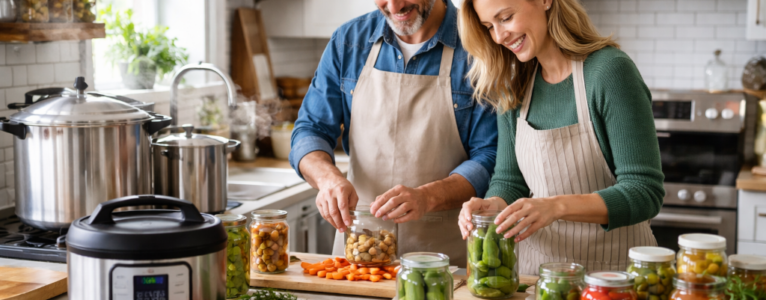

For anyone exploring a low-lectin way of eating, cooking methods quickly become more than a culinary preference. They become a form of problem-solving. Two techniques often mentioned in the same breath like pressure cooking and canning, are frequently assumed to be interchangeable when it comes to lectins. Both use heat. Both use pressure. Both dramatically change food. Yet from a lectin perspective, they are not the same process, and the differences matter more than most people realize.
This confusion is understandable. On the surface, pressure cooking and canning look like variations on the same idea: trap steam, raise the boiling point of water, cook food thoroughly. But the why, how, and end goals of these methods diverge in ways that directly influence lectin behavior in food.
To understand why pressure cooking is often emphasized in lectin-reduction discussions and why canning doesn’t always deliver the same benefits we need to look beyond kitchen labels and into what these processes actually do at a molecular level, without turning the conversation into a chemistry lecture.
Why Lectins Are So Sensitive to How Food Is Cooked
Lectins are proteins produced by plants as part of their defense system. Their job is not to nourish humans, but to discourage being eaten by insects, animals, and microbes. They do this by binding to carbohydrates on cell surfaces, a property that gives them their biological activity.
Unlike many nutrients that break down easily with heat, lectins are structurally resilient. Some are partially damaged by boiling, others barely notice it. This resistance is one reason lectins remain biologically active after digestion and why certain cooking methods reduce them more effectively than others.
What matters most for lectin reduction is temperature, moisture, pressure, and duration, and how consistently those factors are applied. This is where pressure cooking and canning part ways.
What Pressure Cooking Actually Does to Food
Pressure cooking raises the boiling point of water well above 212°F (100°C). In most modern pressure cookers, internal temperatures reach approximately 240–250°F (115–121°C). This higher temperature is not just hotter. It changes the rules of protein stability.
Lectins, like all proteins, have complex folded structures. When enough heat and pressure are applied together, these structures begin to unfold and denature. Once denatured, many lectins lose their ability to bind to cell surfaces, which significantly reduces their biological activity.
Pressure cooking works especially well because:
- Heat is applied evenly through steam and liquid
- Moisture prevents scorching while allowing sustained high temperatures
- Pressure keeps temperatures elevated without evaporation
This combination is particularly effective for legumes, beans, lentils, and some grains, which are among the most lectin-dense foods in modern diets.
Importantly, pressure cooking is a short-duration, high-intensity process. Beans that might simmer for hours on a stovetop reach lectin-reducing temperatures in a fraction of the time, without prolonged exposure that can destroy texture or nutrients unnecessarily.
What Canning Is Designed to Do (And What It Isn’t)
Canning is not primarily a cooking method. It is a preservation method. Its main purpose is to make food shelf-stable by destroying microorganisms and sealing food in an oxygen-free environment.
There are two major types of canning:
- Water-bath canning, used for acidic foods
- Pressure canning, required for low-acid foods like vegetables, meats, and beans
Pressure canning does use high temperatures similar to pressure cooking, but the goals and conditions differ in subtle yet important ways.
Canning prioritizes microbial safety, not protein denaturation. The process is designed to kill bacteria such as Clostridium botulinum, not necessarily to dismantle plant defense proteins as efficiently as possible.
Canning times are often longer, but temperatures may fluctuate depending on jar size, food density, and packing method. Heat penetration must reach the center of each jar, which can be inconsistent, especially in dense or starchy foods.
From a lectin standpoint, this variability matters.
Why Pressure Cooking Is More Reliable for Lectin Reduction
While pressure canning can reduce lectins, it does so inconsistently. The effectiveness depends on factors that are difficult for home canners to control precisely:
- How tightly food is packed
- Whether food is raw-packed or hot-packed
- Jar size and headspace
- Altitude adjustments
- Heat distribution within the canner
Pressure cooking, by contrast, immerses food directly in a controlled environment of steam and liquid. The entire contents experience uniform pressure and temperature for the duration of the cook.
This is why pressure cooking has become the gold standard in lectin-focused dietary approaches. It offers predictability, a crucial factor when someone is trying to reduce inflammatory triggers rather than just prepare food safely.
The Bean Example: A Practical Comparison
Beans are often the focal point of lectin discussions because they contain some of the most biologically active lectins found in common foods.
When beans are pressure cooked properly:
- Lectin activity is dramatically reduced
- Digestibility improves
- Texture becomes softer without disintegration
- Cooking time is shortened
Canned beans, on the other hand, vary widely. Some people tolerate them well; others experience bloating, joint discomfort, or digestive upset despite thorough cooking during canning.
This doesn’t mean canned beans are “bad,” but it does mean they are less predictable from a lectin standpoint. For individuals already dealing with gut permeability, autoimmune issues, or chronic inflammation, predictability often matters more than convenience.
Why Duration Alone Doesn’t Solve the Problem
A common assumption is that cooking something longer will eventually neutralize lectins. This is not always true. Lectins are not uniformly heat-sensitive, and some withstand prolonged boiling surprisingly well.
What breaks lectins down most effectively is not just time, but the combination of time, moisture, pressure, and temperature. Pressure cooking brings all four together efficiently.
Canning emphasizes time and safety margins but does not always maximize lectin denaturation in the same targeted way.
Nutrient Retention: A Side Benefit Worth Noticing
An unexpected advantage of pressure cooking is that shorter cook times can help preserve certain heat-sensitive nutrients. While no cooking method is perfect, pressure cooking often strikes a better balance between reducing harmful compounds and retaining beneficial ones.
Canning, by design, subjects food to longer processing times to ensure shelf stability. This can lead to greater nutrient degradation, especially in vitamins sensitive to heat and oxygen exposure.
From a lectin-aware perspective, pressure cooking allows people to remove what they don’t want while keeping more of what they do.
When Canning Still Makes Sense
Despite its limitations, canning still has a place. Shelf-stable foods are practical, accessible, and sometimes necessary. For people without regular access to pressure cookers, canned foods can be a reasonable compromise, especially when combined with additional preparation steps such as rinsing and further cooking.
Canning also shines in situations where food safety and storage matter more than precision lectin control, such as emergency preparedness or long-term storage.
The key is understanding that canning is a preservation solution, not a lectin-optimization strategy.
The Bigger Picture: Lectins and Modern Food Processing
The pressure cooking versus canning conversation fits into a larger theme: modern food systems prioritize efficiency, shelf life, and transportability and not biological compatibility.
Lectins have traveled with us through agriculture, processing, and global distribution. Cooking methods that once varied widely across cultures have been replaced by industrial shortcuts that do not always account for individual sensitivity.
Pressure cooking represents a return to intentional food preparation, where technique is chosen based on how food interacts with the body, not just how long it lasts on a shelf.
Choosing the Right Tool for the Job
For people navigating lectin sensitivity, autoimmune symptoms, or chronic digestive issues, pressure cooking offers clarity. It reduces guesswork and allows individuals to observe cause-and-effect more reliably.
Canning is not inherently harmful, but it is less precise. It answers a different question: How do we store food safely? Pressure cooking answers another: How do we make food biologically easier to handle?
Understanding that distinction empowers people to make informed choices rather than follow blanket rules.
Final Thoughts
Pressure cooking and canning may look similar, but they serve different masters. One is optimized for biological change, the other for microbial control and storage. When it comes to lectins, that difference is not academic. It’s practical.
For those living low-lectin, pressure cooking remains one of the most effective tools available. It aligns heat, moisture, pressure, and time in a way that consistently reduces lectin activity while preserving food quality.
Canning still has value, but it should be understood for what it is and what it isn’t. When clarity replaces confusion, food stops being a gamble and becomes a choice.
That shift, more than any single technique, is what defines a sustainable low-lectin approach.