
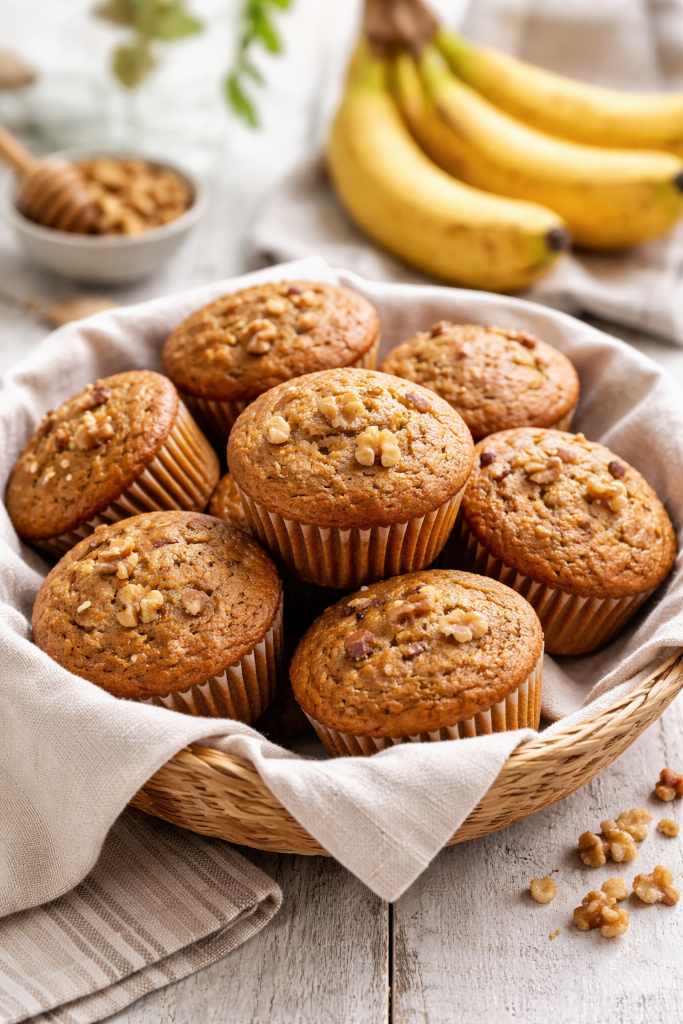
There is something deeply nostalgic about banana muffins. The scent alone can pull you back to a quiet kitchen, overripe bananas on the counter, the oven humming in the background. For many people exploring a low-lectin lifestyle, baked goods are one of the first things they assume they have to give up. Wheat flour, refined sugar, vegetable oils, and certain dairy ingredients are common in traditional recipes, and many of those can complicate digestion for sensitive individuals.
But the goal of living low-lectin is not restriction for its own sake. It is about understanding how food interacts with the body and making thoughtful adjustments that support resilience, not deprivation. When you begin to understand what lectins are, how they behave, and how preparation methods influence them, you start to see that many favorite foods can be reimagined rather than eliminated.
Low-lectin banana muffins are a perfect example.
Why Traditional Muffins Can Be Problematic for Some People
Most standard banana muffin recipes rely on wheat flour. Wheat contains lectins such as wheat germ agglutinin, a protein that has been studied for its ability to bind to certain carbohydrate structures in the gut. In some individuals, especially those with compromised gut barriers or autoimmune tendencies, these interactions may contribute to digestive discomfort or immune activation.
Beyond wheat, conventional muffins often include refined sugars, industrial seed oils, and sometimes soy-based ingredients. While lectins are not the only concern in modern diets, they are part of a larger picture. Highly processed foods can increase gut permeability, disrupt the microbiome, and create an inflammatory environment. In that context, lectins may exert a stronger effect than they would in a metabolically healthy, well-functioning system.
Modern research suggests that lectins are not inherently toxic in typical dietary amounts for most healthy individuals. However, their biological activity is real. Some lectins resist digestion, bind to gut cells, and interact with immune receptors. Cooking methods can significantly reduce lectin activity, particularly in legumes, but not all lectins are equally sensitive to heat.
Understanding that nuance is key. The conversation is not about fear. It is about informed choices.
Plantain Flour as a Low-Lectin Alternative
Plantains offer an interesting opportunity. Unlike wheat, plantains are not grasses. They are large starchy fruits related to bananas. When green plantains are dried and milled into flour, the result is a naturally gluten-free powder with a mild flavor and impressive baking performance.
Plantain flour contains resistant starch when unripe, which can act as a prebiotic fiber. When baked, some of that resistant starch is modified by heat, but the flour still tends to be gentler on digestion compared to wheat for many people. Importantly, plantains are not known for high lectin content in the way grains and legumes are.
The challenge with plantain flour is texture. It absorbs moisture differently than wheat flour. If you simply swap it cup for cup in a standard recipe, the result can be dense or gummy. Achieving the familiar crumb of a traditional banana muffin requires careful balancing of moisture, fat, and structure.
That balance is where food science meets everyday cooking.
The Role of Structure in a Muffin
Wheat flour works in baking because of gluten, a network-forming protein that traps air bubbles and gives baked goods elasticity. When we remove wheat, we remove that structural backbone.
In a low-lectin banana muffin, structure must come from other sources. Eggs provide protein that coagulates with heat and helps set the crumb. Healthy fats such as avocado oil or melted coconut oil contribute tenderness. A small amount of baking soda helps lift the batter, reacting with the natural acidity of ripe bananas.
The goal is not to replicate wheat perfectly. It is to create something that feels familiar, moist, and satisfying.
Low-Lectin Banana Muffins
Ingredients
- 2 cups green plantain flour
- 3 very ripe bananas, mashed
- 3 large eggs
- 1/3 cup avocado oil or melted coconut oil
- 1/3 cup pure maple syrup or raw honey
- 1 teaspoon vanilla extract
- 1 teaspoon baking soda
- 1/2 teaspoon sea salt
- 1 teaspoon cinnamon
- Optional: 1/4 cup chopped walnuts or dark chocolate chunks made without soy lecithin

Instructions
- Preheat your oven to 350°F. Line a muffin tin with parchment liners or lightly grease with avocado oil.
- In a large bowl, mash the bananas until smooth.
- Add the eggs, oil, maple syrup or honey, and vanilla extract. Whisk until fully combined.
- In a separate bowl, mix the plantain flour, baking soda, sea salt, and cinnamon.
- Gradually fold the dry ingredients into the wet mixture. The batter will thicken as it sits. Let it rest for about 3 to 5 minutes to allow the plantain flour to fully hydrate.
- If using walnuts or chocolate, gently fold them in.
- Spoon the batter evenly into the muffin cups, filling each about three quarters full.
- Bake for 20 to 25 minutes, or until a toothpick inserted into the center comes out clean.
- Allow the muffins to cool in the pan for 10 minutes before transferring to a wire rack.
- The result should be moist, lightly sweet, and surprisingly close in texture to a traditional banana muffin. The crumb is soft but not crumbly. The density is satisfying without being heavy.
Why These Ingredients Matter
Each ingredient serves a purpose beyond taste. Bananas provide natural sweetness and moisture. As bananas ripen, their starch converts into sugars, making them easier to digest and eliminating the need for refined sugar. Eggs offer structure and nutrient density. They contain choline, fat-soluble vitamins, and high-quality protein that supports tissue repair and metabolic health.
Avocado oil is stable at baking temperatures and does not carry the same oxidative concerns as many refined seed oils. Coconut oil is another option, particularly for those who tolerate it well. Maple syrup or raw honey adds sweetness with minimal processing. While still sugar, they avoid the additives and potential contaminants found in some commercial sweeteners. Plantain flour acts as the foundational ingredient, replacing wheat while avoiding the higher lectin content associated with many grains and legumes.
When you step back, this recipe is not just about lectins. It is about returning to simpler ingredients and understanding how each component interacts with your body.
The Bigger Picture of Lectins and Digestive Health
Lectins are carbohydrate-binding proteins found in many plant foods. In nature, they serve as defense mechanisms. They can deter insects, fungi, and animals from consuming the plant. From an evolutionary perspective, this makes sense. Plants cannot run from predators, so they rely on chemical strategies.
In humans, some lectins are deactivated by proper cooking. For example, raw kidney beans contain high levels of phytohemagglutinin, which can cause digestive distress if undercooked. Pressure cooking significantly reduces this activity.
Other lectins are more heat-stable, though typically present in smaller amounts. The body’s response depends on many factors, including gut integrity, microbiome diversity, overall diet, and genetics.
For some individuals, especially those with autoimmune conditions or chronic gut inflammation, reducing lectin exposure may help calm immune reactivity. For others, moderate intake of properly prepared lectin-containing foods may pose no issue. A low-lectin approach is best viewed as a tool. It is not a universal mandate. It is a framework for experimentation and awareness.
Texture, Satisfaction, and Psychological Comfort
Food is not only biochemistry. It is emotional and cultural. Many people struggle with dietary changes because they feel disconnected from comfort foods. When a recipe like banana muffins can be adapted without sacrificing taste or texture, it reinforces a powerful message. You are not losing your traditions. You are evolving them.
That shift matters psychologically. Stress itself influences digestion and immune function. If eating becomes a constant battle of restriction and fear, the body can remain in a heightened stress response. Recreating familiar foods with thoughtful modifications can reduce that tension.
In this way, low-lectin banana muffins become more than a snack. They become proof that change does not have to feel punitive.
Modern Research and Balanced Perspective
Current research on lectins continues to evolve. Studies show that lectins can interact with gut epithelial cells and immune receptors. At the same time, many lectin-containing foods such as legumes and whole grains are associated with positive health outcomes in large population studies. This apparent contradiction highlights the complexity of nutrition science.
Dose, preparation, and individual variability matter. A person with robust digestive health may tolerate a wide range of foods without issue. Someone dealing with autoimmune flares, metabolic dysfunction, or chronic bloating may benefit from strategic reduction.
The goal is not to label foods as universally good or bad. It is to observe patterns in your own body while staying grounded in evidence.
Low-lectin baking is one practical expression of that approach. It allows you to reduce exposure where it makes sense without eliminating joy.
Living Low-Lectin in Real Life
When you pull a tray of these muffins from the oven, you are participating in something larger than a recipe. You are practicing awareness. You are choosing ingredients deliberately. You are acknowledging that modern food systems have changed dramatically while human biology has not changed at the same pace.
Living low-lectin is not about perfection. It is about paying attention. It includes sleep, movement, stress management, and community. It includes reading labels, learning cooking methods, and sometimes questioning assumptions that have gone unchallenged for decades.
It also includes moments of simplicity. A warm muffin with a cup of coffee on a quiet morning can remind you that nourishment is both physical and emotional.
These low-lectin banana muffins are one small, tangible step. They show that with a bit of knowledge and experimentation, familiar foods can align more closely with how your body feels its best. That is the heart of the journey.