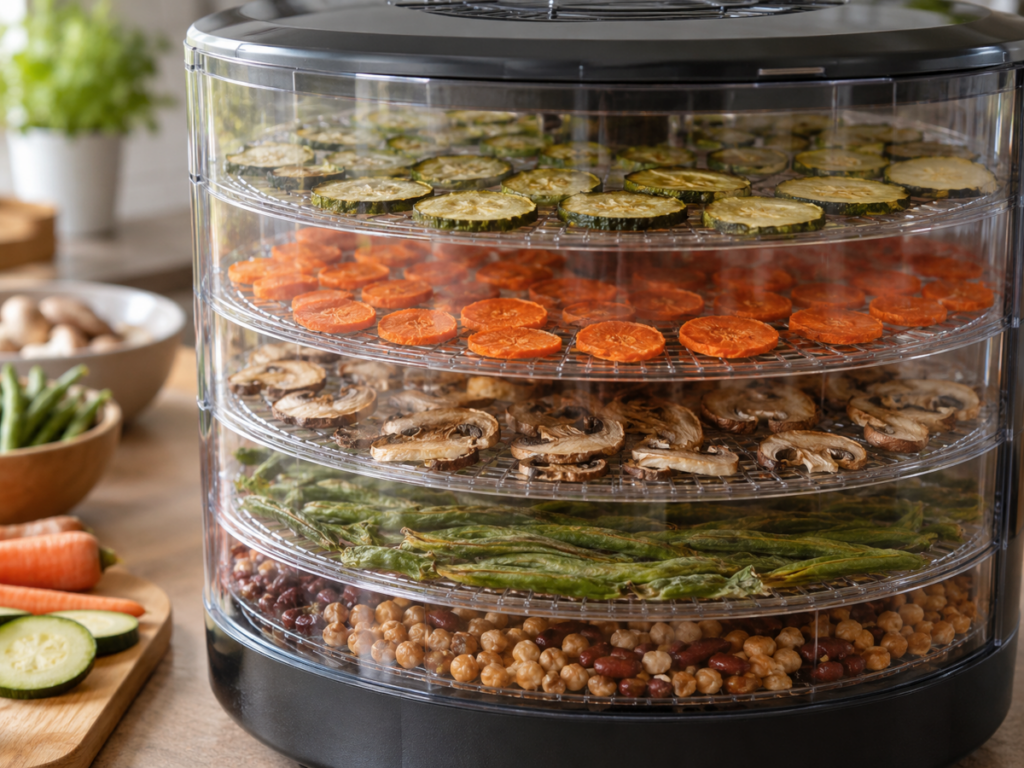
Dehydration can make food lighter, shelf-stable, portable, and intensely flavored, but those benefits come from one basic physical change: water leaves the food. That distinction matters with foods that contain substantial amounts of active lectins, especially raw or inadequately cooked beans. Removing water is not the same process as deactivating a heat-sensitive food compound, so a dehydrator should not be treated as a substitute for proper soaking and cooking.
The strongest food-safety concern is not every lectin in every plant. Lectins are a broad group of carbohydrate-binding proteins, many of which are harmless at the amounts and in the forms people normally eat. The better-established concern involves active lectins in raw or undercooked pulses, particularly phytohaemagglutinin, or PHA, in common beans. In January 2026, the European Food Safety Authority concluded that exposure to insufficiently cooked beans with substantial active lectin remaining can present a health concern, while properly processed pulses do not pose the same lectin-related risk.
Dehydration Changes Water Content, Not Automatically Lectin Activity
Food dehydration works primarily by lowering moisture. As water is removed, microorganisms have less available water for growth, spoilage slows, and the food becomes much lighter. The National Center for Home Food Preservation describes drying as a preservation method built around moisture removal, and common home dehydrators are designed to move warm air across food rather than cook it the way boiling water or a pressure cooker does.
That is why the word “concentrate” is useful here. Suppose a fresh ingredient weighs 100 grams and contains a certain amount of active lectin. If drying removes 80 grams of water while leaving most of that lectin activity intact, the remaining 20 grams contains roughly the same total amount of lectin in far less food mass. On a gram-for-gram basis, the dried food can therefore contain a much higher concentration than the original hydrated food, even though dehydration did not create any new lectin.
The serving size still matters. Eating all of the dehydrated food that came from the original 100 grams would not necessarily deliver more total lectin than eating the original portion, assuming no lectin was lost or altered during processing. The practical issue is that dried foods are compact and easy to eat in larger dry-weight amounts, so a person can consume the equivalent of much more fresh food without the volume that water once supplied.
Typical Dehydrator Temperatures Are Far Below Bean-Cooking Temperatures
The temperature difference explains much of the problem. Home fruit and vegetable drying commonly occurs around 115 to 140 degrees Fahrenheit, or roughly 46 to 60 degrees Celsius, depending on the food and the method. University extension guidance commonly places vegetables in that range, while the National Center for Home Food Preservation describes dehydrators that operate around 140 degrees Fahrenheit for drying.
Those temperatures are useful for moisture removal, but they are not equivalent to boiling. Research on legume lectins has long shown that heating seeds around 70 degrees Celsius for several hours may have little or no effect on lectin activity, while higher-temperature processing is needed for reliable inactivation. That finding fits with more recent public-health guidance emphasizing soaking followed by boiling rather than low-temperature drying as the dependable home method for beans.
EFSA currently advises soaking beans for about 6 to 12 hours, changing the water, and boiling them at 100 degrees Celsius for at least 30 minutes, with cooking continued as needed until the beans are soft. EFSA also notes that steaming, microwaving, and roasting are generally less effective than soaking plus boiling for reducing active lectins in pulses.
Water and Heat Work Differently on Lectin Proteins
Lectins are proteins, and reducing their biological activity generally requires changing their three-dimensional structure enough that they no longer bind carbohydrates in the same way. Heat can cause that structural change, but the result depends on the particular lectin, temperature, time, moisture conditions, and the food surrounding the protein. Some lectins are much easier to deactivate than others.
This helps explain why a warm dehydrator is a poor tool for making raw high-lectin foods safe. The food is gradually becoming drier while it is heated, and the temperature may never approach the conditions shown to reliably deactivate bean PHA. Research on soybean meal, for example, found major reductions in antinutritional factors when the meal was steam-heated at 100 degrees Celsius, with higher processing severity producing greater reductions.
The contrast between dry heating and wet cooking also matters in the kitchen. Boiling surrounds the food with water at about 100 degrees Celsius and keeps transferring heat efficiently into the food. A dehydrator uses substantially cooler moving air and is designed to carry moisture away. Those are different processing conditions, even if both involve heat.
Raw Beans Are the Clearest Example
Raw kidney beans provide the strongest reason to separate dehydration from detoxification. Common beans can contain PHA, and red kidney beans are among the varieties associated with the highest activity. Eating raw or insufficiently cooked beans can cause nausea, vomiting, abdominal pain, and diarrhea, with symptoms sometimes appearing within a few hours.
Dry beans from the grocery store illustrate an easy source of confusion. They are already dehydrated, yet they still require proper preparation before eating. Their dry state clearly has not made them ready-to-eat. Soaking and boiling are separate steps performed because removing water during agricultural drying and storage does not reliably remove the active lectins that matter for food safety.
A large study of commonly consumed plant foods found the highest lectin activity among members of the legume family and showed that soaking and boiling could substantially reduce active lectins. The researchers used soaked and thoroughly cooked kidney beans as a negative control for lectin activity, reinforcing the difference between a dried raw bean and a cooked bean.
“More Concentrated” Does Not Mean “More Dangerous” in Every Dried Food
The concentration principle applies broadly to compounds that remain behind when water is removed, but it should not be turned into a claim that all dried plant foods are hazardous. Dried herbs, fruit, mushrooms, onions, and many other foods can be perfectly appropriate foods, and their lectin profiles are not comparable to raw kidney beans. Food safety depends on the ingredient, the compound involved, the amount eaten, and how the food was processed before drying.
The same caution applies to the word “toxin.” PHA can produce acute illness when enough active lectin is consumed, but many food lectins do not pose the same risk under normal eating conditions. Scientific studies also use different laboratory methods to measure lectin activity, which makes direct comparisons between foods more difficult than simple internet charts often suggest. A 2021 analysis of plant foods specifically called for better harmonization of lectin testing and risk assessment because reported activity varies with assay methods and processing conditions.
For someone following a low-lectin approach, this means dehydration is better understood as a preservation step than a lectin-reduction strategy. Drying may change texture, storage life, flavor concentration, and portion size, but it should not be assumed to neutralize active lectins unless the food received a separate, validated processing step that does so.
Cook First, Then Dehydrate When the Ingredient Requires It
The most practical approach is to separate the jobs. If a food requires cooking for lectin reduction and safe consumption, complete that preparation first. Once it has been properly soaked and cooked, dehydration can be used afterward to create a lightweight ingredient for soups, travel meals, powders, or long-term pantry use.
For beans, that means beginning with the same safe preparation you would use if you planned to eat them immediately. Soak as directed, discard the soaking water, add fresh water, and boil thoroughly until fully cooked. Afterward, the cooked beans can be drained and dehydrated according to a tested drying method. Dehydrating cooked beans does not reverse the protein denaturation that occurred during adequate cooking simply because the food later becomes dry.
The reverse order is less useful. Drying raw soaked beans and planning to rely on rehydration later can leave the important heat-treatment step unresolved. If those beans are later boiled thoroughly, the later cooking may still do the work, but the dehydration itself should not receive credit for making them low in active lectin.
Dehydrated Powders Deserve Extra Attention
Powders are one place where concentration becomes especially relevant. Once a dried ingredient is ground into flour or powder, a relatively large amount of the original food can fit into a spoonful or small scoop. If the ingredient was not adequately processed before drying, any heat-stable or incompletely deactivated compounds can remain concentrated in that dry material.
This is one reason homemade raw bean flour should not be treated like an ordinary ready-to-eat flour. Grinding changes particle size, not the underlying need for adequate cooking. A recipe that merely warms or lightly bakes a raw bean powder may not reproduce the soaking and boiling conditions recommended for whole beans, so the safest approach is to use ingredients that have already received appropriate processing.
Commercial products can be different because manufacturers may use extrusion, pressure, steam, roasting, fermentation, or other controlled treatments before or during drying. Those methods should be judged by the actual processing conditions rather than by the word “dehydrated” on the package. In food science, the sequence and severity of processing matter far more than the final appearance of the ingredient.
Low-Lectin Meal Planning Works Better When Processing Has a Clear Purpose
A low-lectin kitchen does not need to avoid dehydration. A dehydrator can be useful for cooked vegetables, properly prepared legumes, herbs, fruit, jerky made with safe methods, and complete meals that have already gone through the cooking steps required for their ingredients. The useful habit is assigning each technique the job it actually performs.
Soaking can soften beans and allow some soluble compounds to move into the water. Boiling or pressure cooking provides the high-temperature treatment used to deactivate problematic bean lectins. Dehydration then removes water for storage and portability. Treating those steps as interchangeable can lead to poorly prepared food, while treating them as separate tools makes the process much easier to reason through.
For people who track individual food tolerance, dehydrated foods also deserve portion awareness. A small handful of dried food can represent a much larger fresh portion, so reactions that appear to be caused by dehydration itself may sometimes reflect a larger dry-weight serving, a more concentrated dose of fermentable carbohydrates or other food components, or simply a different preparation method. A food journal can help separate those possibilities without assuming that every symptom has one cause.
The best use of dehydration in a low-lectin routine is therefore after the ingredient has already been prepared appropriately. Heat treatment does the protein-changing work where it is needed, while the dehydrator handles moisture removal and storage. That sequence preserves the convenience of dried foods without asking a low-temperature drying process to perform a job it was never designed to do.