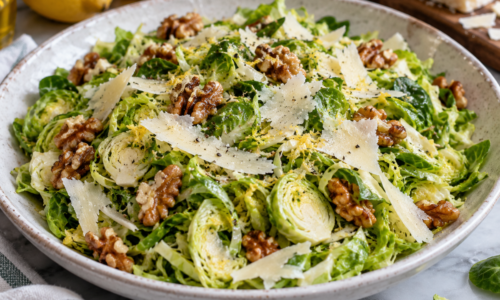
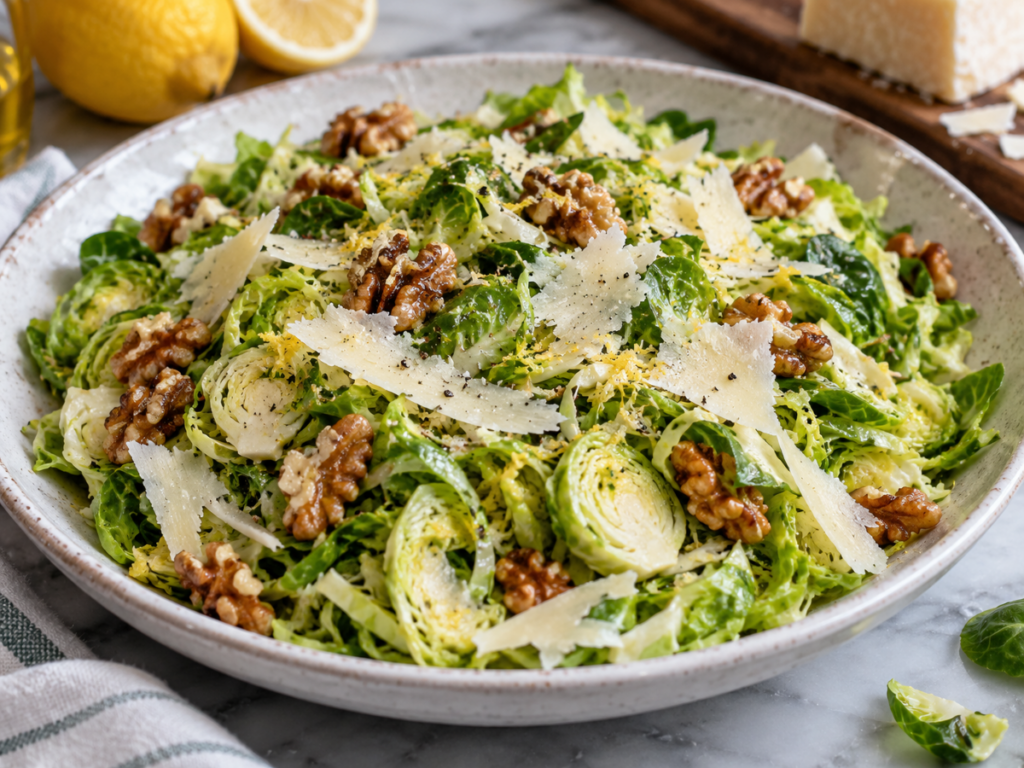
Brussels sprouts are usually associated with roasting pans, browned edges, and cool-weather dinners, but shaving them into thin ribbons changes the vegetable completely. The dense little heads become crisp and almost slaw-like, making them a surprisingly good foundation for a salad that can stand beside roasted chicken, seafood, or a simple piece of grilled meat.
For someone following a low-lectin lifestyle, this kind of salad also offers something useful: familiar whole-food ingredients without relying on grains, beans, croutons, seed-based dressings, or heavily processed substitutes. Brussels sprouts, extra virgin olive oil, walnuts, lemon, and aged sheep’s-milk Pecorino Romano create plenty of flavor on their own. The result is crunchy, salty, slightly sharp, and rich enough that a bowl of vegetables feels like a finished dish rather than an obligation.
Why Brussels Sprouts Work So Well Raw
Brussels sprouts belong to the Brassica family, alongside broccoli, cabbage, cauliflower, kale, and several other cruciferous vegetables. Their compact heads are essentially tightly layered leaves, which is why shaving them produces thin strands resembling finely shredded cabbage.
From a low-lectin perspective, Brussels sprouts occupy a very different category from foods such as raw kidney beans, where lectin exposure presents a well-established food-safety concern. Legume lectins are among the most extensively studied plant lectins, and they are concentrated especially in seeds. Raw or inadequately cooked common beans can contain enough active phytohemagglutinin to cause gastrointestinal illness, which is why proper cooking matters so much with those foods.
That distinction matters because the word “lectin” covers a broad group of carbohydrate-binding proteins rather than one substance behaving identically in every plant. Research on food lectins has focused heavily on legumes, and the evidence does not support assuming that every raw vegetable should be treated like a raw bean. A practical low-lectin approach can therefore pay attention to the foods with better-characterized lectin concerns without turning every plant ingredient into a problem that requires aggressive preparation.
Brussels sprouts also contain glucosinolates, naturally occurring compounds characteristic of cruciferous vegetables. Cooking can reduce their concentration, particularly with methods such as boiling, but that is a separate food-science issue from lectins. Keeping the sprouts raw in this recipe preserves their fresh crunch and assertive cabbage-like flavor, while lightly softening them with an acidic dressing makes them considerably more pleasant to eat.
Shaving Changes the Texture More Than You Might Expect
A whole raw Brussels sprout is dense, firm, and fairly unpleasant to chew. Slice that same sprout into paper-thin pieces and the eating experience changes because each bite contains smaller pieces of leaf with much more exposed surface area.
That extra surface area is useful for dressing. Lemon juice, olive oil, and salt can work between the layers instead of sitting on the outside of an intact sprout, and a short resting period begins softening the shredded vegetable before it reaches the plate. This is similar to what happens when cabbage is dressed for slaw.
A sharp chef’s knife works perfectly well, particularly if you are only preparing enough salad for a few people. Trim the dry end of each sprout, remove any damaged exterior leaves, cut it in half through the stem, and slice each half as thinly as possible. A mandoline is faster, but Brussels sprouts are small enough that I prefer a hand guard or cut-resistant glove rather than trying to shave the final little piece with bare fingers.
A food processor fitted with a slicing disc is the easiest choice for a larger batch. The texture will be slightly less uniform than careful knife work, but this is one of those recipes where perfection does not improve dinner very much.
Toasted Walnuts Add More Than Crunch
Raw walnuts have a mild bitterness that fits Brussels sprouts surprisingly well, but toasting changes their character. A few minutes of heat brings forward their roasted aroma and gives them a crisper texture, which provides contrast against the dressed sprouts.
Walnuts are also one of the nuts commonly included in many practical low-lectin eating patterns. That does not mean every person will tolerate them equally, and someone who has identified nuts as a personal trigger should treat that information as more useful than a generalized food list. Dietary tracking is most helpful when it allows distinctions like that rather than assuming every food within a category produces the same response.
For this salad, I prefer large walnut pieces instead of finely chopped nuts. Small crumbs disappear into the dressing, while coarse pieces provide occasional richer bites and make the salad feel more substantial.
Toast them in a dry skillet over medium-low heat, stirring frequently. Nuts can move from fragrant to burned faster than expected, so remove them from the pan once they smell toasted and show a little additional browning. Leaving them in a hot skillet after turning off the burner can continue cooking them.
Why Pecorino Romano Fits the Salad
Pecorino Romano brings salt, acidity, fat, and a sharp aged flavor that pairs especially well with bitter greens and cruciferous vegetables. Because the cheese is assertive, a relatively small amount can season a surprisingly large bowl of shaved sprouts.
Traditional Pecorino Romano is made from sheep’s milk and aged into a firm grating cheese. That makes it appealing for low-lectin eaters who choose sheep’s- or goat’s-milk dairy as part of their personal approach, although that preference should not be confused with evidence that Pecorino somehow removes lectins from the meal.
Its aging also changes the cheese’s carbohydrate profile. An analysis of several PDO cheeses found Pecorino Romano samples had residual lactose below the study’s limit of quantification, which was less than 10 milligrams per kilogram. That does not mean everyone with dairy intolerance will tolerate Pecorino, since reactions to dairy can involve more than lactose, but it explains why aged hard cheeses can behave very differently from milk or fresh cheese for someone whose concern is specifically lactose.
Buy Pecorino Romano as a wedge when possible and shave it shortly before serving. The broad, irregular pieces soften slightly where they touch the dressing while still retaining enough structure to provide little salty bursts throughout the salad.
Shaved Brussels Sprouts Salad with Toasted Walnuts and Pecorino Romano
Ingredients
- 1 pound fresh Brussels sprouts
- 1/2 cup walnut halves or large walnut pieces
- 1/2 cup shaved Pecorino Romano
- 3 tablespoons extra virgin olive oil
- 2 tablespoons fresh lemon juice
- 1 teaspoon finely grated lemon zest
- 1/2 teaspoon sea salt, plus more to taste
- 1/4 teaspoon freshly ground black pepper
- 1 teaspoon Dijon mustard, optional
- 1 additional tablespoon extra virgin olive oil, if needed before serving
Instructions
- Toast the walnuts. Place the walnuts in a dry skillet over medium-low heat. Cook for about 3 to 5 minutes, stirring or tossing frequently, until they smell toasted and have begun to deepen slightly in color. Transfer them immediately to a plate and allow them to cool.
- Prepare the Brussels sprouts. Trim the dry stem ends and discard any damaged outer leaves. Cut the sprouts in half lengthwise, then slice them very thinly with a sharp knife, mandoline, or food processor slicing disc. Separate any large pieces with your fingers so the bowl contains mostly loose ribbons.
- Make the dressing. Whisk the extra virgin olive oil, lemon juice, lemon zest, salt, black pepper, and optional Dijon mustard in a small bowl. Taste before adding additional salt because Pecorino Romano will contribute quite a bit of its own.
- Dress and soften the sprouts. Place the shaved Brussels sprouts in a large mixing bowl and pour the dressing over them. Toss thoroughly for about 30 seconds so the dressing reaches the many cut surfaces, then let the sprouts rest for 10 to 15 minutes.
- Add the walnuts and cheese. Add most of the toasted walnuts and Pecorino Romano, reserving a small amount of each for the top. Toss gently, taste, and add the remaining tablespoon of olive oil if the salad seems dry.
- Serve. Transfer the salad to a serving bowl or individual plates and scatter the remaining walnuts and Pecorino over the top. Serve soon after assembling for the best balance between crispness and tenderness.
The Dijon is optional because prepared mustards vary considerably in their ingredients. If you use one, check the label and choose a simple version that fits the way you personally structure your low-lectin eating plan. The salad works perfectly well without it, so there is no reason to add another ingredient simply because a conventional vinaigrette usually contains mustard.
Giving the Dressing Time to Work
The 10 to 15 minute rest is worth keeping in the recipe. Freshly shaved Brussels sprouts are quite rigid, and serving them immediately after adding the dressing produces a noticeably tougher salad.
Salt begins drawing moisture from the cut vegetable while lemon juice changes the way the leaves feel in the mouth. You are not cooking the sprouts with acid in the literal sense, but their texture becomes more pliable as the seasoned dressing coats and softens the thin pieces.
The resting period also lets the bitterness of the raw sprouts settle into the richer flavors of olive oil, walnuts, and cheese. I would rather use this brief rest than compensate with a sweet dressing, especially because Brussels sprouts already have enough character to work with a simple savory vinaigrette.
Adjusting the Salad for Digestive Tolerance
Raw cruciferous vegetables are not equally comfortable for everyone. Brussels sprouts contain fiber and fermentable carbohydrates, so some people notice gas or abdominal pressure after eating larger portions, particularly if their usual diet contains relatively little fiber or they are sensitive to certain fermentable carbohydrates. That reaction should not automatically be attributed to lectins, since several components of the food can influence digestion.
For someone who enjoys Brussels sprouts but finds a large raw serving uncomfortable, the recipe can be modified without abandoning it. Blanch the shaved sprouts briefly in boiling water for about 30 to 60 seconds, immediately transfer them to cold water, and dry them thoroughly before dressing. The finished salad will be softer and less aggressively raw while still retaining considerable texture.
Another option is to briefly sauté the shaved sprouts in extra virgin olive oil, allow them to cool, and then continue with the recipe. This turns the dish into something halfway between a salad and a vegetable side, which can be useful during colder months or when raw vegetables simply do not sit well.
Portion size matters too. A person may tolerate a half-cup portion beside protein much better than an enormous bowl eaten alone. Tracking that distinction provides better information than writing off Brussels sprouts entirely after one uncomfortable meal.
Turning the Salad Into a Full Meal
As written, this salad works especially well as a side because its flavors are strong enough to stand beside simply seasoned protein. Roasted or grilled chicken, turkey, wild-caught salmon, cod, sardines, or a modest portion of grass-fed beef can all work without requiring much additional seasoning.
For a lunch bowl, sliced chicken or leftover salmon can be placed directly over the dressed sprouts. The olive oil, walnuts, and Pecorino already supply richness, so another sauce is usually unnecessary.
This is also a good example of how leftovers can make low-lectin meal planning easier. A cooked protein from the previous evening can become lunch the next day simply by making the Brussels sprout base fresh. Keeping walnuts, Pecorino, lemons, and good olive oil available means very little additional preparation is required.
Making It Ahead Without Losing the Crunch
Brussels sprouts are sturdier than delicate salad greens, which gives this recipe a useful advantage. The sprouts can be shaved several hours ahead and stored dry in a covered container in the refrigerator, while the walnuts can be toasted and kept separately at room temperature.
The dressing can also be prepared ahead. Wait to combine everything until roughly 15 to 30 minutes before eating if you want a crisp salad, because long refrigeration in an acidic dressing gradually produces a softer, slaw-like texture.
That softer version is not necessarily a problem. Leftovers kept overnight are less crisp but often more evenly seasoned, and some people actually prefer them the next day. If the salad has absorbed most of its dressing, a small drizzle of extra virgin olive oil and a fresh squeeze of lemon usually brings it back into balance.
The basic combination is easy to adjust without turning the recipe into something entirely different. More walnuts make it richer, extra lemon makes it sharper, and additional Pecorino makes it saltier and more savory. Once the proportions suit your own taste and tolerance, shaved Brussels sprouts become one of those useful refrigerator ingredients that can move from side dish to lunch without requiring a complicated recipe.