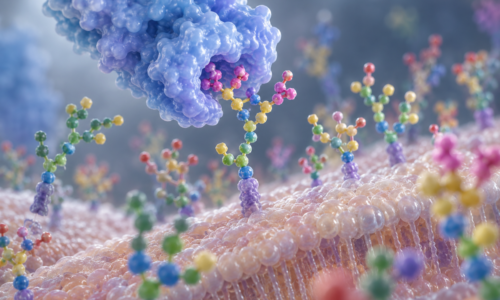
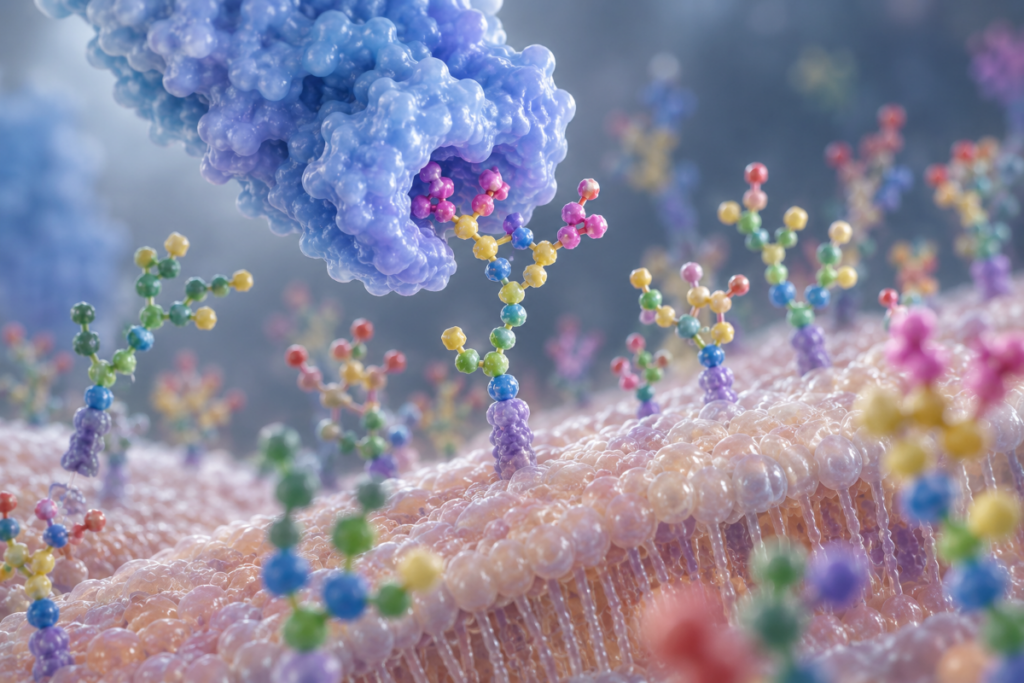
Lectins are often discussed as though they simply “stick to cells,” but that shorthand leaves out the part that makes these proteins biologically interesting. Lectins recognize carbohydrates, more specifically certain sugar patterns arranged on the surfaces of cells, proteins, lipids, and mucus. That carbohydrate recognition helps explain why different lectins behave differently, why some bind strongly to particular tissues or cell types, and why the word “lectin” describes a large family of proteins rather than one single dietary substance.
For someone following a low-lectin lifestyle, this matters because it gives a more accurate picture of what lectins actually do. Their behavior depends on molecular fit, concentration, protein structure, preparation method, digestion, and the specific glycans they encounter. Understanding that chemistry makes it easier to move beyond broad food lists and toward a more practical approach based on preparation, food type, and individual tolerance.
Cell Surfaces Are Coated With Sugar Structures
Every human cell carries carbohydrates at its outer surface. These carbohydrates are usually built into larger structures called glycans, which are attached to proteins and lipids in the cell membrane. Together, these sugar-rich structures form part of the glycocalyx, the outer coating that helps cells interact with their surroundings. Modern glycobiology describes cell surfaces as densely covered with glycans, and many membrane proteins involved in recognition, adhesion, signaling, and transport are glycosylated.
A glycan is very different from the spoonful of sugar someone might add to coffee. It can be a branched chain containing several types of monosaccharides, joined in different positions and orientations. Small changes in those linkages can create a biologically different structure, which is one reason glycan recognition can be so selective. The terminal sugars at the ends of glycan chains are especially important because they are exposed to the surrounding environment and frequently serve as recognition sites for proteins.
This also explains why the phrase “lectins bind sugar” can be misleading if taken too literally. A lectin is not roaming through the digestive tract looking for table sugar or dietary starch simply because those foods contain carbohydrates. It recognizes certain three-dimensional carbohydrate features, often when those sugars are presented as part of a larger glycan on a cell, glycoprotein, glycolipid, or mucus molecule.
Lectins Recognize Patterns, Not Carbohydrates in General
The binding region of a lectin is shaped so that it interacts more readily with particular carbohydrate structures. Some lectins prefer mannose or glucose-related structures, while others recognize galactose, N-acetylgalactosamine, N-acetylglucosamine, fucose, sialic acid, or more complex combinations. A 2024 review of legume lectins describes several major specificity groups based on these preferred carbohydrate ligands.
That specificity is one reason two lectins from different plants can behave very differently even though both belong to the same broad protein category. Their carbohydrate-recognition domains differ enough to change which glycans they bind well. The surrounding shape of the glycan also matters, including branching, linkage position, neighboring sugars, and whether the target is presented repeatedly across a surface.
Binding often becomes stronger when multiple carbohydrate-recognition sites interact with multiple glycan targets at the same time. A lectin may bind a single free sugar relatively weakly yet bind much more strongly to a complex cell-surface structure containing repeated compatible targets. Glycobiology references describe this multivalent binding as a major reason lectins can show far greater affinity for complex glycoconjugates than for isolated monosaccharides.
A Simple Human Example: Blood Group Sugars
The ABO blood group system gives a familiar example of how a tiny change in surface carbohydrates can alter biological recognition. A, B, and O blood groups differ partly because red blood cells display different terminal glycan structures. The A antigen adds N-acetylgalactosamine to a precursor structure, while the B antigen adds galactose; type O retains the underlying H structure instead.
This does not mean ordinary food lectins should be expected to produce blood-group-specific effects in everyday eating. The example is useful because it demonstrates how cells can look nearly identical at a large scale while presenting different carbohydrate details at their surfaces. A protein that recognizes one glycan pattern can therefore interact differently with another pattern that differs by only a small chemical change.
Researchers have taken advantage of this property for decades. Lectins are widely used in laboratories as probes for glycosylation because their binding preferences can help identify which carbohydrate structures are present on cells and tissues. A 2024 review describes lectins as long-standing tools for examining cellular glycosylation and mapping changes in glycan patterns.
Wheat Germ Agglutinin Shows How Sugar Preference Works
Wheat germ agglutinin, commonly abbreviated WGA, is one of the better-known plant lectins. Research describes WGA as having strong affinity for N-acetylglucosamine and also recognizing sialic acid-containing structures. Those sugar residues appear in many glycoproteins and glycolipids, including structures found on animal cell surfaces.
The presence of a preferred sugar does not guarantee that WGA will bind every structure containing it equally well. Accessibility, linkage, neighboring sugars, and the three-dimensional presentation of the glycan all affect recognition. This is a recurring theme in lectin biology: the identity of the sugar matters, but so does the way that sugar is displayed.
For a low-lectin reader, WGA is also a reminder that the amount and form of a lectin in food are separate questions from what an isolated lectin can do in a laboratory. A purified protein placed directly onto cultured cells is not the same exposure as eating a cooked food containing a mixture of proteins, starches, fibers, fats, and other compounds. Digestion, food processing, dose, and the surrounding food matrix all influence what remains available to interact with the intestinal surface.
The Intestinal Surface Provides Plenty of Glycan Targets
The gastrointestinal tract is lined with epithelial cells and a mucus layer rich in glycoproteins. Mucins, the major structural proteins in mucus, carry many carbohydrate chains, so the gut presents a large number of potential binding sites for carbohydrate-recognizing proteins. Glycans can influence cell protection, microbial interactions, signaling, and the physical properties of the mucus barrier.
This is one reason researchers study dietary and microbial lectins in relation to the intestine. In experimental systems, some lectins can bind intestinal glycans and affect epithelial behavior, but the outcome depends heavily on the specific lectin, its dose, whether it remains biologically active, and the model being studied. Evidence from purified lectins or animal experiments should therefore be treated as mechanistic evidence, not automatic proof that ordinary servings of properly prepared foods produce the same effect in humans.
Kidney bean phytohemagglutinin is a useful exception because improper preparation is a recognized food-safety problem. Reviews of common beans report that raw or inadequately heated kidney beans can retain high lectin activity and cause acute gastrointestinal illness, while proper heat treatment greatly reduces that activity.
Cooking Changes the Protein Before It Can Bind
Lectins are proteins, so their ability to recognize carbohydrates depends on maintaining the shape of their binding sites. Heat can disrupt that shape, reducing or eliminating carbohydrate-binding activity in many food lectins. This is why cooking method matters much more than simply knowing that a raw ingredient contains lectins.
Common beans provide the clearest practical example. Research reviews report that soaking alone produces only modest reductions in lectin activity, while thorough cooking is far more effective. One systematic review found that cooking soaked kidney beans at about 95°C for an hour could reduce lectins to undetectable or very low levels, while broader food-processing reviews report large reductions in hemagglutinating activity after adequate cooking.
Pressure cooking can also be highly effective because it combines moisture, high temperature, and pressure. Older food-science work found that pressure cooking kidney beans at 15 psi reduced hemagglutinin activity below detectable levels under the tested conditions. For a person who chooses to include legumes while trying to reduce active lectins, pressure cooking remains a practical preparation strategy, provided the beans are cooked fully rather than merely warmed or softened.
This does not mean every lectin in every food responds identically to heat. Protein structure, moisture, temperature, time, and the food matrix all affect denaturation. It is more accurate to think in terms of reducing biological activity through appropriate preparation than to assume one cooking rule applies to every plant food.
Eating Carbohydrates Does Not “Feed” Lectin Binding
Because lectins recognize carbohydrates, it is easy to make an intuitive but incorrect leap and assume that dietary sugar or starch somehow increases lectin attachment to human cells. The chemistry does not work that simply. Cell-surface glycans are assembled by cells through controlled biochemical pathways, and their structures are determined by enzymes, genetics, cell type, developmental state, and metabolic conditions rather than by a direct one-for-one transfer of the carbohydrates in a meal.
Diet can influence metabolism and, over time, may affect aspects of glycosylation through broader physiological pathways, but that is different from saying that eating a particular sugar immediately creates more docking sites for plant lectins. A slice of fruit, a serving of rice, and the N-acetylglucosamine on an intestinal glycoprotein all involve carbohydrate chemistry, yet they occupy very different biological contexts.
This distinction also helps keep low-lectin eating from turning into unnecessary carbohydrate fear. Someone can choose foods based on lectin content or tolerance without treating all carbohydrates as equivalent. The lectin question is mainly about which lectin is present, whether it remains active after preparation and digestion, and which glycans it can recognize.
Why Individual Responses Can Still Differ
People do not all present exactly the same glycan patterns. Genetics can change glycosylation, as the ABO system clearly demonstrates, and different tissues produce different glycomes. Cell state, age, microbial activity, inflammation, and other biological conditions can also alter glycan expression.
That biological variation is interesting, but it should not be used to claim that glycan differences explain every reported food reaction. Human evidence connecting specific dietary lectins to chronic symptoms in otherwise healthy people remains limited, and many digestive symptoms have several possible causes. Fiber load, fermentable carbohydrates, food allergies, intolerances, fat content, meal size, food additives, and underlying gastrointestinal conditions can overlap with what someone may initially attribute to lectins.
A practical tracking approach is therefore more useful than trying to predict personal tolerance from molecular theory alone. Recording the food, preparation method, portion, accompanying ingredients, and timing of any symptoms can help reveal patterns. Repeating a food under more controlled conditions, when medically appropriate, can also help separate a consistent response from coincidence.
The Most Useful Connection Is Between Structure and Preparation
The carbohydrate connection gives lectins their defining behavior, but it also shows why broad labels are insufficient. A lectin has to remain structurally capable of binding, encounter a compatible glycan, and be present in enough active form for that interaction to matter. Food preparation can change the first part of that sequence before the food ever reaches the digestive tract.
That is why a low-lectin kitchen can be practical rather than absolute. Properly cooking beans, choosing foods that fit personal tolerance, using pressure cooking where it makes sense, and paying attention to repeated reactions are more informative than treating every plant carbohydrate as a problem. The biology begins with molecular recognition, but everyday decisions still come down to the food on the plate, how it was prepared, and how the individual responds to it.